



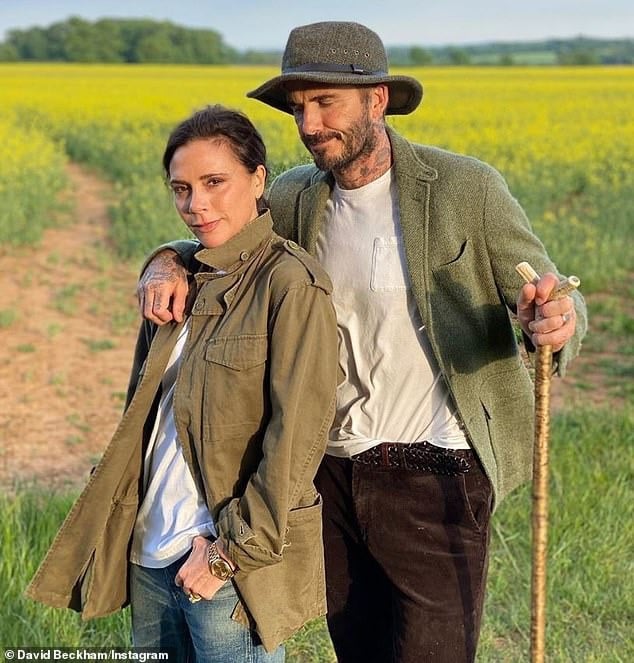
David Beckham’s £12 million Cotswolds home was designed with a footprint in the shape of the letter E, echoing a centuries-old architectural tradition used by Tudor courtiers to flatter Queen Elizabeth I, in a revelation that has prompted speculation about Beckham’s own devotion to the late Queen Elizabeth II ahead of his eventual knighthood.
The house, built in Great Tew near Chipping Norton in 2017, was constructed from what Beckham has described as a derelict “pile of bricks” — a trio of Cotswold-stone barns, one thatched and one stone-tiled, which he transformed into an elegant country residence. While the E-shaped footprint is not visible from ground level, it becomes unmistakable when viewed from above.
The design choice was highlighted by television presenter Alan Titchmarsh in an interview with Country Life magazine. “Eight years ago, David began the task of transforming the two existing derelict Cotswold-stone barns – one thatched and one stone-tiled – into an elegant country house,” Titchmarsh said. “He also added a third building, opting to join the trio to a longer wing to create what historians will recognise as a tactful trend during the reign of Elizabeth I: a house in the shape of the capital letter E.”
During the Elizabethan era, between 1558 and 1603, wealthy subjects frequently designed their country estates in the shape of an E as a form of political flattery aimed at securing royal favour. Elizabeth I regularly undertook summer “progresses” around the country, staying at the estates of her subjects — visits that were ruinously expensive to host, but politically essential to receive. The E-shaped layout, along with lavish architectural flourishes, was intended to signal absolute loyalty to the Crown and demonstrate a courtier’s wealth and standing.
Montacute House in south Somerset offers one such example, built by lawyer Sir Edward Phelips, who was knighted in 1603 and became Speaker of the House of Commons the following year before serving as Master of the Rolls under James I. Burghley House in Lincolnshire, built by William Cecil, Lord Burghley — one of the most powerful men in Elizabethan England as Lord Treasurer — followed the same pattern, with historians describing such “prodigy houses” as a form of architectural propaganda designed to inscribe the Queen’s initial into a courtier’s home. Hardwick Hall in Derbyshire, built in 1590 for Bess of Hardwick, then the wealthiest woman in England after the Queen herself, was similarly designed to project wealth, power and loyalty to the Crown.
It remains unclear how directly Beckham’s admiration for Queen Elizabeth II influenced the design of his own home, though those close to him note he has long placed significance on symbolism and superstition. He is well known for his attachment to the number seven, his shirt number for both England and Manchester United, which he also gave as his daughter Harper’s middle name and as the name of his superyacht. His pre-match routines as a player were famously rooted in order, repetition and superstition, and he is heavily tattooed with symbols carrying personal meaning — making an E-shaped family home, intentional or not, consistent with a broader pattern.
Beckham’s devotion to the monarchy is well documented. He queued for 13 hours without fanfare to pay his respects to Queen Elizabeth II as she lay in state in September 2022, and has maintained a close relationship with King Charles, Queen Camilla and the Prince and Princess of Wales, serving as a high-profile ambassador for The King’s Trust. He was knighted by King Charles at Windsor Castle in November 2025.
Elsewhere in the interview, Titchmarsh asked Beckham why he chose the Cotswolds for the project. “Because it’s one of the most beautiful parts of the countryside and I knew that, if I picked the right location and the children could get there in a day from London, they’d come,” Beckham said. He also revealed that he had bought the property without telling his wife Victoria beforehand, as he was concerned she would be reluctant to take on another renovation project.
