



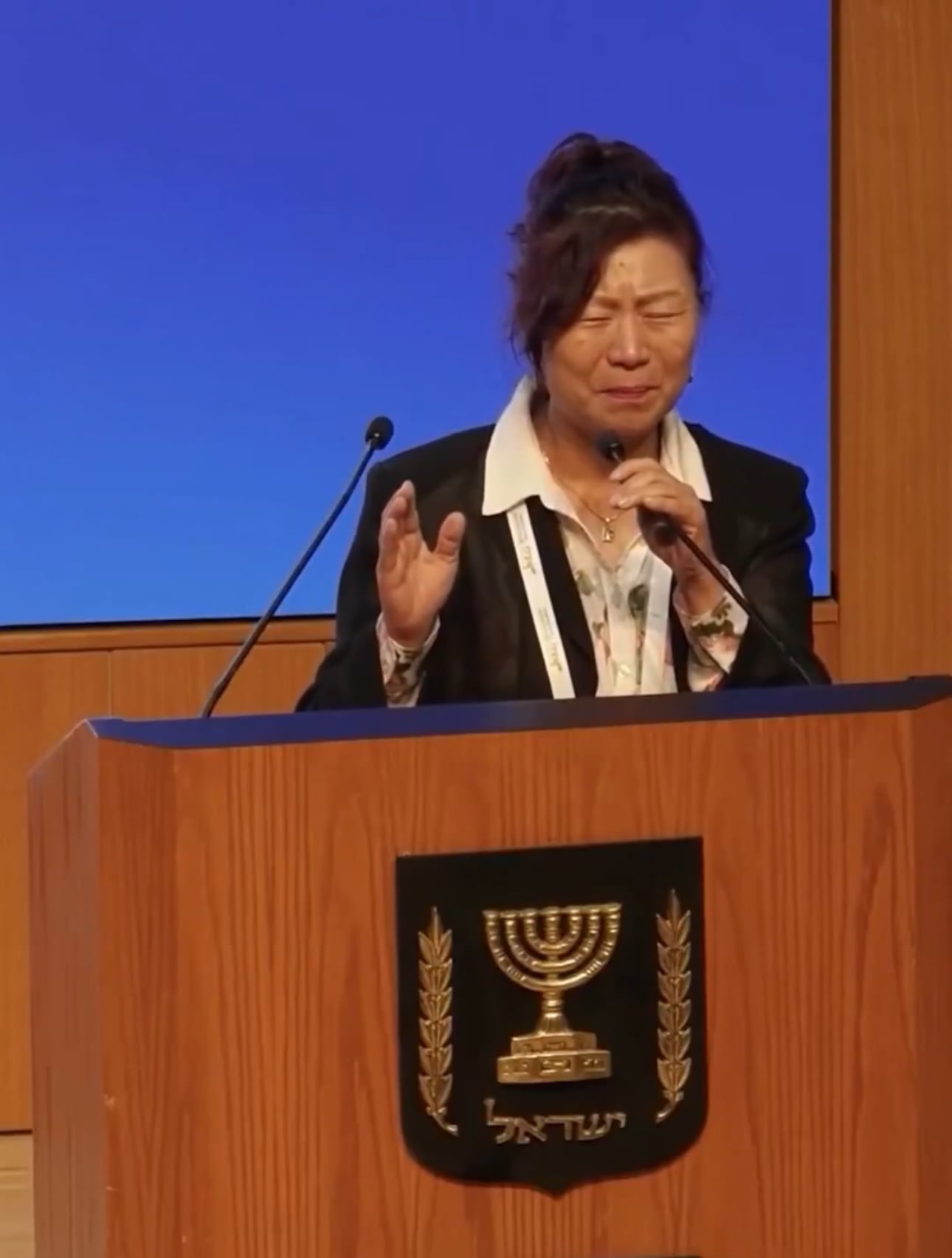
A Korean pastor’s emotional speech at Israel’s Knesset, in which she begged God to forgive South Korea for not fully supporting Israel and declared that the God of Israel was also the God of both Koreas, has gone viral and ignited fierce debate about Christian Zionism, performative political religion and the influence of pro-Israel advocacy on international evangelical Christianity.
The clip, shared widely on X by account @infolibnews, shows Pastor Rebecca Kim standing at a wooden podium bearing Israel’s official emblem inside the Knesset, visibly emotional and with tears in her eyes, as she delivers her prayer. “God forgive, forgive nation of Korea who spoke the word against Israel and people in Israel,” she says. “God forgives those evil things done towards people of God. So even though words were spoken from the government against Israel, I say today: God of Israel, Abraham, Isaac, Jacob is God of Korea. God of both South and North Korea. Today I stand here in the Knesset of Israel. I say Korean government will stand with Israel.”
The footage, accumulated over 200,000 views rapidly, was filmed at the 10th annual Jerusalem Prayer Breakfast — an international gathering modelled on the US National Prayer Breakfast that brings together Christian leaders, government officials and political influencers from approximately 38 nations. The event, held at the Knesset from 26 to 28 May, is chaired by former Israeli Knesset Member Robert Ilatov and co-chaired by former US Congresswoman Michele Bachmann. Its stated aim is to pray for the “peace of Jerusalem” and build Christian solidarity with the state of Israel, drawing on the biblical injunction of Genesis 12:3.
Pastor Kim’s speech was one of several “repentance” moments at the event, in which representatives from various countries publicly ask forgiveness on behalf of their nations for past antisemitism or insufficient support for Israel. A similar address from a German delegate drew comparable controversy online in parallel threads.
The South Korean angle struck many observers as particularly incongruous. South Korea does have a large and politically engaged evangelical Christian population with deep historical ties to Israel — many Korean churches treat the concept of “blessing Israel” as theologically central, and Korean delegations have attended previous Jerusalem Prayer Breakfasts in significant numbers. But the invocation of North Korea — one of the world’s most isolated and atheist-governed states — as also standing with Israel prompted widespread mockery online.
Reaction across X was overwhelmingly hostile. Critics described the speech variously as “insanity theatrics,” a “humiliation ritual” and “the most ridiculous propaganda stunt Israel has done yet.” Others raised objections from a religious standpoint, arguing the display debased Christian faith. A smaller number of evangelical Christians defended the speech as sincere intercession, but they were heavily outnumbered in the viral threads.
The Jerusalem Prayer Breakfast is formally documented on its own website and has been covered by Christian news outlets including CBN and All Israel News. The organisers have not commented on the viral controversy.
