



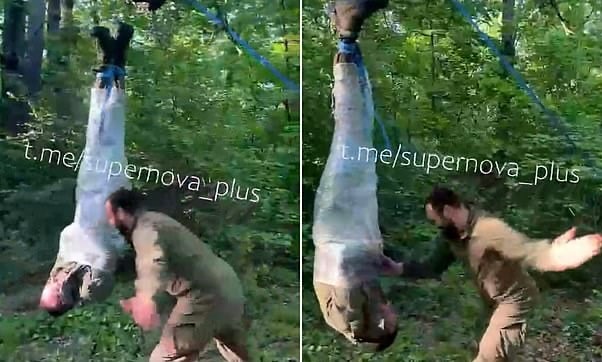
A disturbing new video has emerged showing a Russian soldier wrapped from head to toe in clingfilm, suspended upside down from a tree and slapped repeatedly by his commander — the latest in a wave of footage documenting systematic abuse within Putin’s armed forces as Russia’s casualties in Ukraine approach half a million.
The clip, shared on a Telegram channel, shows the serviceman hanging helplessly in what appears to be a forest, his entire body bound in layers of clingfilm forming a cocoon as he spins and groans in pain. A commander can be seen repeatedly striking him across the face while fellow soldiers laugh and shout encouragement in the background. The precise reason for the punishment is unclear, but the footage follows a well-documented pattern of commanders brutalising their own troops for infractions ranging from refusing orders and abandoning suicide missions to remaining on sick leave.
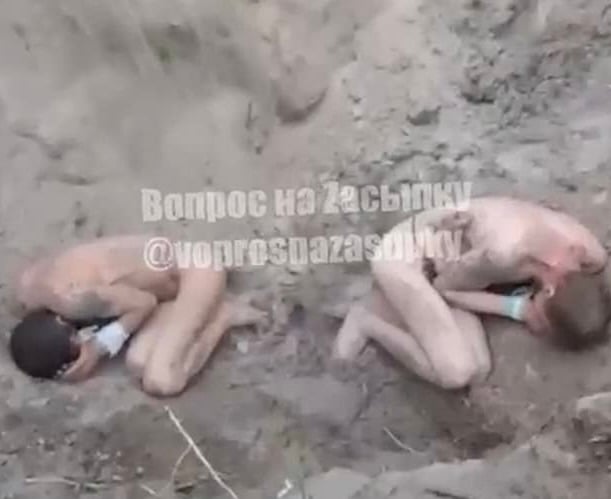
It is one of several such videos to have surfaced in recent weeks. In April, another clip showed a near-naked soldier being forced to eat dirt in a pit while his commander screamed abuse at him. “Since you’re a dog, go on, have a walk, crawl around on all fours,” the commander shouted. When the soldier pleaded that his ribs were broken, the commander responded: “F*** your ribs! Tomorrow you’ll go on a raid with a pancake” — a reference to a landmine.
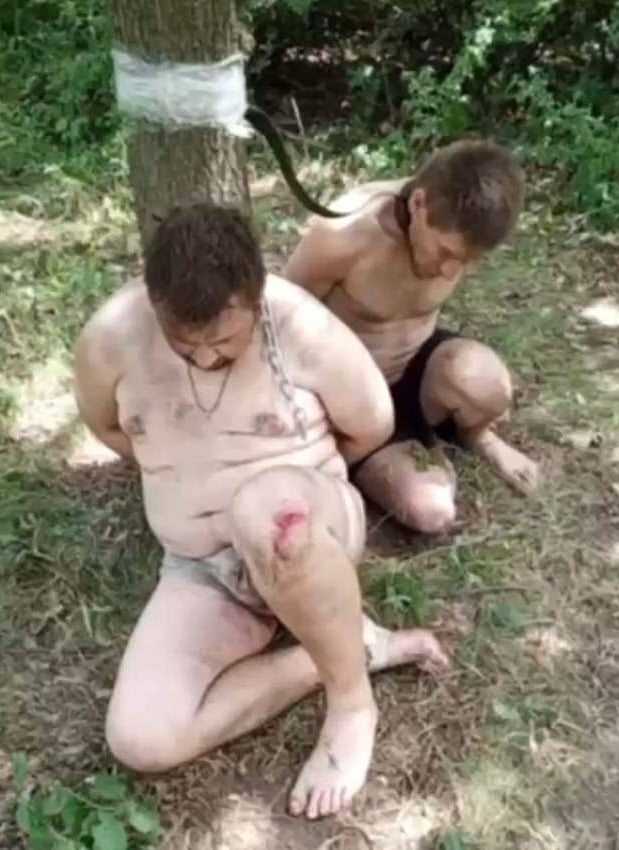
Other footage reviewed by the Daily Mail shows injured soldiers on crutches being returned to the frontline; troops surviving on stolen potatoes after being left without food by their own army; two naked men lying in a pit as a commander fires bullets into the ground beside them; soldiers chained to trees and forced to bark like dogs before being urinated on; and a man being electrocuted by laughing colleagues.
The videos are emerging as Russia’s losses reach a scale that British intelligence has described as staggering. GCHQ director Anne Keast-Butler revealed this week that almost half a million Russian soldiers have been killed since the conflict began — significantly higher than the 350,000 deaths estimated by the Centre for Strategic and International Studies in Washington earlier this month. Commanders are routinely sending troops into what their own men describe as “meat storm” assaults — waves of soldiers thrown at Ukrainian positions until ammunition runs out — with those who refuse or flee facing violent retribution.
Russian military expert Keir Giles told the Daily Mail the abuse was a symptom of structural rot that ran through Russian society itself. “The Russian army reflects the society from which it’s drawn. And that’s a society in which violence, extortion, and corruption are endemic,” he said. “We shouldn’t be surprised when these behaviours are displayed, whether it’s against the people that the Russian army conquers, or to their own people, because the social structure within Russia has always been built upon anybody that has even a tiny amount of power exploiting it to the greatest extent possible.”
Giles explained that attempts earlier this century to eradicate “dedovshchina” — an extreme culture of hazing and abuse of junior recruits that had historically caused fatalities — had largely failed. “They tried to abolish it. They never really succeeded,” he said.
Reports suggest the human cost is being disproportionately borne by Russia’s poorest communities. Poverty-stricken men from small towns and deprived regions are being recruited — and in some cases coerced — into service, with exiled news outlet Vyorstka reporting last year that police officers were being offered between £98 and £975 per detainee they signed up to fight. Methods including beatings and electric shocks are reportedly used to pressure men into enlisting. Wealthier Russians in Moscow and other major cities, by contrast, can avoid service through bribes or medical exemptions.
“If you look at the proportion of people serving from remote villages, ethnic minorities and the periphery compared to Moscow, the difference is stark,” Giles said. “Putin does not want to mobilise large numbers from cities, where people can exchange information and understand the real cost of the war.”
