



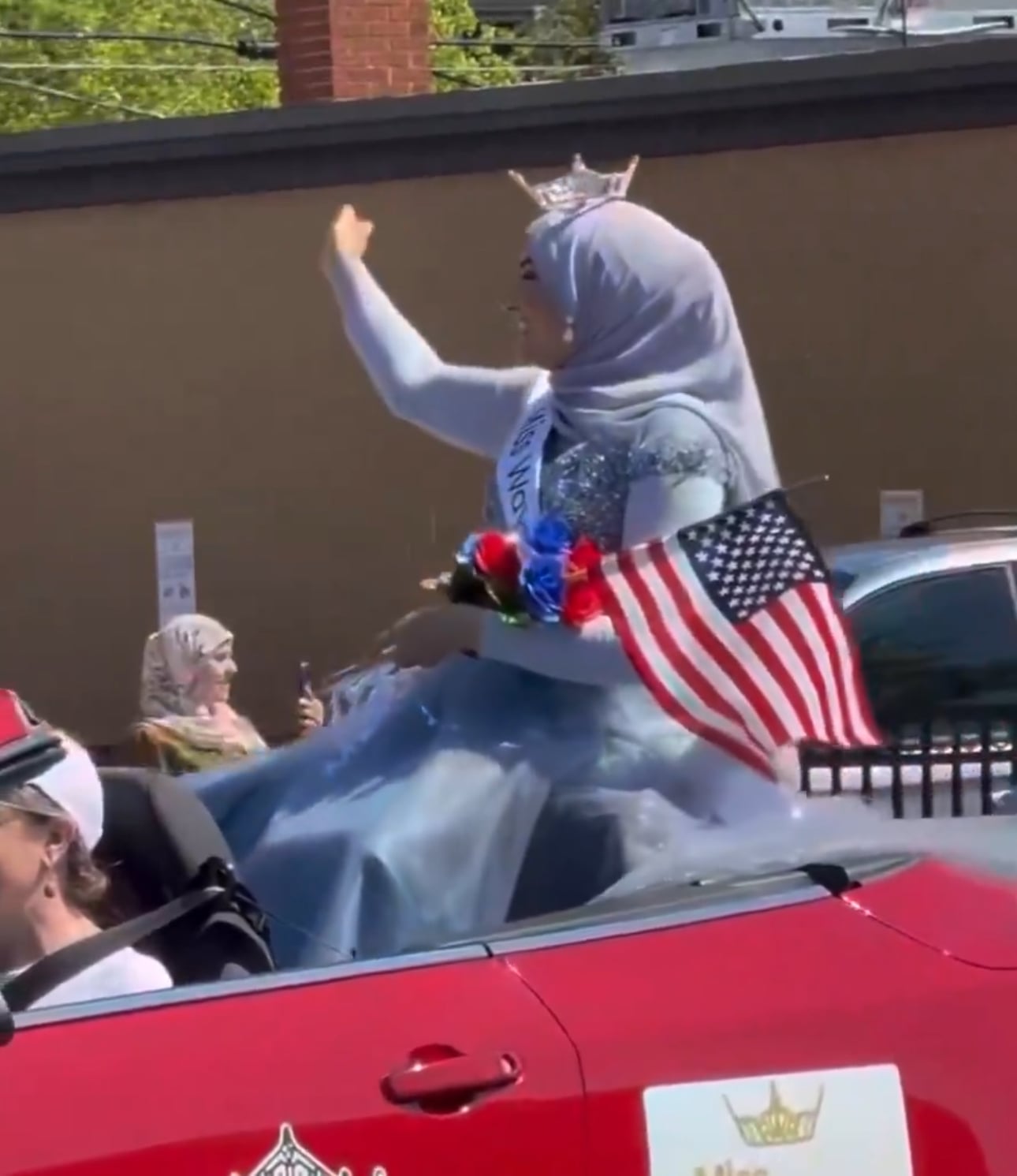
A Lebanese-American beauty queen has ignited a fierce national debate about identity, religion and patriotism after appearing at a Memorial Day parade in Michigan wearing a hijab while waving the American flag — with the images spreading rapidly across social media and drawing sharply divided reactions from across the country.
Nour Khalil, 25, a Wayne State law graduate and daughter of Lebanese immigrants from Dearborn Heights, made her first major public appearance as Miss Wayne County at the 25 May parade in Dearborn, Michigan, which honoured 347 local fallen service members before thousands of spectators. Dressed in her pageant sash and hijab, Khalil waved the Stars and Stripes as crowds lined the route. Local outlets reported that children cheered as she passed, with one girl reportedly describing her as a “real princess.”
For Arab-American community leaders and local media in Dearborn, the moment carried significant symbolic weight. The city is home to the largest concentration of Arab-Americans in the United States, with a population that is heavily Lebanese and includes a substantial Shia Muslim community built up over four decades of immigration. Community figures celebrated Khalil’s appearance as meaningful representation in a city whose demographics have been transformed beyond recognition — and one where Arab-Americans have a documented history of military service stretching back generations.
But the images quickly travelled far beyond Dearborn, drawing sharp criticism from conservative voices online. Actor and commentator Kevin Sorbo was among those who publicly questioned whether a hijab was appropriate attire for a military commemoration. His remarks were representative of a broader current of opinion, with many arguing that the hijab — as a marker of Islamic religious observance — constituted a deliberate cultural statement that sat uneasily against the backdrop of an event specifically dedicated to honouring those who died defending the American constitutional order.
Khalil’s supporters responded that the image of a Muslim-American woman waving the flag was precisely what American civic pluralism was supposed to look like. They pointed to the deep roots of Arab-American military service and argued that excluding such representation from patriotic events would itself represent a failure of American values.
The episode lands in already contested territory. Dearborn has repeatedly found itself at the centre of American debates about Muslim immigration, cultural integration and the pace of demographic change — scrutiny that has intensified in recent years as the city has become a flashpoint in national culture war arguments. The broader question of religious symbols at national commemorations is equally contested, with parallel debates over hijabs at public ceremonies and institutions having generated prolonged political controversy across Europe as well as the United States.
Khalil, who promotes fitness and civic service through her Miss Wayne County platform and has been widely praised for her academic and professional achievements, had not publicly responded to the criticism at the time of publication.
