



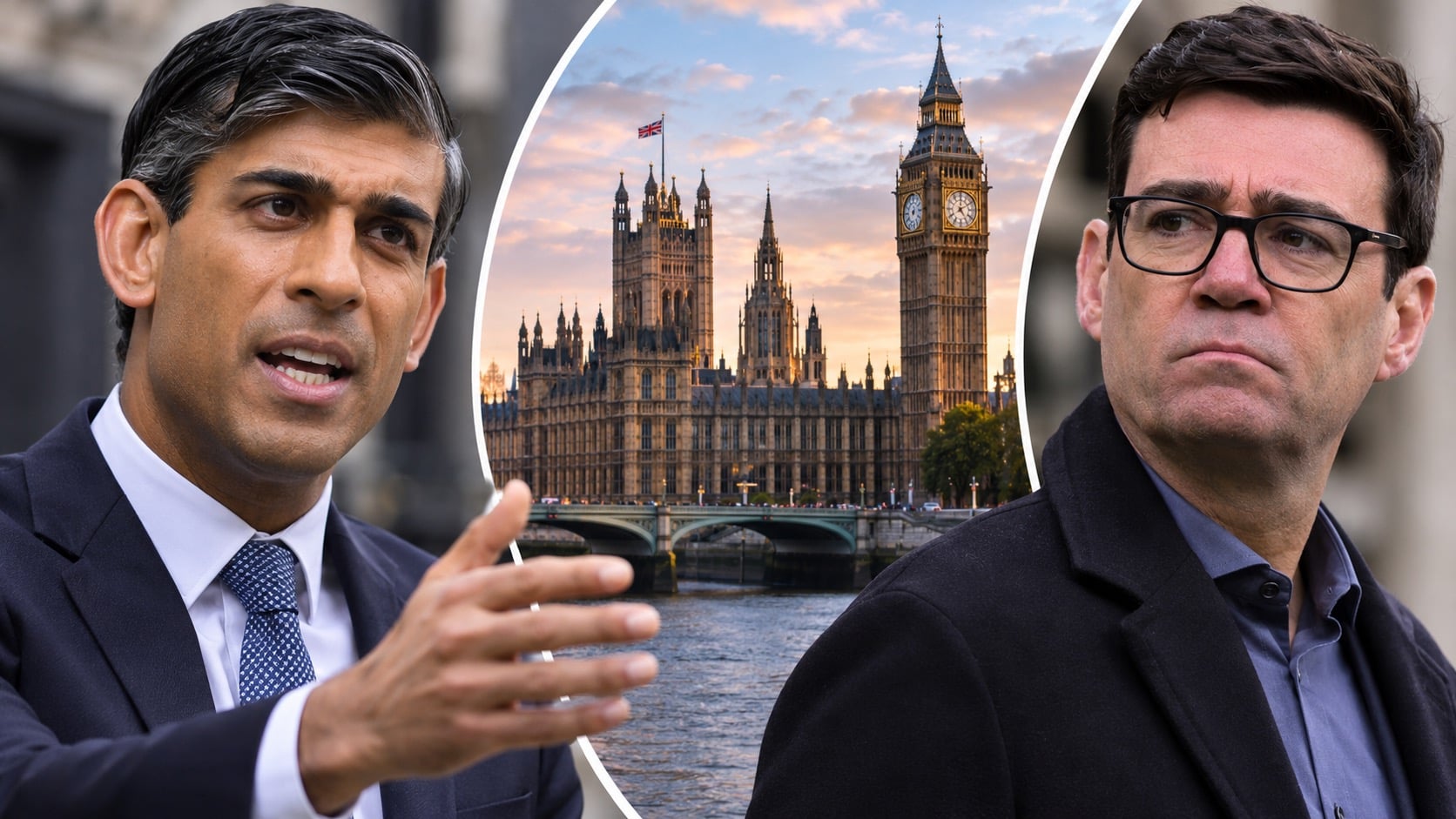
The former prime minister says the “biggest threat to our democracy” is voters repeatedly choosing change without seeing results. The government says it is already reviewing 306 arm’s-length bodies.
Rishi Sunak has called on Andy Burnham to embrace what he calls an “elective dictatorship”, arguing that Britain has been held back by “an unholy alliance of the unaccountable and the unelected”. Writing in The Times, the former prime minister called for a “radical transfer of power from unelected and unaccountable bodies to elected and accountable ministers”. He urged Mr Burnham to focus on “giving himself more power”. Mr Burnham, for his part, plans to publish a ten-year plan in December that seeks to move decision-making closer to communities.
Sunak’s argument
Mr Sunak said: “The biggest threat to our democracy is that voters keep voting for change and nothing happens. It isn’t healthy for democracy when governments of all stripes find it so hard to deliver what they have promised; it makes voters cynical and dissatisfied.” He said it was not “anti-democratic” for prime ministers to be powerful and that the country had reached a “rare moment when nearly all parties can see that our system of government needs fixing”. He described a “sclerotic system of government” and said more than 300 quangos hamstrung delivery and undermined “much-needed democratic accountability”.
He gave one example. “Natural England was able, without explicit parliamentary consent, to issue planning advice which held back the construction of 100,000 homes,” he said. “When we attempted to overturn it, the House of Lords stopped us.” He added: “We won’t restore balance until we scrap many of the checks and balances that have accumulated over the past 30 years.”
Mr Sunak said Sir Keir Starmer had once despaired of “a whole bunch of regulations, consultations, arm’s-length bodies” whenever he tried to “pull a lever”. “When you are Prime Minister, you don’t feel like much of a dictator,” Mr Sunak said. He noted that the phrase “elective dictatorship” was first used as criticism by the Conservative politician Lord Hailsham, who was angry that even slim majorities gave Labour the authority to make huge changes. “But the right response to policies you disagree with is to defeat them at the ballot box,” Mr Sunak said. He concluded: “Elective dictatorship is the worst form of government except all the others we have tried. It is time to go back to it.”
In 2024, Lord (Ken) Clarke, who served as chancellor under Sir John Major, accused Mr Sunak of moving the country towards an “elected dictatorship” over the Rwanda bill. He told the Lords: “The sovereignty of Parliament has its limits, which are the limits of the rule of law, the separation of powers and what ought to be the constitutional limits on any branch of government in a liberal democratic society such as ours.”
The government’s own plans
Mr Burnham has said he wants to tackle the UK’s “unaccountable state”. Cabinet Office minister Mark Ferguson told MPs on 10 September that ministers had reviewed all 306 active arm’s-length bodies and committed to reforming more than a third. Ministers describe the approach as “devolution by default”: functions could move to local elected leaders or back into departments, not necessarily to the prime minister. A Cabinet Office reform paper dated 7 September, The Simplification and Agency of Government, proposes changes to consultations, legal advice and judicial review. It criticises prolonged consultation but also recognises the need for evidence from affected groups. It does not propose abolishing elections or Parliament.
In a speech on 16 November, ITV News reported, Mr Burnham said his ten-year plan would move decision-making closer to communities. He also credited Mr Sunak with setting up the AI Security Institute.
The Institute for Government (IfG) says total funding for arm’s-length bodies was £394.8bn in 2023-24, about £2.4bn lower than the year before. The number of bodies was 295 in March 2022, 305 in March 2023 and 309 in March 2024. NHS England and the Education and Skills Funding Agency accounted for 67% of budgeted spending, and both are being brought back into their parent departments, according to a parliamentary answer on 23 March.
The 100,000-homes claim
The 100,000 figure is a government projection, not a count of homes blocked. In September 2023, Mr Sunak’s government estimated that nutrient-neutrality requirements affected about 16,500 homes a year, more than 100,000 by 2030. The rules applied in areas with sensitive waterways and aimed to stop nitrogen and phosphorus pollution harming protected habitats. The government proposed a £280m mitigation package alongside the planned relaxation. The Office for Environmental Protection warned the change would weaken existing protections, according to a Commons Library briefing. The policy affected 74 planning authorities across 27 river catchments. A 2025 Parliamentary Office of Science and Technology briefing identified 31 protected sites and cited a Home Builders Federation estimate of 160,000 homes delayed. These figures use different methods.
Hailsham and the constitutional debate
Lord Hailsham’s 1976 Richard Dimbleby Lecture warned of the dangers of a government with a Commons majority dominating Parliament, so Mr Sunak is reversing the original emphasis. A 1999 government-commissioned reform report cited him in arguing for stronger parliamentary scrutiny. A Lords constitutional inquiry has received written evidence in October and November 2026 on whether the UK’s uncodified constitution offers enough safeguards. Contributors name judicial review, parliamentary oversight and judicial independence as key protections.
Mr Sunak also argued that the legally binding 2050 net-zero target invites challenges to ministers’ decisions and draws judges into disputes he believes should be settled politically. The Constitutional Reform Act 2005 places a duty on ministers to uphold judicial independence.
