



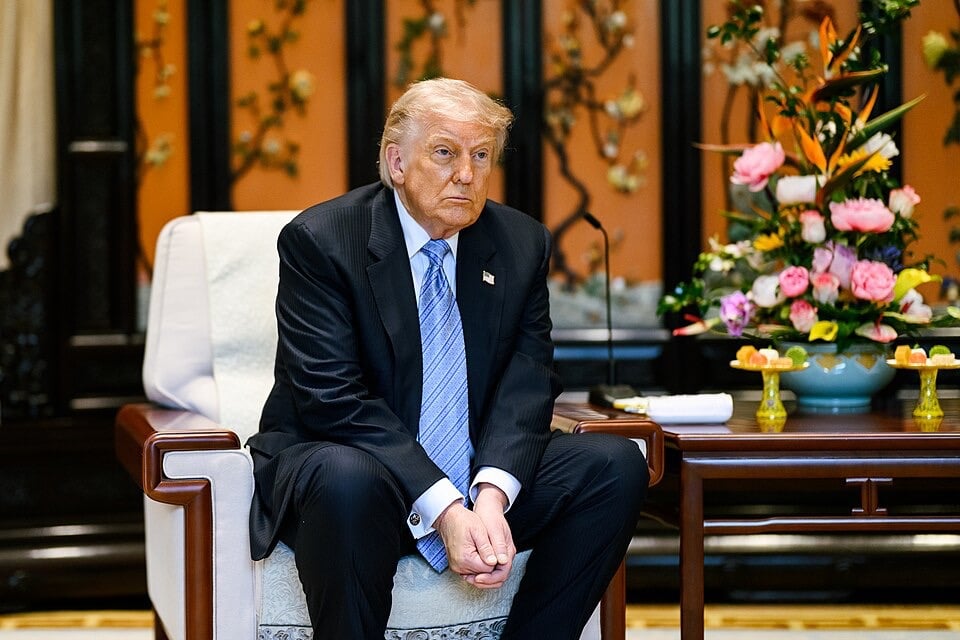
The president said the June agreement “delayed things a little bit” and showed that Iran “can’t be trusted”. He insisted that Vice President JD Vance’s removal from the talks was not a sign his standing had slipped.
President Donald Trump has described the Iran ceasefire memorandum negotiated by Vice President JD Vance as “a waste of time”, in a rare public critique of his own deputy’s diplomacy. Speaking to Fox News ahead of meetings with Vladimir Putin and Xi Jinping in Shenzhen, Mr Trump said he “didn’t like doing it but I listened to people”. The remarks come about a week after Mr Vance was taken off the Iran negotiating brief he had held since the spring. Mr Trump nonetheless said Mr Vance was “doing a very good job”.
What Trump said
“We had this, I think, a waste of time, I didn’t like doing it but I listened to people,” Mr Trump said of the memorandum. “I have some very good people, and it could have worked out. But we had a little memorandum of understanding. I never believe too much in memorandums. You go right to a contract, forget the memorandum.”
He added that the agreement “delayed things a little bit” but “wasn’t a mistake”. “Actually, we got to know them very well during that period, and we got to know that they can’t be trusted,” he said.
Mr Trump said the change in Mr Vance’s role had nothing to do with the vice president’s criticism of the war, which Mr Vance voiced after the midterm elections. He said Mr Vance “basically just left one thing out. If we had it to do again, would you do [the war] again? And the answer is absolutely yes.” Mr Trump added: “What we’re doing is the right thing. I think long-term we’ll be judged very well. Short-term, I [knew] the elections are coming up. They say, ‘This is a problem,’ but I’m not going to be guided by that.”
A rift in the White House?
The Daily Beast, citing New York Times reporting, said on 18 November that Mr Trump had expressed frustration with Mr Vance in private for about two weeks. The reports say the president complained to White House aides about how his deputy publicly discussed the Republicans’ midterm defeat, and that he wanted Mr Vance to acknowledge what he saw as the benefits of the military campaign. The White House has not confirmed the account.
Mr Vance denied a fundamental policy disagreement in a Fox News interview with Laura Ingraham on 16 November. He said he remained confident that Mr Trump would prevent the conflict from becoming another prolonged American war, despite disagreements over the political cost. Anadolu Agency reported on 17 November that Mr Vance also defended his role in the June memorandum against critics in his own camp. He suggested some commentators were using him as a substitute target for criticism of the president. He argued that his opposition to an indefinite war was consistent with the administration’s electoral promises.
Fox News reported on 9 November that Mr Trump joked at the G7 summit in France in June that he would take credit if the Iran negotiations succeeded and blame Mr Vance if they failed, in remarks to the network’s Peter Doocy.
The Wall Street Journal reported on 11 November that Mr Vance had considered meeting a senior Iranian security official face to face, with preliminary planning involving American and Middle Eastern officials. The meeting was never confirmed. The Journal said Mr Trump had told aides and foreign counterparts he was open to another diplomatic initiative shortly before Mr Vance’s role was withdrawn. The Los Angeles Times reported on 12 November that the White House said Washington retained leverage despite ending his assignment. An official cited the naval blockade and pressure on the Strait of Hormuz, and said the aim remained preventing Iran from obtaining nuclear weapons.
Brian Kilmeade, a Fox News presenter, publicly questioned Mr Vance’s suitability for the vice-presidency, TV Insider reported on 18 November. He argued that Mr Vance’s position on the conflict was incompatible with the administration’s war policy. That is one commentator’s view, not an official Republican position. Secretary of State Marco Rubio has defended the campaign. He told the Associated Press that confronting difficult national-security challenges could be unpopular but necessary. Neither Mr Rubio nor Mr Vance has declared a 2028 presidential candidacy.
What the memorandum contained
The agreement, titled the Islamabad Memorandum of Understanding, was negotiated through a process involving Pakistan. Its 14 provisions were sent by the White House to Congress on 18 June. It set out a path for the US and Iran to begin ceasing hostilities and to negotiate an end to the war. Fighting continued on and off for the rest of the year.
Reuters reported on 18 June that Washington committed to ending its naval blockade of Iranian ports within 30 days. In return, Iran agreed to let commercial vessels through the Strait of Hormuz without charges for an initial 60 days. The text also provided for talks on the future administration of the strait with Oman and other Gulf states, and for further discussion of nuclear differences, according to the American Presidency Project and Defense News.
A House of Commons Library briefing of 2 July noted competing conditions. Iran said a ceasefire between Israel and Hezbollah in Lebanon was necessary for broader talks and that its ballistic missile programme was not negotiable. Gulf states separately insisted that any regional settlement address threats beyond Iran’s nuclear activities.
Blockade tightened as diplomacy stalls
Reuters reported on 18 November that US Central Command had expanded blockade enforcement to ships receiving Iranian cargo at sea. A new advisory warns that vessels could be treated as blockade evaders even if they never enter an Iranian port, and may be boarded, diverted or captured. It also says ships refusing lawful instructions could face enforcement measures, potentially including force consistent with applicable law. No new seizure was announced.
Reuters said the first blockade began on 13 April, was lifted in June after the preliminary agreement, and was reinstated on 14 July after the deal collapsed. Shipping and security sources told the agency that Iran’s crude exports remained close to a standstill, but that it had still shipped some liquefied petroleum gas and aviation fuel.
Diplomacy has continued in parallel. Iranian Foreign Minister Abbas Araghchi met Oman’s Sultan Haitham in Muscat on 17 November, after talks in Pakistan the day before with Foreign Minister Ishaq Dar and military chief Field Marshal Asim Munir. Qatari and Iranian officials also met in Doha on Tuesday, The National reported. Officials told the outlet that Pakistan, Oman and Qatar had passed messages between Washington and Tehran without a decisive breakthrough. A source familiar with Tehran’s position suggested Iran might accept synchronised steps rather than insisting on fully sequential action, but would not drop its main conditions. The National described that as anonymous-source reporting, not a formal Iranian offer.
Separately, International Atomic Energy Agency director general Rafael Grossi said on 18 November that Iran had not allowed inspections of an underground enrichment facility at Isfahan for months. He said inspectors had only been able to visit Bushehr, and that the lack of access prevented the agency from giving the transparency assurances sought, The National reported.
Summit with Xi and Putin
The Associated Press reported on 19 November that Mr Trump met Mr Xi at the APEC summit in Shenzhen, then held a discussion of about 40 minutes with Mr Putin. He raised the importance of restoring oil shipments through the Strait of Hormuz with Mr Xi and asked China to buy more American agricultural products. Reuters reported on 18 November that Kremlin aide Yuri Ushakov said the Trump-Putin meeting would involve members of both delegations and was not planned as a full-scale summit. According to Iran International, Mr Trump told Fox News he did not need Russian or Chinese help to end the Iran conflict. He said the US had severely weakened Iran’s military and could conclude it alone. That is Mr Trump’s own assessment, not an independently verified outcome.
