



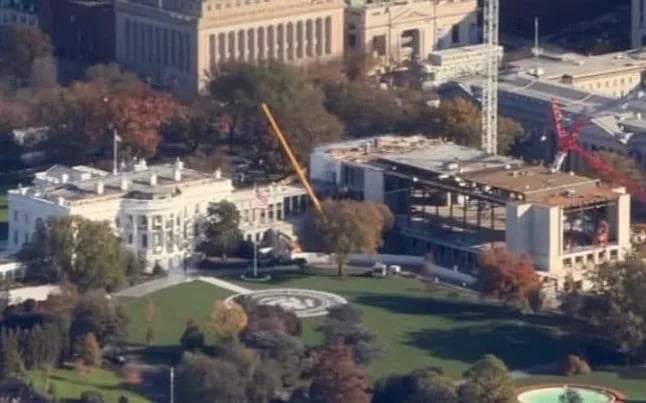
A new photograph shows the East Wing and State Ballroom complex taking shape. At 90,000 sq ft, it is far larger than the 55,000 sq ft executive residence, though the ballroom itself is smaller than that figure suggests.
A new aerial photograph has shown the scale of the East Wing and State Ballroom complex that Donald Trump is building at the White House. The project covers 90,000 sq ft, compared with 55,000 sq ft for the executive residence, which has housed US presidents since 1800. It is more than six times the size of the original East Wing, built in 1902. Completion is not due until September 2028, but the structure is quickly taking shape. The complex has also drawn legal challenges, and the Trump administration has now taken the dispute back to the Supreme Court.
“A gilded ballroom”
Hillary Clinton was among those who criticised its size. “It says everything about Donald Trump that his gilded ballroom dwarfs the size of the People’s House,” she wrote. “And it says everything about the American people that they repudiated him loudly and clearly last Tuesday.” She was referring to the midterm elections, in which Democrats won both chambers of Congress.
Joe Walsh, a former Republican congressman and conservative radio host, called the building a “complete stain” on the presidential residence and a “national disgrace”. He urged future presidential candidates to pledge to “tear this monstrosity down”.
Mr Trump visited the site after the midterm defeats to watch the last steel beam lifted into place. He signed it on 4 November, writing “Love!” above his signature between two gold presidential seals, CBS News reported. He said the ballroom would be the “safest place in Washington” and “the most beautiful anywhere in the world”. It is expected to seat 900 to 1,000 guests. As well as the ballroom, the complex will house military facilities, a “state-of-the-art” hospital and a bomb shelter, and Mr Trump has described it as a national security issue.
How big is the ballroom itself?
The 90,000 sq ft figure covers the whole East Wing complex. According to February meeting records from the US Commission of Fine Arts, the ballroom is roughly 110ft by 200ft, with ceilings about 40ft high, and its floor area is around 22,000 sq ft. Architectural drawings analysed by Engineering News-Record put its roof at about 88ft 11in above grade, against 122ft 11in at the ridge of the main residence. It may look larger in aerial photographs because of its footprint, but it is not taller than the historic building.
The National Capital Planning Commission approved the revised plans on 2 April by nine votes to one, with two abstentions. DC Council chairman Phil Mendelson opposed the scale of the proposal, while other commissioners argued that it would improve security and capacity for presidential events. The commission said the south portico stairs were removed and the southwest staircase redesigned after architectural review.
The demolished East Wing housed the Office of the First Lady upstairs, visitor and security operations at ground level and secure facilities below. Planning documents show that alternatives that would have kept the old building, including a separate ballroom to the south or a walkway-linked structure, were considered and rejected. The designs include a garden court west of the ballroom, incorporating the Jacqueline Kennedy Garden.
The cost and who is paying
The original cost was put at $200m, then doubled to $400m. A contractor’s estimate puts it at $600m.
The Washington Post obtained an estimate prepared by Clark Construction and dated 5 March 2026. It allocated the cost as follows:
| Funding source | Estimated contribution |
|---|---|
| Private donations | $293m |
| US Secret Service | $155m |
| White House Military Office | $149m |
| Executive Residence | $3m |
| Total | $600m |
That means about $307m, or roughly 51.2%, would come from taxpayer-funded sources. The administration distinguishes between the privately funded ballroom space and government-funded security and military facilities. The Post also obtained invoices showing that federal authorities had approved more than a dozen payments, totalling tens of millions of dollars, to Clark by March. Early Secret Service budgets allocated $3.6m for initial site work and more than $1.6m for part of the East Wing demolition, and procurement experts questioned whether those costs fell within the agency’s protective mission. Emails show White House lawyer Caroline C. Hunter discussing changing contract language to tie the work more closely to security requirements, which she said mattered for compliance with federal spending rules. No court has found the spending unlawful.
Who is donating
A Post investigation published on 15 October identified 67 donations of more than $10,000. An internal fundraising spreadsheet showed commitments of about $333m, of which at least $77m came from donors who asked to remain anonymous. These are recorded commitments, not necessarily money already spent. Apple and Nvidia each committed $25m, as did the Adelson family and the telecoms billionaire Charles Ergen. Nvidia reportedly asked for anonymity, and its spokesperson defended the gift as support for a nonpartisan national institution that was independent of the company’s business interests. Amazon, Caterpillar, Comcast, Microsoft and T-Mobile were also named as contributors, and more than three-quarters of the reported total came from commitments of $5m or more. The records did not show a donation from Mr Trump himself, although he has said he is helping to pay personally.
The Post reported that a company linked to Mr Ergen committed $25m while major telecoms deals were under federal review, following discussions involving Federal Communications Commission chairman Brendan Carr, and that federal approvals followed. It said the timing does not establish an exchange. A Rocket Companies subsidiary pledged $10m three weeks after the Federal Housing Finance Agency approved its acquisition of Mr Cooper. Rocket denied any connection. Marc Benioff reportedly committed $1m personally, and Salesforce two further $1m sums, with Mr Benioff asking for anonymity for his own gift.
A 12-page agreement with the Trust for the National Mall requires donor confidentiality to the extent permitted by law, unless White House staff authorise public recognition. The trust says anonymity requests are common in philanthropy.
Back at the Supreme Court
Solicitor General D John Sauer has asked the justices either to overturn an appeals court ruling against the project without further argument or to agree to hear the case in full, the National Constitution Center reported on 13 November. The National Trust for Historic Preservation has until 7 December to respond, the Washington Examiner reported.
On 31 August, the Supreme Court ruled 5-4 to let construction continue, with five justices finding that the preservation group was unlikely to have the legal standing to sue. That did not decide whether the project is lawful. Chief Justice John Roberts joined the three liberal justices in dissent, arguing that the work probably needed congressional authorisation.
On 7 August, a divided three-judge appeals panel had upheld an injunction against above-ground construction, citing Congress’s constitutional authority over federal property. That injunction is currently suspended by the Supreme Court’s order.
With Democrats now controlling both houses, Mr Trump’s opponents will have more power to cut funding for his other major construction plans, including the Trump Triumphal Arch in Washington. They are unlikely to be able to halt the ballroom, but will have more scope to examine the donors funding it.
