


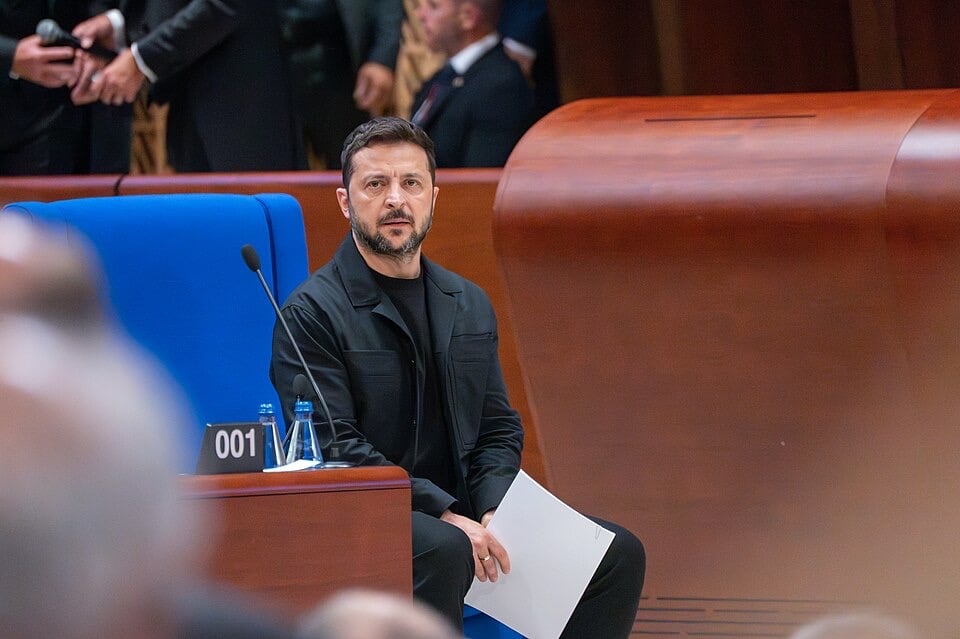
The Ukrainian president said “our soldiers will come home” after talks in Dublin with US envoys Steve Witkoff and Jared Kushner. Russia describes the deal as preliminary, and details have yet to be confirmed.
Ukrainian President Volodymyr Zelensky has welcomed an agreement with Russia to exchange prisoners of war, which he said would be “the biggest exchange of war prisoners”. He spoke to reporters on Thursday evening alongside Mr Witkoff and Mr Kushner, after almost an hour of talks at Baldonnel Aerodrome on the outskirts of Dublin. “Our soldiers will come home,” he said. He also welcomed progress towards giving European representatives a seat at the next round of negotiations. Russia’s chief negotiator has described the deal as an agreement in principle, with details still to come.
What Zelensky and the US envoys said
“I’m very thankful to all our negotiators,” Mr Zelensky said. “This is a real result, this is very important and successful for the families and to all of us that people will come home to their families.” On Europe’s role, he said: “They will have a voice. This is important for us because the war is in Europe.”
Mr Kushner, President Donald Trump’s son-in-law, described the talks with Russia in Abu Dhabi as “very intense”, and said he had a “very detailed and productive” meeting with Vladimir Putin and his negotiating team. “We were able to finalise on the prisoner of war exchange, which is a very important thing,” he said. “A lot of people are being impacted by this war, and to return these thousands of people to their families I think will be a very nice milestone to achieve.”
He said the US had been working “very, very closely” with Europeans for several months. “We cannot conclude this deal without the Europeans being at the table … and I think that we’re able to achieve that with President Putin,” he said. Mr Witkoff said Mr Trump was “intent on leading the charge to end this war”. “We’ve got another meeting on the schedule, and we’re all going to work very, very hard to get to that goal,” he added.
UK Prime Minister Andy Burnham had said the UK national security adviser, Jonathan Powell, would join Mr Zelensky for the talks with the US envoys. Downing Street later said the meeting was delayed and Mr Powell would no longer be able to attend. Ukraine’s presidency said he did take part in a separate meeting earlier with European advisers.
How big could the exchange be?
The Kyiv Independent reported on 11 November that the two sides had discussed swapping between 2,000 and 3,000 prisoners in total. Mr Zelensky had earlier said negotiators were considering either 1,000 or 1,500 from each side. These are proposals and not a published list. The Kyiv Independent also reported that Vladimir Medinsky, Russia’s chief negotiator, said an agreement in principle had been reached and details would be announced later.
ITV News and the Associated Press reported that General Alexander Zorin, who took part in the talks, told Russian state television that more than 1,000 people from each side could be released, exceeding the previous exchange of 1,000 per side. He suggested it could happen within two to three weeks, which would put it in late November or early December. Neither government has formally committed to a date.
For comparison, the Kyiv Independent reported that on 23 to 25 May 2025 each country swapped 1,000 people over three days. Ukraine received 390 on the first day, 307 on the second and 303 on the third, and the first stage included 120 civilians. On 23 October this year, the latest completed exchange returned 270 people to each side, including 261 Ukrainian service members and nine civilians, and was reported as the 11th of 2026. The categories covered by the new arrangement have not been confirmed.
Russia’s stance on territory and troops
The Guardian reported on 13 November that Mr Putin told the US delegation Russia would keep the four regions it claims to have annexed: Donetsk, Luhansk, Kherson and Zaporizhzhia. Russian forces do not control all of that territory. Le Monde reported that Mr Putin warned European troops deployed in Ukraine could become military targets, and that Moscow proposed a humanitarian operation in Kostiantynivka. No operation has been announced. The Guardian reported on 12 November that Russia also wants talks to cover Europe’s wider security architecture, including Nato, a prospect that has worried European officials.
Reuters confirmed plans for another round of talks, but there is no ceasefire or territorial settlement.
Who will speak for Europe?
The Associated Press reported that European governments disagree over whether one person should represent the EU alone or a wider group that includes Britain and Norway. António Costa, Kaja Kallas and Finnish President Alexander Stubb have been discussed, though no one has been appointed. Euronews reported that Mr Kushner suggested choosing a single representative could prove difficult. Before the US envoys arrived, Ukraine met national security advisers from Britain, Germany, France and Italy, along with representatives of the European Commission and European Council, according to the Ukrainian presidency.
Summit in Dublin
The war dominated a major political summit in Dublin on Thursday, where Mr Zelensky warned European leaders that Russia wants to reshape the continent’s security framework. Taoiseach Micheál Martin said the EU is “potentially in a process” on negotiations to find a peace agreement. The Ukrainian presidency said about 20 international partners attended, including Canada’s Mark Carney, Nato’s Mark Rutte, Poland’s Donald Tusk and Germany’s Friedrich Merz. A meeting of the Coalition of the Willing is planned in Berlin next week to discuss security guarantees and military aid.
Mr Zelensky told the summit that renewed restrictions on Starshield satellite communications, with a speed limit of about 161km/h (100mph), were stopping some Ukrainian interceptor drones from catching faster Russian drones. He said Kyiv has asked Washington for an explanation, according to The Guardian. No explanation has been published. He also raised the issue with Mr Rutte, who the Ukrainian side says is willing to help with PAC-2 and PAC-3 Patriot interceptors. No quantities or timetable have been given.
The Ukrainian presidency said Mr Zelensky told Emmanuel Macron that Russia carried out more than 310 attacks on Ukrainian energy facilities since 1 November, leaving almost 700,000 households without power. It also cited 115 Russian missiles in the first week of November and 60 locomotives struck in October. These are Ukrainian government figures and are not independently verified.
On 12 November, the UK government said Britain had become the first country to sanction all 10 of Russia’s major oil producers. The package adds Slavneft, shadow fleet vessels, major coal companies and Rosneft’s Arctic project, Vostok Oil.
