



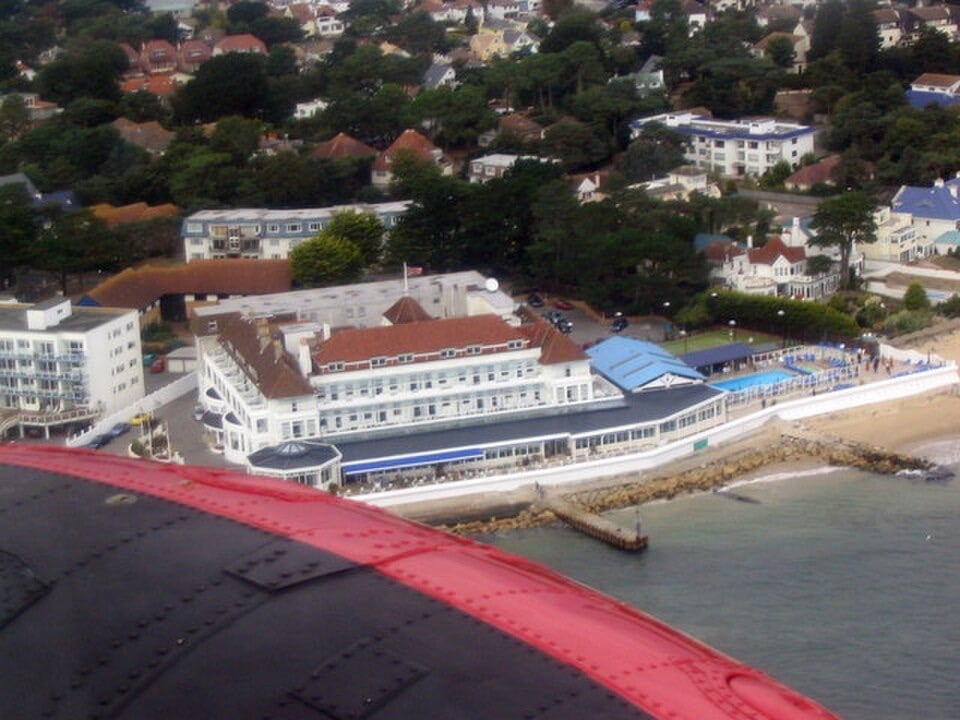
Residents in Sandbanks, Poole, have condemned plans by FJB Hotels to demolish the historic Haven Hotel, where Guglielmo Marconi once conducted pioneering wireless telegraphy experiments, branding the move an “act of vandalism” ahead of a council decision on the demolition application.
Furious residents in Poole Harbour, Bournemouth, have hit out at plans to bulldoze the historic Haven Hotel, describing the proposal as a “disgusting act of vandalism.” The hotel, built in 1880 and located in the affluent Sandbanks area, where average house prices reach £1.5 million, is owned by FJB Hotels, which is seeking to demolish the current building. A planning agent acting on behalf of the company says the firm intends to construct a cheaper hotel of similar size in its place, though residents have strongly objected to the plans.
The formal application
FJB Hotels has formally submitted a demolition application for the Haven Hotel, identified in planning documents as being located at 161 Banks Road, Poole, BH13 7QL, within the Canford Cliffs ward. The application, reference P/26/04225/PNDEM, was validated by Bournemouth, Christchurch and Poole Council on 2 September 2026, and seeks prior approval for demolition of the existing buildings on the site.
The application has not yet been approved and remains under consideration by the council, with a current consultation deadline of 23 September 2026, meaning residents still have time to submit formal objections. It is worth noting that the current application relates specifically to demolition, rather than to the proposed replacement hotel itself, raising the possibility that the council could approve demolition before any full planning application for a new hotel has been determined.
Residents’ objections
Resident Keith Ulyatt, in his formal objection letter, warned of the risk of the site standing empty for an extended period. “Granting permission for demolition without any proposal of what is to replace it is totally unacceptable,” he wrote. “It raises the prospect of a flattened empty building plot being in place for years, in the most iconic of local locations…so that any subsequent proposed building would be acceptable compared to the wasteland created.”
Many locals fear the site could remain vacant for a prolonged period, potentially clearing the way for more profitable proposals involving luxury flats to be pushed through instead. Andrew Reed echoed these concerns, saying: “This application is nothing short of vandalism, a ploy to avoid the rigorous assessment of a future development application by reducing a usable and valuable asset to a piece of waste ground in the most prominent of locations.”
Resident Carl Emms suggested the hotel’s condition may have been allowed to deteriorate deliberately. “I’m disgusted that a property of such historic significance has been left to deteriorate,” he said. “It seems to have been a deliberate lowering of maintenance and worth so to convince decision makers that the hotel’s future is not sustainable.”
A site steeped in radio history
The 84-bedroom hotel, which overlooks the Channel, holds particular historical significance as the birthplace of radio. Italian engineer Guglielmo Marconi moved into the hotel in 1898, setting up a makeshift laboratory in its lounge to experiment with wireless telegraphy, and constructing a 120-foot wooden transmitter mast within the hotel grounds. When the Titanic sank in April 1912, operators aboard the ship used the Marconi radio network to transmit their SOS signals back to shore.
The developer’s case for demolition
Despite the hotel’s historical importance, Richard Carr of Property Planning Strategy, working on behalf of FJB Hotels, has argued that the building cannot be saved. “The site has to be used as a hotel and we plan to submit a new application very soon for an 85-bedroom hotel,” he said. “We are planning to demolish the Haven which isn’t listed or in a Conservation Area. The building has come to the end of its life.”
Carr described the building’s structural condition as a key factor behind the decision. “The majority of it is a steel-form building which faces the sea and has been exposed to salt water and south-westerly winds for over 100 years. Parts of it are severely corroded,” he said. “If you run a bath, you get yellow water from where the pipes were made of galvanised steel that has perished over the years.” He added that the hotel’s running costs were “eye-watering” and “ridiculous,” and said the proposed replacement, built from modern materials, would be significantly cheaper to operate.
A long-running dispute over the site
The current proposal is far from the first attempt to redevelop the Haven Hotel site. In July 2022, BCP Council’s Planning Committee unanimously rejected an earlier, much larger redevelopment scheme that would have replaced the Haven with 119 residential apartments, rather than retaining it as a hotel. That wider proposal, which also involved changes to the neighbouring Sandbanks Hotel and Harbour Heights sites, envisaged a 171-bedroom hotel at the Sandbanks Hotel site and a 38-suite aparthotel at Harbour Heights, and attracted more than 6,000 objections from the public.
Objections to that earlier scheme centred on concerns including the loss of hotel accommodation, excessive building height and scale, traffic impact, flood risk, landscape impact and effects on local views. Its rejection means the current, more limited demolition proposal represents a substantially different redevelopment strategy to the one previously put forward and turned down.
A prestigious address
Sandbanks, home to around 800 households, is known for its collection of high-profile residents, including former football managers Harry Redknapp and Graeme Souness, and computer magnate Sir Peter Ogden, underlining the prominence of the location at the centre of the current planning dispute.
