



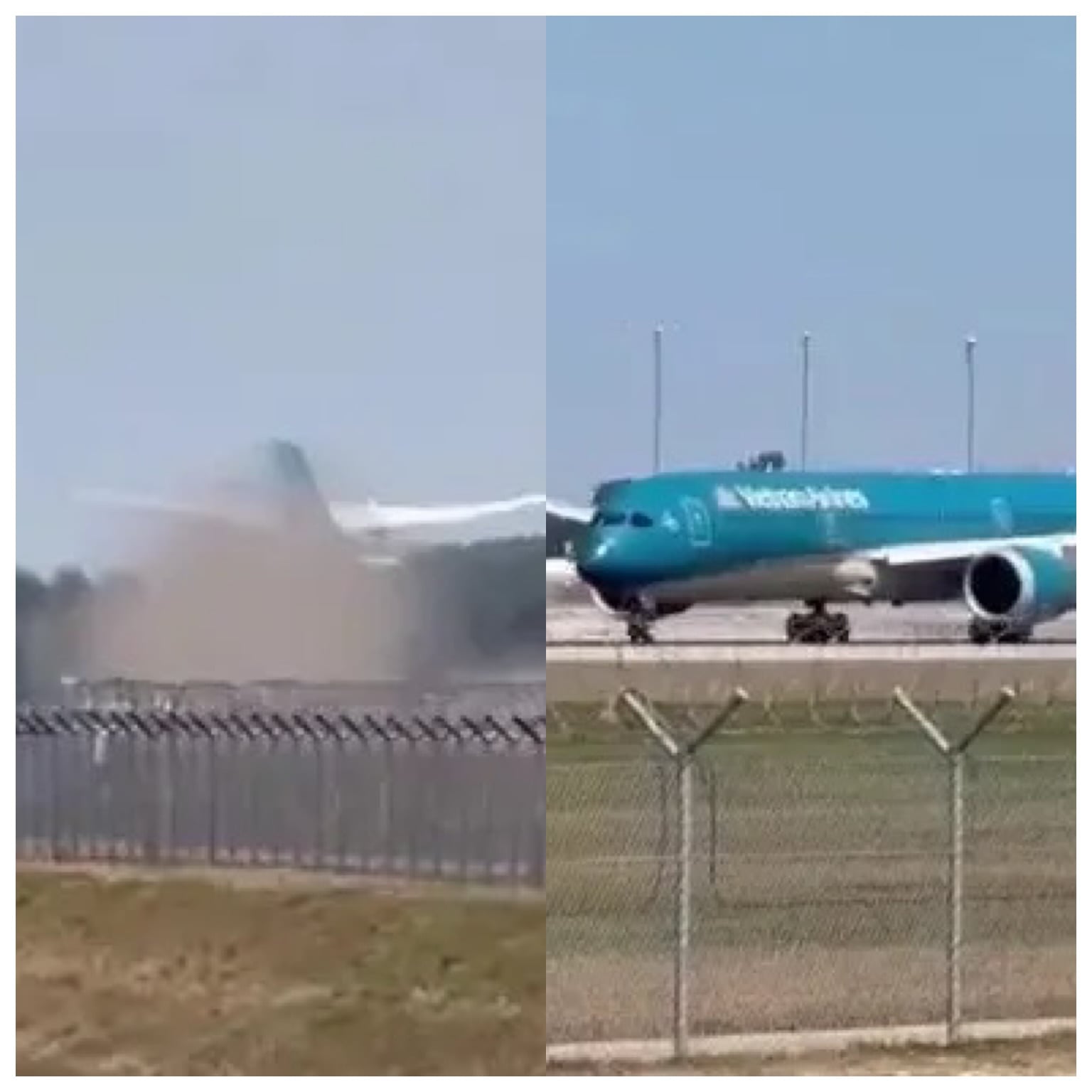
A Vietnam Airlines Boeing 787 Dreamliner carrying 287 people struck its tail on the runway during a chaotic take-off from Munich Airport, forcing the aircraft to circle for two hours dumping fuel before landing safely, as German investigators now examine why the plane’s acceleration dropped twice during its take-off roll.
A Vietnam Airlines Boeing 787 carrying 287 people ran into trouble during take-off from Munich Airport, striking its tail on the runway in a chaotic departure that sent up a huge cloud of dust and debris. The aircraft, identified as a Boeing 787-9 Dreamliner registered VN-A867 and operating flight VN34 to Hanoi, was carrying 271 passengers and 16 crew members when it experienced an unexplained loss of acceleration during its take-off roll. Passengers described a loud “pop sound” and said they feared for their lives before the plane eventually lifted off using almost the full length of the runway.
A chaotic take-off roll
According to Vietnamese aviation authorities’ preliminary account, the aircraft began its take-off at 1.57pm local time from Munich’s Runway 26L. During the roll, the crew reportedly noticed the aircraft’s speed stop increasing for around two seconds. The speed then rose again to V1, the critical decision speed of 180mph for a Boeing 787, before reportedly dropping once more.
By this point, the pilots concluded there was no longer enough runway remaining to safely reject the take-off, and pushed the engines to maximum thrust rather than attempting to stop. According to the preliminary account, the aircraft ultimately lifted off with only around 91 metres of runway remaining. Footage of the incident shows the plane bouncing across grass and striking light posts before finally becoming airborne in a cloud of dust.
Passengers describe fear on board
A German woman travelling with her husband and two daughters told local newspaper Muenchner Tageszeitung of the terror on board. “We thought this was the end of us,” she said. Passengers were subsequently instructed to remove their shoes and adopt the brace position as the crew prepared for what was expected to be an emergency landing.
Warning systems in the cockpit indicated a tail strike and tyre damage once the aircraft had become airborne. Reports and images taken after the plane landed showed substantial damage to several tyres, with smoke also reportedly seen coming from the main landing gear.
Circling to burn fuel before landing
Rather than attempting an immediate return, the aircraft circled Munich for two hours, dumping fuel to reduce its weight ahead of landing. During this time, the plane carried out two low passes over the airport, allowing ground staff to visually inspect the damaged landing gear before the crew attempted to bring it down.
The Boeing 787 landed safely in Munich at 4pm local time, with no passengers injured. Once on the ground, the aircraft had no power of its own and had to be towed away from the runway, while passengers were transported from the aircraft by bus. The incident caused wider disruption at Munich Airport, with one runway reportedly closed while the damaged aircraft remained stranded, forcing other flights to operate from the airport’s remaining runway while staff cleared tyre debris from the affected strip.
Who was flying the aircraft
The long-haul flight to Hanoi was being crewed by three captains and a less experienced first officer at the time of the incident, which occurred on 15 August.
What investigators have found so far
Germany’s Federal Bureau of Aircraft Accident Investigation (BFU) confirmed in a statement: “During the rotation phase, the tail touched the ground.” The bureau added: “Tyre marks were identified at the end of the runway and were attributed to the aircraft.”
German investigators have reportedly seized both the flight data recorder and cockpit voice recorder for examination as part of their inquiry. The investigation is being handled by the BFU rather than criminal prosecutors, and authorities have said there is currently no criminal investigation into the incident. Investigators are examining not only possible technical faults and the actions of the flight crew, but also whether wider organisational or operational factors may have played a role. A preliminary report could reportedly be available within several weeks, though a full final report may take several months to complete.
Vietnam Airlines has so far described the incident broadly as a technical issue, saying it is cooperating with the relevant authorities to establish the precise cause. The exact reason behind the aircraft’s sudden changes in acceleration during the take-off roll remains undetermined, and speculation about possible braking problems or other technical failures has not been confirmed by investigators. The inquiry is expected to focus heavily on the cockpit recordings and flight data in an effort to establish why the aircraft’s acceleration changed twice during the critical take-off roll, and why the crew ultimately chose to continue the departure rather than aborting earlier.
Debate among pilots over the crew’s decisions
The incident has prompted debate within the aviation community over whether the slowdown in acceleration was caused by the crew, a system malfunction, or other factors, with online discussions among pilots noting that the aircraft’s two engines appeared to have been delivering normal thrust throughout.
Jacques Jaurand, a retired Air France Boeing captain, told The Times: “There may have been a problem with decision-making on the flight deck and also perhaps a problem with the aircraft itself.” He added that it was possible, though difficult to imagine, that a pilot had applied the brakes without the captain’s awareness.
Juan Browne, an American Airlines Boeing pilot who discussed the incident on his video channel, questioned why the crew had not rejected the take-off at the first sign of reduced acceleration, before the aircraft reached its decision speed. However, he said the pilots had been right to continue and lift the aircraft into the air once they passed that point, adding that “a rejected take-off this near to the end of the runway would have been a disaster.”
