



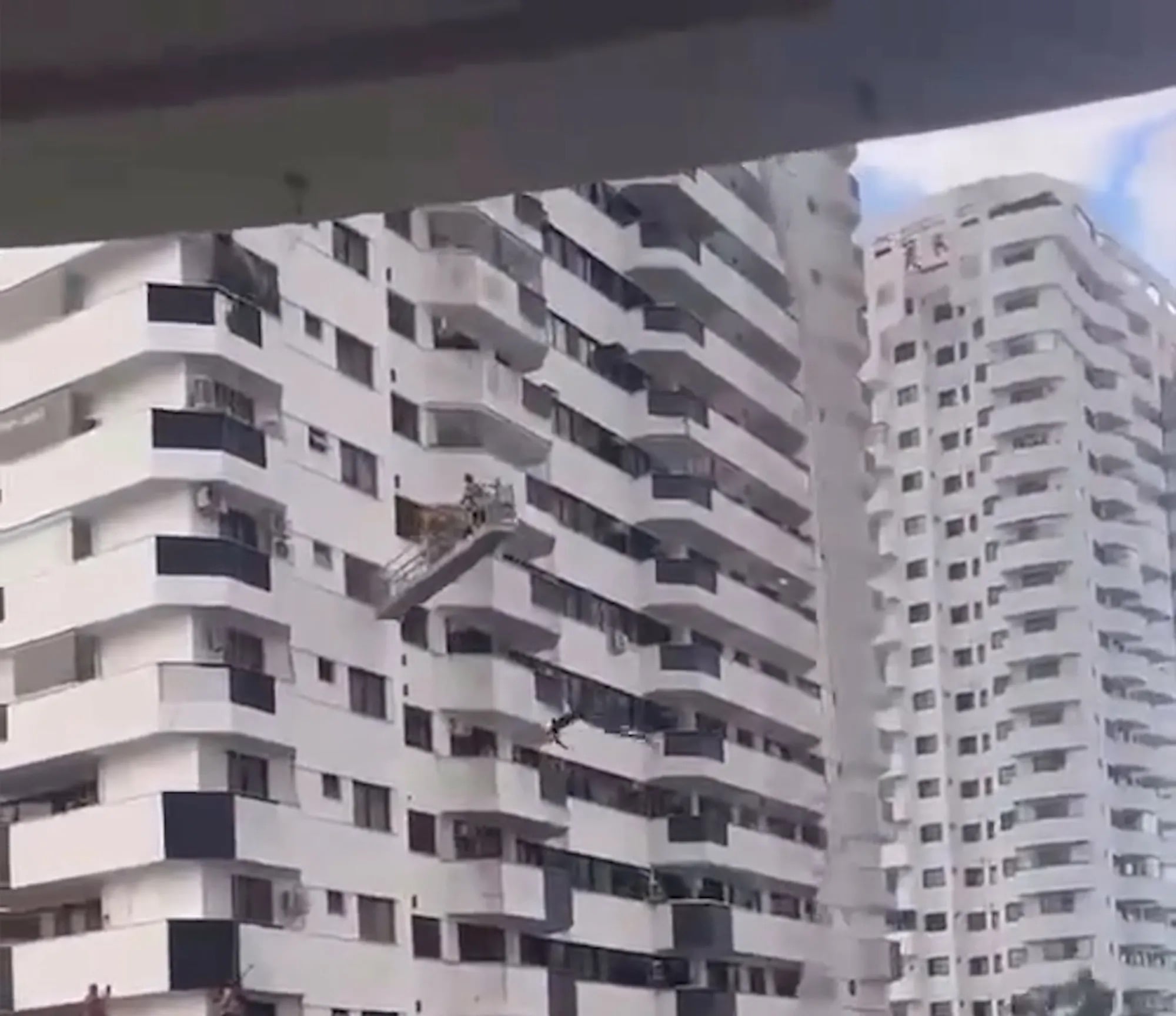
Three maintenance workers were left dangling 70 feet above the ground in Rio de Janeiro after ferocious winds sent their suspended platform crashing repeatedly into a high-rise tower, before they managed to scramble to safety through an apartment balcony.
Three terrified workers were left clinging to a suspended platform 70 feet above the ground after powerful winds sent it slamming repeatedly into a high-rise building in Rio de Janeiro. The men were battered by gusts topping 62mph as their platform, known as a gondola or Building Maintenance Unit (BMU), was hurled violently against the Apple Bali tower at the Barra Bali condominium in the Barra da Tijuca neighbourhood, in the city’s West Zone, on 29 July.
Dramatic footage of the ordeal
Footage filmed by a resident shows the platform buckling violently between the seventh and eighth floors of the tower as it is repeatedly thrown against the building’s facade by the ferocious winds. At one point, debris can be seen falling as the platform spins uncontrollably in the extreme conditions.
Gondolas of this kind are commonly used for window cleaning and façade maintenance on high-rise buildings, and are designed to be secured against strong winds. Occupational safety guidance generally requires work on suspended platforms to be halted once wind speeds reach unsafe levels, as strong gusts can cause the platforms to swing uncontrollably and collide with the structure they are working on.
How the workers escaped
The trapped men eventually seized a chance to escape when the swinging platform came close enough to a seventh-floor apartment balcony. They managed to grab hold of the concrete railing and pull themselves towards safety, anchoring the structure before climbing over the balcony ledge to reach the apartment. The three workers sheltered inside for around an hour as the winds gradually began to ease, before leaving the building safely via the internal lift.
The Rio de Janeiro Fire Department was not required to carry out a rescue, as the workers reached safety on their own before emergency crews needed to intervene. Safety experts say workers on suspended platforms should be fitted with full-body harnesses attached to independent lifelines, providing an added layer of protection should a platform become unstable or suffer a mechanical failure. The incident has renewed calls for contractors to monitor weather forecasts closely and suspend exterior high-rise maintenance work whenever severe wind warnings are in place.
A city battered by extreme weather
The incident occurred as a powerful storm swept through Rio de Janeiro, triggered by a strong cold front moving across southeastern Brazil that brought gale-force winds exceeding 100kph, heavy rain and unusually low temperatures for the region. Rio’s City Hall placed the city under a Stage 2 alert, indicating a high risk of operational disruption, and urged residents to avoid unnecessary travel while the severe conditions continued.
The storm caused widespread disruption across the metropolitan region, including power cuts, disruption to train and metro services, and the closure of Santos Dumont Airport, alongside numerous fallen trees. Emergency services responded to dozens of weather-related incidents throughout the city, including structural damage and power outages. Two people were killed in the Santa Teresa neighbourhood after being struck by a collapsing wall during the storm, according to firefighters. By late afternoon, the strongest winds had begun to subside, though rain remained in the forecast for the evening.
A similar incident abroad
The scare in Rio follows a similarly terrifying incident in which a window cleaner was killed after being violently thrown against a high-rise building. Two window cleaners had been working from a gondola in Surabaya, a city on the eastern side of Java, Indonesia, when heavy rain and strong winds struck the area on Monday. Footage from the scene showed the gondola swinging violently against the building as fierce winds swirled around the tower.
