



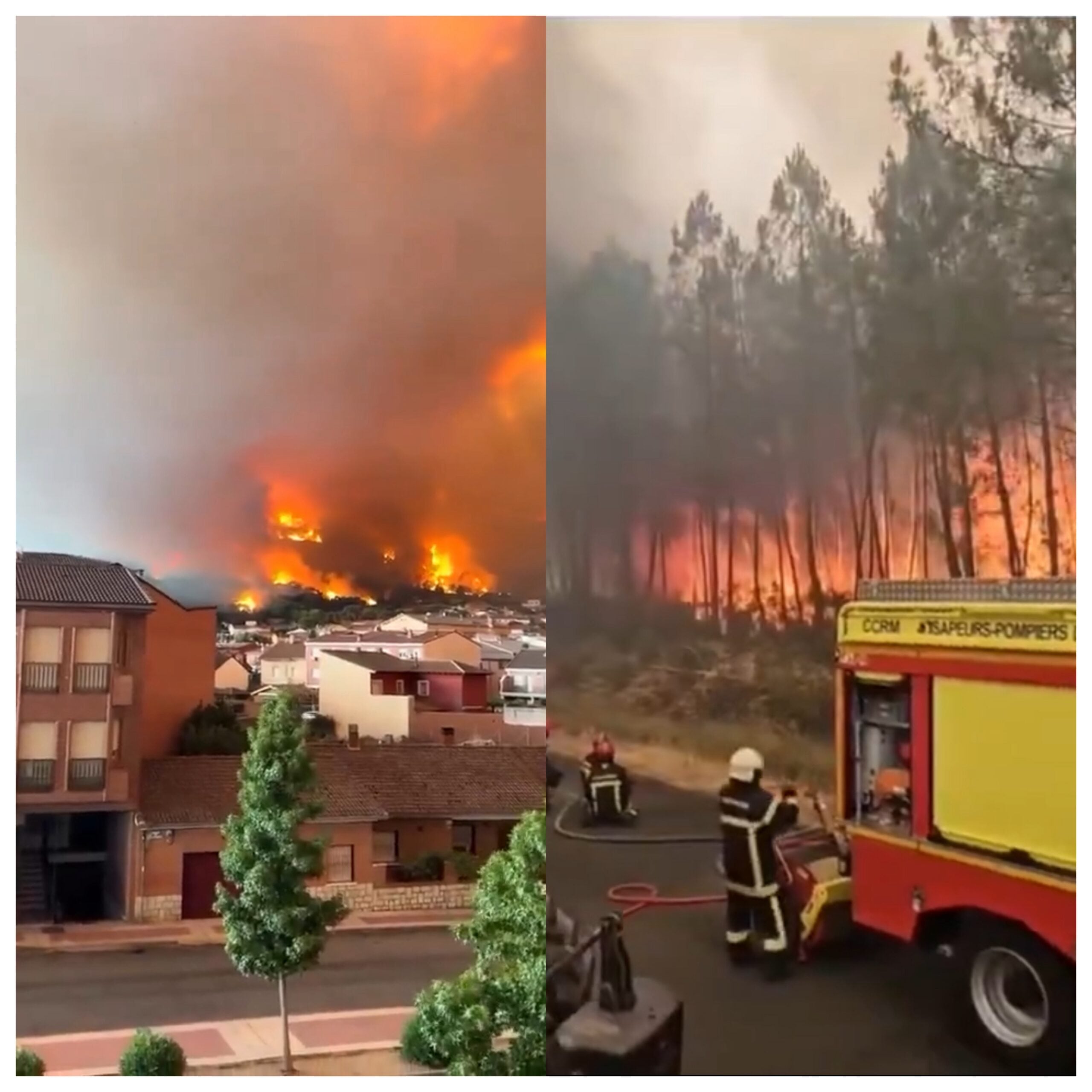
As fires sweep across Spain and France, questions are circulating online about what causes them — and why rain-making technology isn’t used to extinguish them. Here’s what the science actually says.
Europe is in the grip of one of its worst wildfire emergencies in years. More than 267,000 people have been forced from their homes by wildfires raging in France and Spain, with CNN reporting the displacement figure has since passed 300,000 after new evacuation orders were issued. Spain has declared a national emergency after a massive wildfire west of Madrid — described by regional president Isabel Díaz Ayuso as the “worst fire in the history of the region” — burned through around 15,000 hectares across Madrid and neighbouring Ávila province. In France, Prime Minister Sébastien Lecornu said around 30 wildfires were burning simultaneously, with nearly 100,000 hectares already destroyed — a level he called “unprecedented”.
The images are dramatic, and the questions they prompt are understandable: why does this keep happening, is anyone setting these fires deliberately, and why can’t modern technology — cloud seeding in particular — simply make it rain over the flames? This explainer sets out what is known.
How bad is this year — and is it getting worse?
The trend is clear. According to the World Health Organization’s European office, the amount of land burned by wildfires across Europe has increased by 57 per cent in four years, with 2.2 million hectares destroyed in the WHO’s European Region in 2025, up from 1.4 million in 2022. In Spain and Portugal alone, the number of wildfires has more than doubled since last year.
The current outbreak follows a record-breaking June heatwave, with above-average temperatures expected to persist. Spanish Prime Minister Pedro Sánchez has warned the season is worsening, pointing out that the total area burnt this year had jumped from 130,000 to 150,000 hectares in less than 24 hours.
What actually causes Europe’s wildfires?
Wildfires need three things: fuel, dry conditions and an ignition source. The fuel is vegetation, which builds up where land is no longer grazed or managed. The dry conditions come from heat and drought — Spain has seen a series of blazes in recent days as a heatwave and dry conditions have heightened the risk of fast-moving fires, particularly in scrubland areas where dry vegetation has fuelled the flames.
The ignition itself is very often human, though rarely dramatic. As the Associated Press notes of the Madrid fires, authorities have not identified the cause, and fires can be started by sparks from agricultural machinery, lightning strikes, an errant cigarette or even intentional arson.
So are the fires ‘planned’?
Individual fires are sometimes started deliberately or through reckless behaviour — and when they are, arrests follow. In the current Spanish emergency, one person has been arrested by Spain’s Civil Guard in connection with the Burgohondo wildfire, with investigators examining whether heavy machinery sparked the blaze during a period of fire restrictions.
But the leap from “some fires involve criminal or negligent behaviour” to “wildfires across Europe are being coordinated” is not supported by evidence. Investigators in each country examine ignition points case by case, and their findings point to a mixture of accident, negligence, natural causes and isolated criminal acts — not an orchestrated campaign. No plot is required to explain why the same regions burn each summer: when a heatwave leaves vegetation tinder-dry, almost any spark, however it originates, can become a major fire. Climate conditions do the work — which is why the WHO’s Hans Kluge has warned that “as climate change drives a warming world, we need to prepare for more frequent and intense wildfires”.
Why can’t cloud seeding put the fires out?
Cloud seeding cannot “shoot down” a wildfire, and the reason is built into how the technique works.
Cloud seeding involves dispersing particles — most commonly silver iodide — into existing clouds to encourage droplets or ice crystals to form and fall as precipitation. The crucial word is existing. Seeding does not create clouds; it can only give a modest boost to clouds that are already moisture-laden and close to raining. Even then, the increase in rainfall is limited, hard to measure and impossible to aim at a specific patch of burning ground.
Wildfire weather is precisely the opposite of cloud-seeding weather. Fires take hold during heatwaves and droughts, when skies are hot, dry and largely cloudless — with no suitable clouds overhead, there is nothing to seed. And even if a seedable cloud drifted over a fire zone, the light rainfall seeding might produce would do little against an intense blaze, which generates enormous heat and can evaporate light rain before it lands. Large fires can even generate their own violent weather — pyrocumulonimbus clouds — producing erratic winds and dry lightning that spread flames rather than dousing them.
In short: cloud seeding isn’t being withheld from firefighting. It simply isn’t a firefighting tool.
What is actually being used?
The real response is less futuristic but far more effective — and it is on full display right now. In Spain, the national emergency declaration allowed additional resources to be deployed more quickly and placed the Military Emergency Unit in charge of coordinating the response. In France, 1,400 firefighters, 1,500 military personnel and 1,700 internal security forces are working to extinguish fires and secure evacuated areas, with about 2.5 million filtering face masks being distributed to address health concerns from smoke. The French army has been drafted in to help, while President Macron has asked the European Union for assistance.
Alongside water-bombing aircraft, firebreaks and early-detection systems, the last resort remains evacuation — and when fires outpace containment, as the Madrid emergency chief Carlos Novillo admitted the blaze near the capital was “at its peak and currently beyond the capacity of firefighters to contain”, getting people out becomes the priority.
The bottom line
Europe’s wildfires are driven by hot, dry conditions, abundant fuel and — in most cases — human ignition, whether careless or criminal. Individual suspects are arrested and investigated; evidence of a coordinated continental plot does not exist. And cloud seeding, whatever its uses elsewhere, cannot extinguish fires burning under the clear, dry skies in which wildfires thrive. The unglamorous truth is that firefighting still comes down to aircraft, firebreaks, land management, early detection and, when all else fails, evacuation.
