



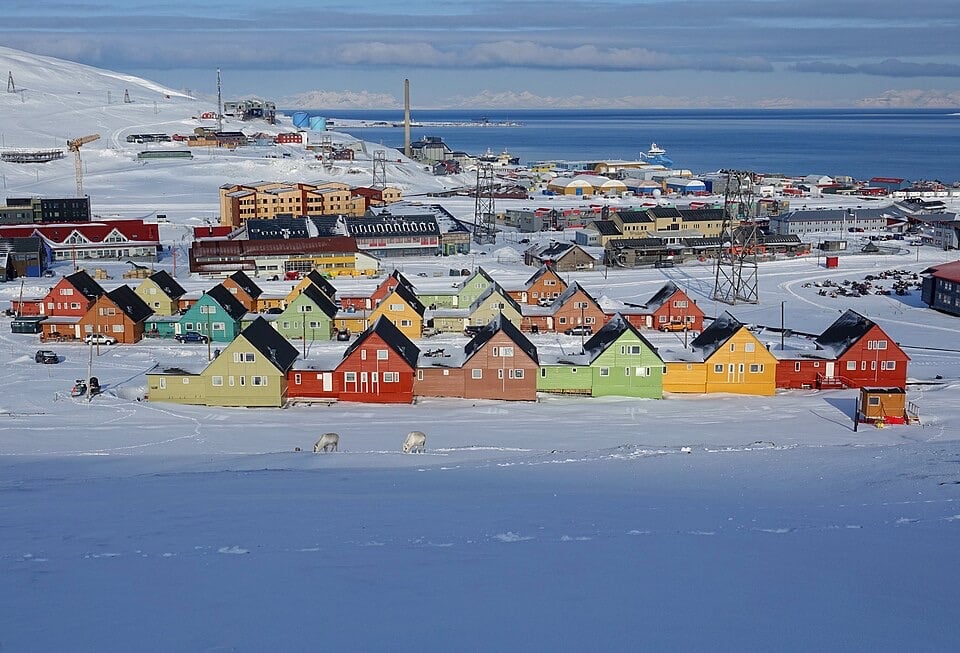
Longyearbyen, a remote Arctic settlement in Norway’s Svalbard islands, has built its reputation as one of the world’s loneliest towns around a set of highly unusual rules, from a longstanding restriction on new burials to a ban on keeping cats.
Perched at the top of the world, the Norwegian town of Longyearbyen could easily be mistaken for the loneliest place on Earth. Situated at a latitude of 78 degrees on the Svalbard islands, it holds the distinction of being the world’s northernmost permanently inhabited settlement, sitting just over 1,000km from the North Pole. With polar bears and reindeer roaming freely around its edges, daily life in Longyearbyen follows an unusual set of rules shaped almost entirely by its extreme Arctic environment.
A town of extremes
Nestled in a valley on the shore of the Adventfjord, surrounded by mountains and glaciers, Longyearbyen has recorded temperatures as low as -46.3C. Its location also means the town experiences 24 hours of continuous daylight between April and August, followed by 24 hours of total darkness through October and February, a period known locally as the Polar Night. During this time, residents are encouraged to wear high-visibility clothing, given the near-total darkness and limited street lighting.
Despite its harsh climate, Longyearbyen is home to just over 2,500 residents, all of whom rely on a single grocery store within the town’s roughly four-square-mile boundary. The settlement also has a kindergarten, a school, a church, a post office and a gourmet restaurant, alongside brightly coloured houses set against a backdrop of snow-capped mountains.
The truth behind the “burial ban”
Longyearbyen’s best-known quirk is its long-standing restriction on burials, often described as a ban on dying in the town. In reality, it is not illegal to die there; rather, new burials in the town’s cemetery are generally not permitted. The restriction dates back to the discovery that bodies buried decades earlier had failed to decompose in the permafrost. Scientists later found that victims of the 1918 Spanish flu buried in Longyearbyen’s cemetery had remained remarkably well preserved, raising concerns that infectious pathogens could potentially survive within the frozen ground for decades.
As a result, anyone who is terminally ill is typically transferred to mainland Norway for end-of-life care, since the town lacks long-term care facilities and has no dedicated care home for the elderly. Cremated ashes can still be interred in Longyearbyen, but only with permission from local authorities.
Life under unusual rules
Beyond the burial restrictions, Longyearbyen operates under a number of other distinctive regulations. Cats are banned entirely, a rule designed to protect Svalbard’s fragile Arctic ecosystem, particularly its ground-nesting bird populations, from predation. Alcohol purchases are similarly controlled: tourists can buy beer and spirits only by showing a valid airline ticket, while permanent residents are subject to monthly quotas on certain alcoholic drinks.
Anyone travelling beyond the town’s boundaries is required to carry a firearm for protection against polar bears, and visitors are strongly advised never to venture outside the settlement without an experienced guide, given the genuine danger the animals pose in the surrounding wilderness. Drinking water directly from rivers or streams is also discouraged, owing to the risk of a rare but dangerous tapeworm parasite found in Arctic wildlife.
Many public buildings in the town, including some hotels, museums, libraries and restaurants, ask visitors to remove their shoes before entering, a tradition rooted in Longyearbyen’s coal-mining history, originally intended to stop coal dust being tracked indoors.
A hub for science, tourism and culture
Over the years, Longyearbyen has developed into a significant research and educational centre, home to a university where students can study Arctic biology and geophysics, alongside a North Pole Expedition Museum. The town is also home to the Svalbard Global Seed Vault, often referred to as the “Doomsday Vault,” which stores more than 1.3 million seed samples from around the world as a safeguard against the loss of global crop collections.
The settlement now welcomes more than 100,000 tourists annually, most arriving via a three-hour flight from Oslo. Despite its remote location, Longyearbyen hosts a surprising range of cultural events throughout the year, including blues, jazz, literature and food festivals, alongside concerts and other gatherings.
A transient, international community
Longyearbyen’s population is notably international, drawing residents from around 50 different nationalities, making it one of the most diverse small communities in the world relative to its size. However, most residents do not stay long term, with the average person living in the town for only around seven years before moving on, often having relocated there for research, tourism or specialist work.
Practical life in the settlement comes with its own quirks: there are no banks or cash machines anywhere in Longyearbyen, and visitors are advised to rely on bank cards rather than cash. Svalbard is also a tax-free zone, meaning residents and visitors pay no VAT on goods purchased locally, although imported fresh food is often expensive due to the cost of transporting it from mainland Norway.
The end of an industrial era
Until 2025, Longyearbyen was home to Norway’s last operating coal mine, known as Mine 7. Its closure brought to an end more than a century of Norwegian coal mining in Svalbard, with tourism and scientific research now serving as the town’s primary industries.
During the winter months, snowmobiles significantly outnumber people and serve as the main form of transport outside the settlement, since many roads disappear beneath heavy snowfall. The town maintains dedicated snowmobile routes running alongside its regular roads to keep snowmobile traffic separated from vehicles. Drone flights are prohibited throughout much of the Longyearbyen area, including within a 5km radius of the airport, both for aviation safety and to limit disturbance to local wildlife.
