



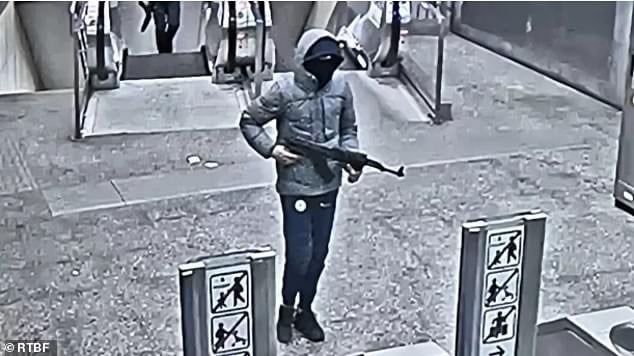
From a French mayor forced into police protection to a Belgian port overrun by cartel corruption and a record-breaking cocaine submarine seized off Portugal, Europe is grappling with an escalating wave of organised crime violence as drug gangs tighten their grip across the continent.
Drug cartels are increasingly terrorising communities across Europe, threatening public officials, infiltrating major ports and fuelling levels of violence rarely seen on the continent before. In France, the mayor of Alès was placed under police protection this week after intelligence suggested an imminent attack by the country’s dominant drug gang. In Belgium, legally grown Canadian cannabis is flooding into the port of Antwerp through a smuggling network linked to Chinese organised crime. Meanwhile, Spain has overtaken Belgium and the Netherlands as Europe’s primary cocaine gateway, according to the EU Drugs Agency, a shift blamed for a surge in gang violence along its southern coast.
France cracks down as threats escalate
Christophe Rivenq, the 60-year-old mayor of Alès in southern France, was removed from his home overnight on Tuesday and placed under police protection after French Interior Minister Laurent Nunez said credible intelligence pointed to an imminent attack against him by the DZ Mafia, France’s leading drug trafficking organisation. The gang, which originated in Marseille roughly 160 kilometres south of Alès, has grown rapidly from a local operation into one of the country’s most serious security threats through its control of the drug trade.
Rivenq had already been targeted earlier this month, when 9mm bullets were left in his mailbox alongside threatening graffiti daubed on his home, according to France’s National Prosecutor’s Office for the Fight Against Organised Crime (PNACO). “I’ve never received threats on this level,” Rivenq said in a statement. “This shows that the actions we’re taking against DZ and drug trafficking are paying off. I will not be intimidated.” PNACO itself was established in January 2026 specifically to coordinate investigations into drug trafficking, money laundering and other serious organised crime offences.
Days later, reality television star and influencer Carla Moreau, 29, received a threatening letter from the gang at her home in Marseille after her car was set alight overnight. Prosecutors have opened an investigation into suspected extortion after the message, delivered alongside a mobile phone, was found to contain death threats.
The scale of the problem is reflected in the growth of France’s illicit drug market, which nearly tripled in value between 2010 and 2023, rising from an estimated €2.3 billion to €6.8 billion, according to a December 2025 report by the French Monitoring Centre for Drugs and Drug Addiction (OFDT). French Justice Minister Gérald Darmanin has previously described the country as suffering a “cancer” of drug dealing, warning there are no “safe places” left. “Drugs, for example, have always existed, but today we can clearly see that in the smallest rural town, they know about cocaine, cannabis,” he said. “It’s no longer just in the places where we were looking for the potential problem.” In response to the growing threat, the French government has announced plans to build high-security prisons specifically for the country’s most dangerous traffickers, aimed at preventing them from continuing to direct criminal operations from behind bars.

Belgium’s Antwerp becomes a smuggling superhighway
In neighbouring Belgium, an investigation by The Telegraph found that cannabis farms legalised under former Canadian Prime Minister Justin Trudeau are supplying smugglers with high-potency marijuana destined for the port of Antwerp. Customs officials seized 32 tonnes of cannabis at the port in 2025, a 500% increase on the previous year, and a further 10.8 tonnes had already been seized in the first six months of 2026.
The smuggling operation is reportedly managed by Chinese state-linked criminal networks. Officials told The Telegraph that gangs are paying corrupt dock workers up to £40,000 to divert six-metre shipping containers carrying the drugs to different areas of the port, allowing them to bypass customs inspections. Once inside Belgium, the cannabis is transported onward to the Netherlands, Germany, France and Italy via lightly monitored land routes. Cocaine is also smuggled through the port in large volumes, most of it originating in Colombia, Ecuador, Panama, Paraguay and Brazil.
Despite intensified customs checks and the installation of advanced container-scanning technology, Antwerp remains Europe’s largest entry point for cocaine by volume. In response, Belgian authorities have significantly increased security at the port, adding extra customs officers, AI-assisted cargo screening and stricter vetting procedures for dock workers, in an effort to tackle corruption linked to organised crime.
Violence, intimidation and a “parallel force”
Antwerp has become an increasingly dangerous battleground, with criminals armed with assault rifles and hand grenades blackmailing and intimidating public officials in an effort to keep drug shipments out of police hands. Some officials have been placed under police protection after being followed and targeted with attempted bribes.
Senior Belgian judge Bart Willocx warned earlier this year that, without urgent action, innocent civilians risk being caught up in the violence. His court published an open letter last October from an anonymous judge who said mafia groups had effectively taken hold of the country, describing them as “a parallel force that challenges not only the police, but the judiciary.” Guido Vermeiren, prosecutor general for the Antwerp and Limburg regions, echoed those concerns, saying Belgium had become a place defined by “threats” and “corruption.”
Speaking to The Guardian, Willocx described the devastating impact of the drug trade on Belgian society, including on children as young as 13 who have been bribed by gangs to steal cocaine from the port. “We really have a problem and we should make more investments in staff and in other resources to cope with it,” he said. He added that port employees who refuse to cooperate with gangs face serious consequences, saying some had “received letters, photos of their children” and experienced “attacks at their homes with homemade explosives.”
Years of gruesome violence
Gang violence linked to the drug trade has plagued the region for years. In October last year, the dismembered body of Tijn, a 25-year-old man who had gone missing from Alkmaar in September, was discovered at a holiday home in Belgium, with reports suggesting his death was connected to a drugs dispute.
In 2022, 46-year-old Yacine El M’Rabet was tortured to death in Brussels after allegedly stealing cocaine from his bosses, Michaël Pindeville and Ahmed El Battouti. He was found on the street having reportedly been burned with an iron and a homemade blowtorch, doused in ammonia, beaten with a gas canister and a metal bar, and raped with the same bar. That same year, Dutch media reported that a 17-year-old had part of his earlobe cut off, tendons in his hand severed and a piece of a toe removed, after being suspected of tipping off a rival gang to the location of 300kg of cocaine in East Flanders.
In one particularly harrowing case, an 11-year-old girl was shot dead in Antwerp’s Merksem district in 2023 after being caught in crossfire between warring drug traffickers while having dinner with her family at home.
In 2020, Dutch police uncovered a soundproofed shipping container nicknamed the “treatment room” by criminals, found in a warehouse in Wouwse Plantage, a village in the southwestern Netherlands close to the Belgian border. Inside was a dentist’s chair fitted with restraints, along with pliers, scalpels and handcuffs. Six further containers at the site were lined with foil to avoid detection by thermal imaging cameras, with some fitted with chemical toilets to hold prisoners. Police said the chamber had not yet been used. The discovery followed the cracking of the encrypted phone network EncroChat, which led to the arrest of 746 organised crime figures in Britain alone.
Spain overtakes Belgium as Europe’s cocaine gateway
According to the EU Drugs Agency, Spain has now overtaken Belgium and the Netherlands as Europe’s primary cocaine entry point, a shift that law enforcement officials say is driving unprecedented levels of violence. Spain’s long Atlantic coastline and historic ties to South America have long made it a natural entry point for illicit cargo, while the narrow nine-mile stretch of water separating Morocco from the southern port of Algeciras, easily crossed by high-powered boats within minutes, has made the country the main corridor for hashish entering Europe.
Once known chiefly as a bolthole for Britain’s most wanted criminals, Spain’s “Costa del Crime” has become a front line in the battle between narco gangs and Spanish police. Shootings, high-speed chases and violent punishments have become alarmingly common along the country’s southern coastline.
Earlier this year, Spanish police uncovered a sophisticated underground tunnel network used to smuggle tonnes of hashish from Morocco into Europe, hidden beneath an industrial warehouse in the North African exclave of Ceuta. The passage was fitted with pumping systems and soundproofing to avoid detection, and investigators described it as a remarkable feat of engineering, featuring multiple levels, rail tracks and heavy-duty lifting equipment designed to move large quantities of drugs across the border. Authorities believe the network was capable of transporting significant volumes of drugs into mainland Spain and onward across Europe.
Violence linked to the trade has continued to escalate. Last summer, two Scottish gangsters were shot dead in a bar popular with expats in southern Spain, and days later a Swedish rapper was gunned down outside a café in front of terrified holidaymakers. In September, footage filmed by tourists on Playa Ancha in Casares showed at least six men calmly unloading what appeared to be bales of drugs from a speedboat onto a waiting vehicle in front of stunned beachgoers.
Record cocaine haul seized off Portugal
In January this year, Portuguese authorities intercepted a “narco submarine” carrying a record haul of cocaine believed to be worth £520 million, roughly 265 miles off the Azores archipelago in the North Atlantic. Nearly nine tonnes of narcotics were seized in the operation, which a police spokesperson described as “the biggest seizure of cocaine ever in Portugal.” Officers were assisted by the Portuguese navy and air force, as well as UK and US authorities, working in difficult weather conditions. The submersible eventually sank during the operation, taking 35 of the 300 packages of drugs to the seabed as police attempted to board it. The vessel had travelled from Latin America and was carrying three Colombian nationals and one Venezuelan, all of whom were arrested.
The scale of Europe’s drug crisis
According to the European Union Drugs Agency (EUDA), the EU cocaine market is now worth more than €13 billion annually, making it the largest illicit drug market on the continent. Europol has warned that organised crime groups are becoming increasingly networked across borders, with criminal organisations from the Balkans, Latin America, North Africa and the Middle East now cooperating directly on trafficking operations. The agency has also flagged growing use of encrypted messaging platforms, drones and cryptocurrency by gangs seeking to coordinate smuggling operations and launder drug profits.
The EUDA has further warned that record levels of cocaine production in South America, particularly in Colombia, continue to drive rising availability and violence across Europe, with criminal networks increasingly expanding their operations beyond major cities and into smaller towns and rural areas.
