



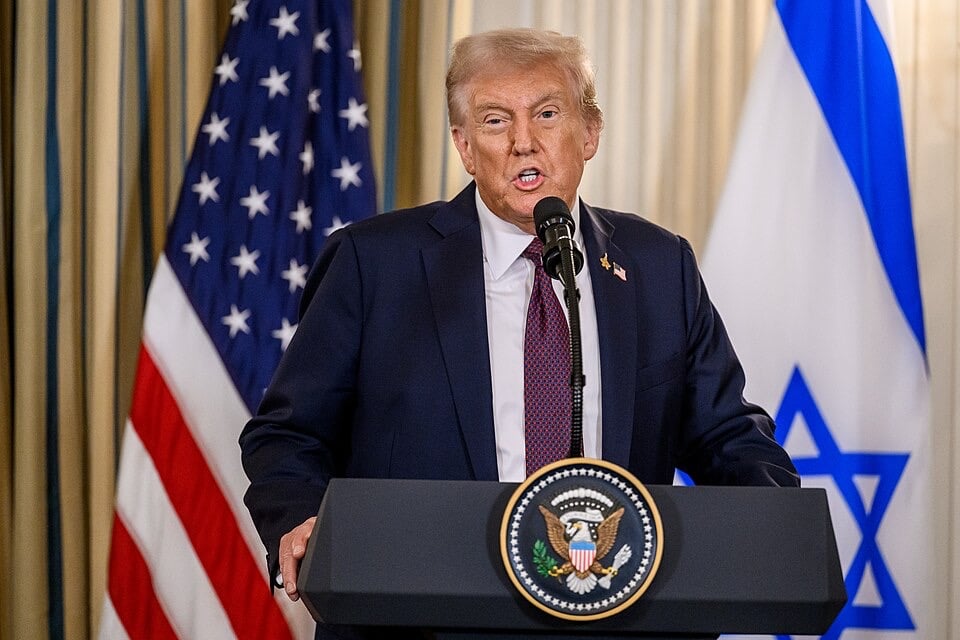
President Donald Trump used a dramatic primetime address to allege that China had illicitly obtained 220 million US voter files in what he called the largest compromise of election data in history, while several major broadcasters declined to air the speech live. The address also touched on alleged Venezuelan efforts to manipulate vote totals, and formed part of the administration’s wider push for the SAVE America Act.
Speaking from the Oval Office, Trump made his central allegation directly. “The People’s Republic of China carried out what is believed to be the largest compromise of election data in history, resulting in China’s illicit acquisition of 220 million U.S. voter files,” he said, adding: “That information includes names, addresses, phone numbers, political party preferences, and other sensitive data.” According to the White House, the alleged breach is said to have begun during the 2020 election cycle, and officials described it as an “unprecedented election security nightmare.” During the address, Trump also claimed that US intelligence agencies had withheld information about the alleged breach from him during his first term, accusing elements of the intelligence community of involvement in a cover-up.
Networks decline to air the speech live
The address drew scrutiny before it even began, with several major US television networks, including ABC, NBC and CNN, declining to broadcast it live or limiting their coverage, citing concerns about airing unverified election claims. Trump criticised the decision directly during his remarks. “In a rare move, NBC and ABC fake news have both said that they would not cover this speech,” he said. “They know how corrupt our system is and … They and others in the media are part of a plot.” ABC and NBC ultimately chose to stream the remarks rather than broadcast them on their main networks.
What US intelligence has previously found
The claims sit at odds with prior US intelligence assessments. A March 2021 intelligence report concluded that while China had considered influence operations targeting the 2020 election, Beijing ultimately did not deploy such efforts. No evidence has been established of voting machine insecurity or fraud in the 2020 election. Despite this, Trump used the address to allege that China had wanted him to lose the 2020 contest, referencing his administration’s trade policy at the time: “I was wise to them, charged them billions and billions of dollars worth of tariffs,” he said.
Claims about Venezuelan interference
Trump also raised allegations involving Venezuela during the speech, citing a CIA report he said had been declassified on Thursday. According to Trump, the report showed that the government of Nicolás Maduro had developed methods to digitally alter vote totals in ways that “could not be detected, even with an audit, no matter how deep they went.” The same 2021 intelligence assessment referenced elsewhere in reporting on the claims found that while Maduro may have wanted to sway US public opinion against Trump during the 2020 election, Venezuela lacked the actual capability to do so.
Part of a long-running dispute over the 2020 result
Trump has maintained for close to a decade that he won the 2020 election against Joe Biden, and his administration has been investigating the circumstances of that loss, including the seizure of election records in Fulton County, Georgia. The White House invited senior national security officials to attend the primetime address, including leaders from the CIA, FBI, the Office of the Director of National Intelligence, and the Department of Homeland Security.
Reaction from Republicans and Democrats
The speech prompted a strong reaction among Trump’s supporters. Ohio Republican Senator Bernie Moreno wrote on X: “This may be the most important Oval Office address since the Cuban Missile Crisis. The time for complacency with China is over.” Democrats, by contrast, characterised the address as a repetition of Trump’s long-standing grievances, arguing his claims lacked supporting evidence.
Polling suggests the president’s claims continue to resonate strongly within his own party. According to an April Reuters poll, nearly two in three Republicans, 63 per cent, agreed that the 2020 election was stolen from Trump through fraud, compared with 21 per cent of independents and just 9 per cent of Democrats who held the same view.
Link to the SAVE America Act
The address came against the backdrop of the administration’s continued push for the Senate to pass the SAVE America Act. If passed, the legislation would require documentary proof of US citizenship to register or update voter registration for federal elections, mandate the removal of non-citizens from voter rolls, and require states to check federal databases to verify voter eligibility. The bill has already passed the House but remains stalled in the Senate, where it would need 60 votes to pass, including support from a number of Senate Democrats. Critics argue the bill would create barriers preventing eligible voters from casting ballots, while supporters maintain it is necessary to secure the electoral process.
Build-up to the address
The White House first announced the primetime address on Monday, offering few details about its focus. The following day, Trump offered a preview of what was to come, telling reporters: “What we’re going to talk about Thursday, it doesn’t get bigger because without free and fair elections, you don’t have a country. We’ll be discussing other things too, but it’s going to be a very big announcement.” White House Press Secretary Karoline Leavitt struck a similar tone ahead of the speech, saying the US “should have the safest and most secure elections in the history of the world … and what the President will be speaking about tonight will show you that perhaps that is not the case.”
