



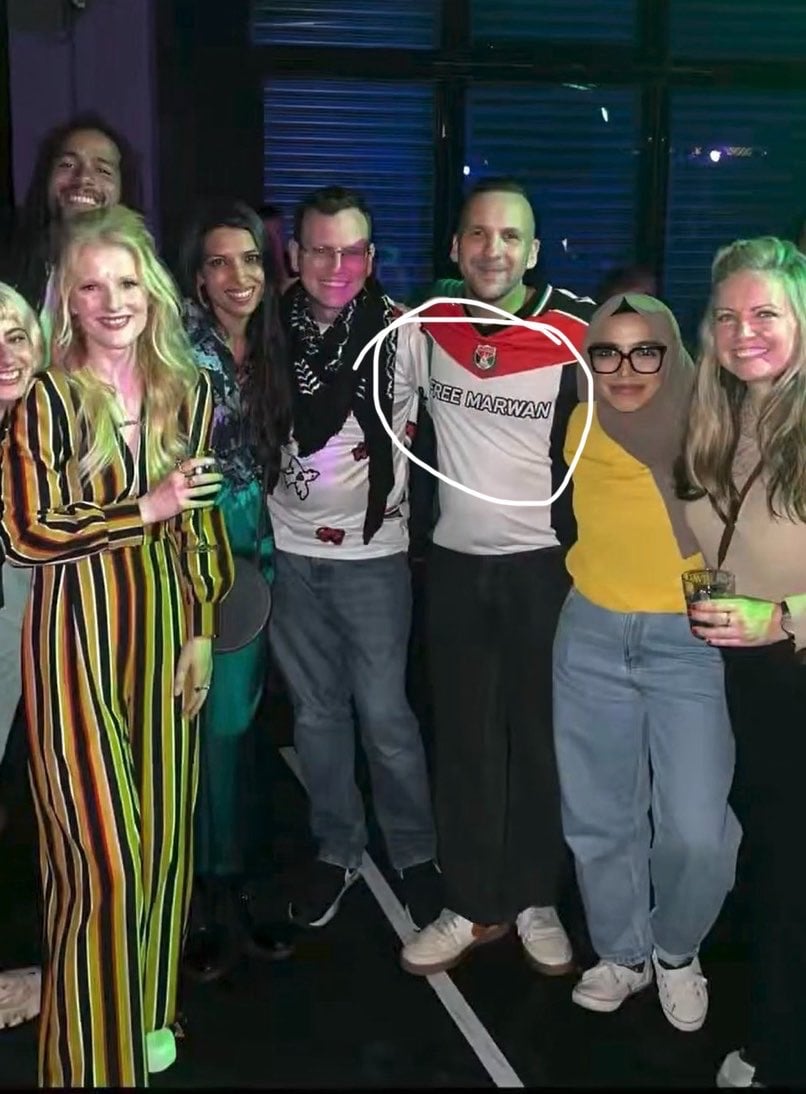
Zack Polanski, the Jewish leader of the Green Party of England and Wales, has sparked fierce controversy after being photographed wearing a “Free Marwan Barghouti” T-shirt during celebrations of the party’s record-breaking local election results — with Jewish and pro-Israel voices condemning the move as glorifying terrorism while Polanski doubled down defiantly on social media.
The photographs surfaced on Sunday evening as the Greens celebrated their most successful local election performance in the party’s history, having won hundreds of new council seats, taken control of several councils including Norwich, Hastings and parts of London, and secured the party’s first-ever elected mayors in Hackney and Lewisham. Polanski, who took over as party leader in September 2025, was photographed in the T-shirt during those celebrations.
Barghouti is a Fatah leader convicted by an Israeli court in 2004 on five counts of murder for his role in ordering and organising attacks during the Second Intifada — a period of sustained violence between 2000 and 2005 in which an estimated 1,000 Israelis, many of them civilians, were killed in suicide bombings and shootings. The victims of the specific attacks attributed to Barghouti included a Greek Orthodox monk and diners at a restaurant. He is currently serving five life sentences. He led Fatah’s Tanzim militia and was linked to the Al-Aqsa Martyrs’ Brigades.
Polanski responded to the criticism directly on X, quoting a post that described Barghouti as a terrorist who “murdered five civilians.” His reply was defiant. “Good. Let’s talk about Marwan Barghouti,” he wrote. “Imprisoned for 25 years. An inter-Parliamentary Union report found he was not given a fair trial. Nelson Mandela: ‘What is happening to Barghouti is exactly the same as what happened to me.’ Free Marwan.”
The reaction from Jewish and pro-Israel organisations was immediate and furious, with commentators and victim advocacy groups describing the shirt as an endorsement of political violence against civilians. Critics pointed to the families of those killed in the attacks for which Barghouti was convicted and argued that framing a convicted murderer as a political prisoner was a deliberate provocation made worse by Polanski’s own Jewish identity.
Supporters of Barghouti — and there are many internationally — point to an Inter-Parliamentary Union report that raised concerns about the fairness of his trial, citing alleged witness coercion and due process failures. They draw comparisons to Nelson Mandela’s imprisonment, noting that Barghouti had historically supported the Oslo Accords and is frequently described as a figure who could potentially unify Palestinian factions. Palestinian and international human rights advocates regard him as a political prisoner rather than a convicted terrorist.
Polanski has not issued any further statement beyond his X reply, and the Green Party has made no official comment on the photograph. The incident arrives at a politically charged moment — the Greens have surged in urban areas partly by attracting voters disillusioned with Labour’s handling of the Gaza conflict, and Polanski has steered the party toward increasingly vocal pro-Palestinian positions since taking the leadership. The T-shirt, worn at the moment of the party’s greatest electoral triumph, is unlikely to have been an accident.
