



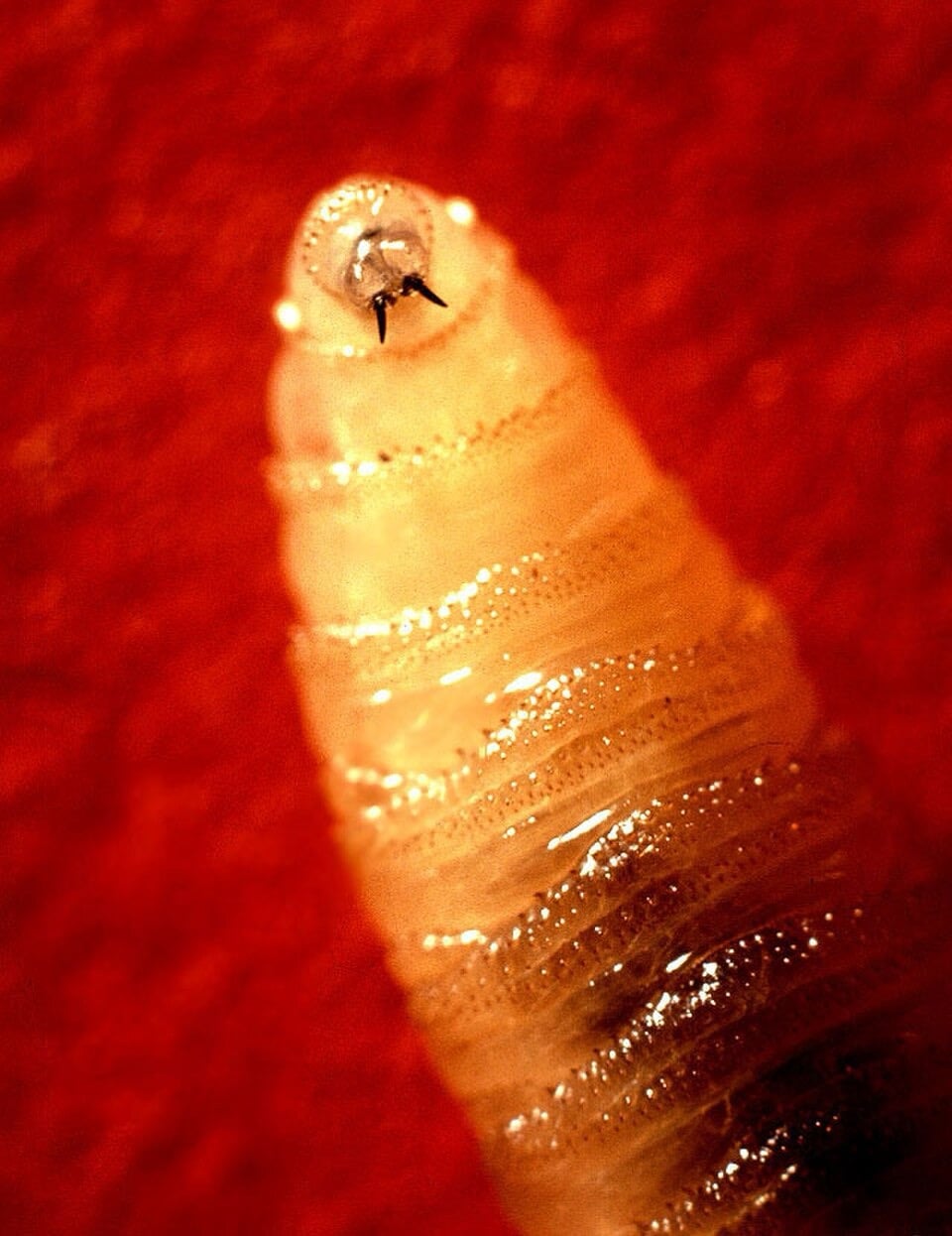
A flesh-eating parasite that was eradicated from the United States more than four decades ago has been confirmed on American soil for the first time since 1966 — triggering a quarantine zone in Texas and raising alarm across the country’s multi-billion dollar livestock industry.
The New World Screwworm, a parasitic fly whose larvae burrow into living tissue and consume their host from the inside, has been detected in a three-week-old calf in LaPryor, Texas, approximately 50 miles from the Mexican border. Agriculture Secretary Brooke Rollins confirmed the case and said a 12-mile quarantine zone had been established, prohibiting the movement of any warm-blooded animal — including pets — outside the zone without a prior inspection.
The parasite’s method of attack is as effective as it is disturbing. A female screwworm fly lays between 200 and 300 eggs at a time in an open wound or body orifice — attracted by the scent of exposed tissue — with entry points as small as a tick bite, a newborn’s navel or a nasal passage, according to the Texas Parks and Wildlife Department. The eggs hatch within hours into larvae that bore into the flesh in a corkscrew motion, consuming living tissue as they go. A single female can lay as many as 3,000 eggs over her lifetime. If left untreated, infestations lead to deep, painful wounds, severe infection and frequently death.
The parasite has been advancing northward through Mexico for the past year, with cases confirmed as close as 25 miles from the US border in the days before the Texas detection. Rollins had held an online news conference just 24 hours before the confirmation to outline the USDA’s containment efforts, which have included dropping millions of sterile screwworm flies across the region to mate with wild females — the same method used to successfully eradicate the parasite the first time around. Despite the confirmed case, Rollins said the USDA was “confident there is no threat of mass infestation” and that there was “no reason to believe this incursion will result in the establishment of the pest in our country.”
Texas Governor Greg Abbott had already issued a disaster declaration in February as the threat drew closer, granting the state greater authority and resources to respond. Texas Agriculture Commissioner Sid Miller urged ranchers and families along the southern border to remain vigilant and inspect all warm-blooded animals immediately if larvae infestation was suspected. “The New World Screwworm is inching closer to Texas each and every day, and we must be proactive in responding to this threat,” he said.
The economic stakes are significant. When screwworms were a major problem in the United States before their eradication, they cost the country $200 million — the equivalent of approximately $1.8 billion today — in livestock losses.
The detection in Texas is not the only recent alert. In February, the Florida Department of Agriculture found larvae in an open wound on a horse imported from Argentina. The animal was immediately quarantined. Florida officials warned that the screwworm’s return “would pose a serious threat to livestock, wildlife, and domestic animals, particularly in states like Florida with warm climates and abundant animal populations.” Miller sought to reassure the public that the Florida case did not constitute evidence of a domestic outbreak, noting it had been caught during a routine inspection of an imported animal.
While the primary threat is to livestock, the parasite can infest humans. A 2024 case in Maryland involved a patient who had recently returned from El Salvador with an active infestation — the first such case reported in a traveller arriving from a country experiencing an outbreak, according to the Department of Health and Human Services, which stressed the risk to the general public remained “very low.” KHOU 11 reported the figures on the fly’s reproductive capacity.
The screwworm was officially eradicated from the United States in 1966 following a decades-long programme. Its reappearance, even in a single confirmed case, has placed agricultural authorities across the southern states on high alert.
