



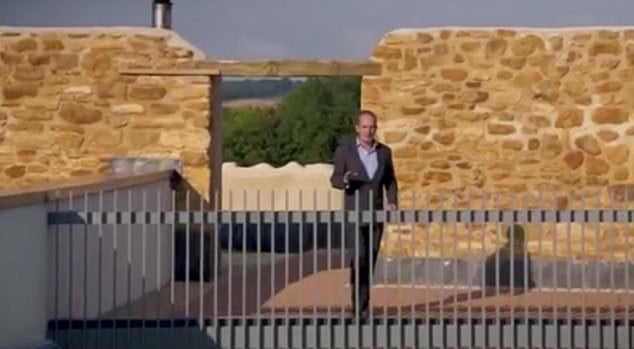
A pioneering underground eco-home that featured on Grand Designs and became England’s first certified Passivhaus property has gone on sale for £3.25 million — with the extraordinary selling point that its running costs amount to little more than £300 a year in logs and the occasional filter replacement.
Underhill House in the Cotswolds was built by architect couple Helen and Chris Seymour-Smith between 2008 and 2010, after they devised an audacious solution to appease sceptical planning officials in the protected countryside on the Gloucestershire and Warwickshire borders: restore a 300-year-old Cotswold stone barn on the site and hide the family home underground beside it. The result was effectively loft-style living buried in a hillside, near-invisible from the surrounding countryside and built to standards of thermal efficiency that have never been bettered in a British home.
The house has no radiators and no central heating system. Instead, warmth generated by sunlight, household appliances and the people living inside is captured and recirculated through a mechanical ventilation with heat recovery system — known as an MVHR — that maintains a consistent internal temperature of around 20 degrees Celsius even in the depths of winter. When snow fell on the house, it reportedly remained unmelted on the outside of the triple-glazed windows for four days. In 2010, the Seymour-Smiths achieved what was described as Britain’s best-ever airtightness score — the combined air leakage of the entire property was compared to a hole the size of a squash ball.
Current owner Glenn Jones described the experience of living in the property to researchers in a 2014 university study into Passivhaus design. “Their expenditure on electricity is nil, due to the solar panels on the roof,” the study reported. “Other than that the only cost is £300 a year on logs for the fire and a new filter for the MVHR every six months.” Jones said he was feeling “phenomenally smug” as energy bills climbed elsewhere. Hot water is provided primarily by a solar thermal system using 1,000 yards of rubber piping in the barn roof, capable of heating water to temperatures as high as 100 degrees Celsius when the sun shines, with a wood-burning stove and electric immersion heater as backup.
Helen Seymour-Smith told Grand Designs at the time that the couple had deliberately set out to avoid what she described as a “hairshirt eco-house, with composting loos,” opting instead for something “crisp, modern, white and very un-Cotswolds.” The build was followed by presenter Kevin McCloud and, unusually for the programme, passed without the dramatic setbacks that have made many Grand Designs episodes memorable. Mrs Seymour-Smith later joked: “I didn’t get pregnant and we didn’t run out of money.”
The six-bedroom, five-bathroom property sits beside the restored barn in half an acre of grounds near Barton-on-the-Heath in an Area of Outstanding Natural Beauty, and also includes five reception rooms and a cinema room. The couple sold it in 2012 for £1.4 million — more than double its £600,000 construction cost — before moving on to refurbish a Grade II-listed property in the same village. The property is now listed on Rightmove, which describes it as “one of the most architecturally and environmentally important private homes ever constructed in the English countryside.”
The site has a colourful history. It reportedly once housed a shepherd, and at one point is said to have been owned by Roger Taylor, the drummer with Duran Duran.
