



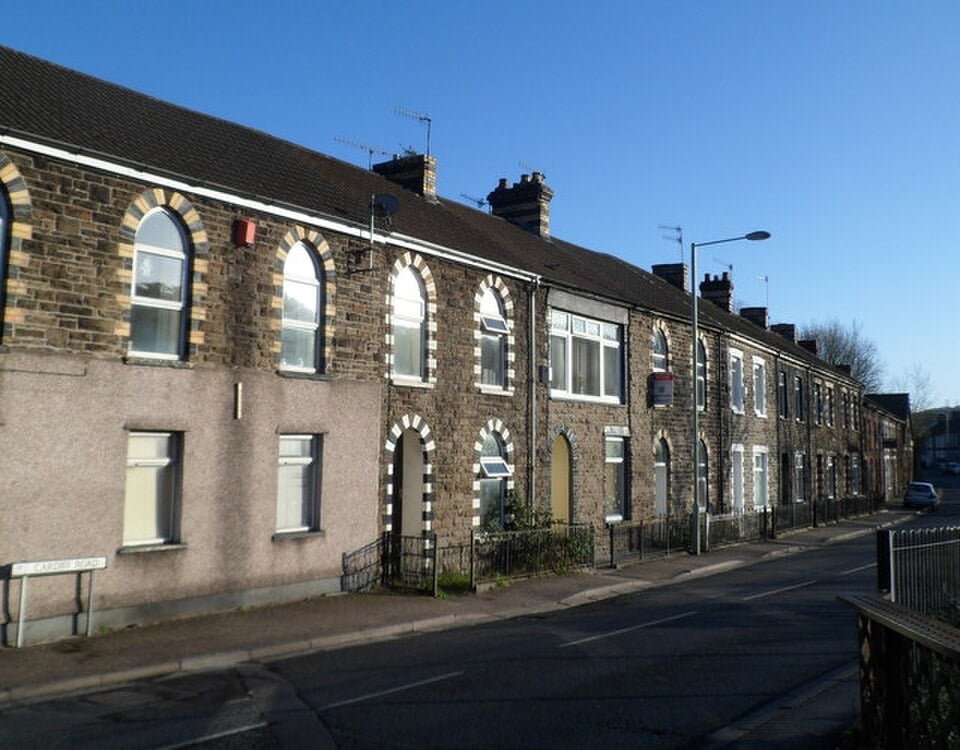
Residents of a Welsh street who developed PTSD, anxiety and claustrophobia after years of catastrophic flooding are finally leaving their homes after Rhondda Cynon Taf Council agreed to purchase most of the properties on Clydach Terrace in Ynysybwl for £2.57 million — with the entire row expected to be demolished.
The decision, approved by the council’s cabinet in February and reported by the BBC, marks what is believed to be one of the first times a local authority in the UK has bought an entire inland residential street purely as a measure of climate defence. The height of the main river in relation to the residential street presents a unique set of circumstances at Clydach Terrace, according to the council. Numbers 1-16 Clydach Terrace — apart from 6a and 6b, which sit at a higher elevation — are at severe risk from flooding from the Nant Clydach and have suffered during Storm Dennis and Storm Bert.
Natural Resources Wales explored several possible flood risk management solutions for the street, including the construction of a raised flood defence wall, but found this was not economically viable under UK and Welsh Government funding rules. With no viable defence possible and the risk increasing year on year, the council took what it described as an exceptional decision to intervene.
The human toll of years living under constant threat has been severe. Builder Paul Thomas, 66, who has lived on the street for 46 years, said he was lucky to be alive after being dragged from his home by floodwater during Storm Dennis in 2020. “The river was too powerful and it dragged me from my house to the wall. I managed to swim back across the river with wellies on. It was an absolute nightmare,” he said. He went on to develop PTSD and claustrophobia, suffering nightmares about the river and going days without sleep during flood events. Despite the relief of finally being able to leave, the feeling is mixed. “It’s so necessary for us to do — the geography of the street is a death sentence,” he said. He also revealed that Storm Dennis alone cost him £50,000 in repairs, with the financial strain of the past five years leaving a significant dent in his finances.
Delivery driver Mike Preddy, 40, who bought his home 16 years ago on a street where he and his partner played together as children, described the anxiety of recent years as “through the roof.” Sandbags have been a permanent feature outside the homes. “We’d be on edge from an amber to red warning of heavy rain, but now even a yellow warning is starting to threaten the street,” he said. “It’s just being up all night, moving furniture up and down week in week out — we couldn’t do it anymore.” He has found a new home just up the road and expects to move within weeks.
Resident Rebecca Chadwick told the council’s cabinet at the time of the decision: “No family should have to live with the constant fear that the next heavy rainfall could put their lives at risk. It is the only path that fully resolves the situation and protects the well-being of every resident of Clydach Terrace.”
Kevin Fender, 63, told the BBC: “I didn’t expect to be moving at my time of life. You don’t realise how hard it is to do something like that. It’s life-changing.”
Residents faced a danger-to-life scenario during Storm Dennis, when flooding inside their homes reached almost two metres high, according to the council. The council’s report noted that the expectation climate change will make flooding “a more frequent occurrence” was taken into account when weighing options. Many residents had also found their properties effectively uninsurable in recent years, leaving them trapped in homes they could neither adequately protect nor sell.
A Rhondda Cynon Taf Council spokesperson said the decision had not been taken lightly, acknowledging residents’ “mixed emotions” while stressing that the council’s priority throughout had been their “safety, wellbeing and long-term security.” Officers have been authorised to progress preparations for the buildings’ demolition and to develop a public realm for the site once residents have moved out.
