



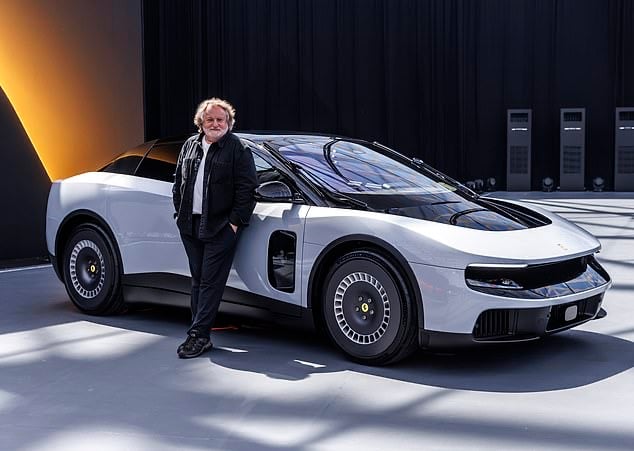
Ferrari’s first ever electric vehicle has been savaged online, condemned by the brand’s former chairman and sent the company’s share price tumbling — in one of the most turbulent launches in the Italian marque’s history.
The Ferrari Luce, priced at £474,320 and the company’s first five-seater, was unveiled this week to a reception that ranged from sceptical to outright hostile. Luca di Montezemolo, who served as Ferrari chairman from 1991 to 2014, was among the most cutting in his assessment. “If I had to say what I really think, I would be hurting Ferrari,” he told Italian media. “This is surely a car that at least the Chinese won’t copy from us.” Shares fell more than eight per cent on the Milan stock exchange and over five per cent in New York on the day of the launch.
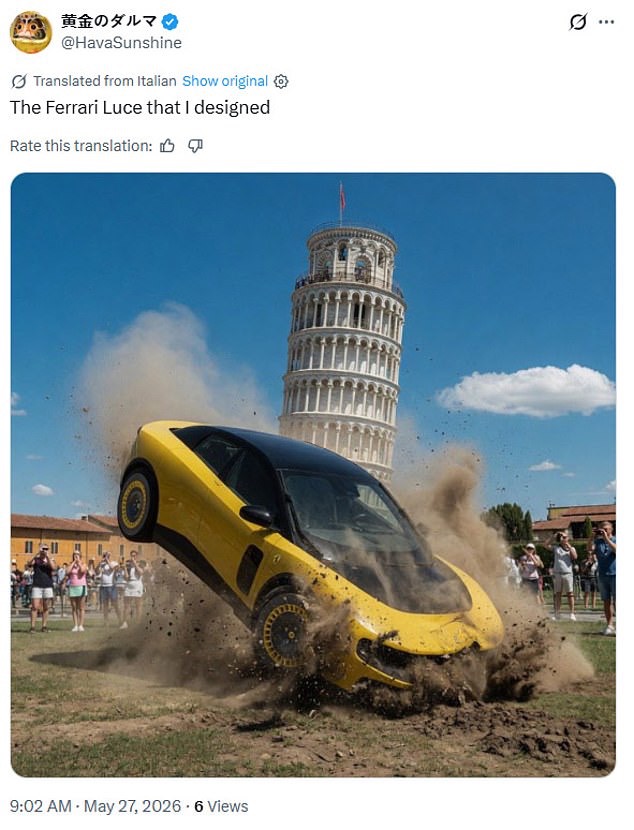
Social media reaction was no kinder. “Ferrari just killed their brand just like Jaguar did. This is straight to the junkyard trash,” read one widely shared comment. Digitally altered images spread rapidly on X, with some depicting the Luce as a vacuum cleaner, others placing battered tin vehicles alongside the caption: “Look at that, I spot that brand-new Ferrari Luce right here nearby already!” The car’s design was compared to one infamously drawn by Homer Simpson, while an AI-generated image showed it crashing into the ground at the foot of the Leaning Tower of Pisa.
The Luce — Italian for “light” — was designed in collaboration with LoveFrom, the agency co-founded by former Apple design chief Sir Jony Ive, and has taken half a decade to develop. Its saloon-like silhouette represents a significant departure from the low-slung, aggressive lines that have defined Ferrari’s road cars for generations. The shift has not gone unnoticed by critics.
Matt Prior, editor-at-large of UK automotive review site Autocar, said the internet had “made up its mind” about the exterior, though he was more positive about the interior. “The big thing here is there is no obvious place where the engine goes because there isn’t one,” he said. “That makes them look taller, that makes the look less sleek. For a company whose entire history is based on making dynamic-looking, sleek cars, it’s maybe harder for Ferrari to get around than it is for other manufacturers.” Pierre-Olivier Essig, head of research at AIR Capital, wrote in a note for clients reported by Bloomberg that the car looked like “a mix between a Honda Accord EV and Tesla 3,” adding: “We are lost in translation with Ferrari’s new strategy.”
Ferrari chief executive Benedetto Vigna defended the decision in Rome, arguing that leadership demanded courage in the face of new technology. “Ferrari Luce was born precisely from this challenge, offering our unprecedented vision of electrification,” he said. The car delivers 1,000 horsepower, reaches 60mph in 2.5 seconds and offers a range of more than 329 miles across four electric motors — one per wheel. Ferrari said all components are manufactured in-house to protect long-term repairability and resale value.
John Elkann, the brand’s president, also presented the Luce to Pope Leo at his summer residence at Castel Gandolfo on Tuesday. When the pontiff asked whether it was the first four-door Ferrari, Elkann replied: “The first five-seater.” The Pope sat in the driver’s seat as Ferrari test driver Raffaele De Simone knelt beside him to explain the controls.
Not everyone was dismissive. Ferrari’s chief design officer Flavio Manzoni, speaking to YouTuber Cleo Abram, acknowledged the car was “polarising” but said he believed opinion would shift in the months ahead. Some commenters on Drive’s reveal coverage called it “different but stunning” and praised the LoveFrom-designed interior as “phenomenal.” “It’s a bold departure for Ferrari, but is as modern and stylish as any four-door, five-seater EV could ever be,” wrote one supporter.
The launch comes at an awkward moment for the broader EV market. Ferrari had previously targeted 40 per cent of its lineup being fully electric by 2030, a goal it has since scaled back to 20 per cent — a retreat mirrored by rivals including Lamborghini and Porsche, which have both pulled back EV plans amid sluggish demand and intensifying competition from Chinese manufacturers. Global electric car sales reached 20 million last year, with European sales up more than 30 per cent in 2025 according to the International Energy Agency — but Prior cautioned that much of the growth remained “legislation-driven rather than natural demand-driven.”
