



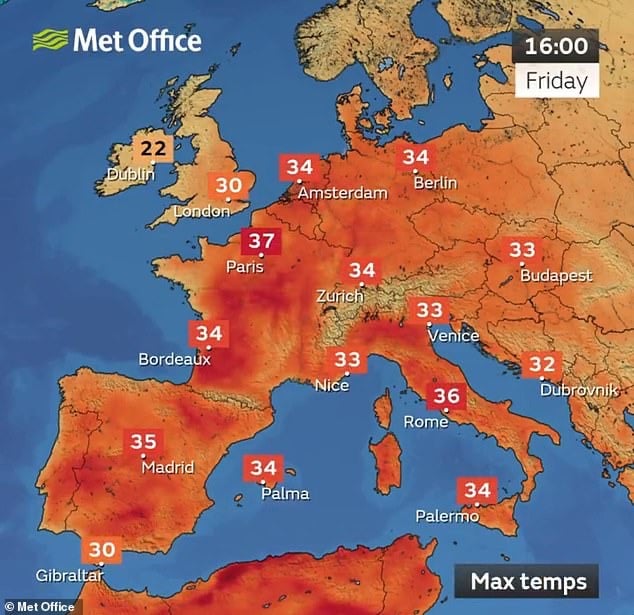
Britain could record its hottest ever June day next week, with temperatures forecast to reach 34C, as the UK Health Security Agency issued amber heat health alerts and officials warned of a fresh spike in water-related deaths after 17 people drowned during last month’s heatwave.
The Met Office said there is a 40 per cent chance the heatwave will break the current UK June temperature record of 35.6C, set in both London in 1957 and Southampton in 1976. Temperatures are expected to climb steadily through the coming days, with the South and South East reaching 32C on Sunday before pushing to 34C or beyond on Monday. The hot spell is forecast to continue with highs of 32C on Tuesday and 30C on both Wednesday and Thursday, though the outlook becomes less certain beyond that.
A static area of high pressure over mainland Europe — known as a “heat dome” — is trapping warm air over southern England, driving the second major heatwave of 2026 less than a month after London recorded an all-time May record of 35.1C. Met Office meteorologist Alex Deakin described the temperatures as “pretty unusual even for the middle part of June.” Forecasters warned conditions would be “very humid and muggy,” particularly in the South, making the heat feel more oppressive than May’s dry spell, with the possibility of “tropical nights” where temperatures fail to drop below 20C.
The UKHSA has activated amber heat health alerts for London, the East, South East and South West of England, running until Tuesday with the possibility of extension. The Midlands is under a yellow alert, while no alerts currently cover the North. The amber warning cautions of “a rise in deaths, particularly among those aged 65 and over or with health conditions,” alongside significant pressure on health and social care services, overheating in indoor environments, rising power demand and potential staffing issues linked to transport disruption.
Deputy chief forecaster Gregory Wolverson said: “Some areas in the South and South East of England are likely to see heatwave criteria met over the weekend, with the potential for temperatures to reach the low 30Cs in the warmest locations.” He confirmed 34C was possible in the South and South East on Monday, adding: “There is a slight chance that hot conditions may persist deeper into next week, but confidence in this aspect is rather low at this stage.” He cautioned that despite the heat, conditions may not bring the clear skies seen in May. “It’s important to note that while temperatures may be high, we might not all see the wall-to-wall sunshine and blue skies we experienced back in late May because there may be more cloud around. Couple this with fairly high humidity, and it may feel rather oppressive at times.”
Water safety has become a major focus following the deaths of at least 17 people during May’s heatwave. Samantha Hughes, national water safety partner at the Royal National Lifeboat Institution, urged caution. “With warmer weather approaching, it’s important to remember that the water is still cold. Entering it unexpectedly can lead to cold water shock, causing a sudden increase in breathing and heart rate, which may trigger panic.” She advised anyone struggling in water to “Float to Live” — tilting the head back, relaxing and controlling breathing — and to always choose lifeguarded beaches where possible.
Angelo Makri of the Alzheimer’s Society warned of particular risks for people living with dementia, who may not recognise when they need to drink water or dress appropriately for the heat, urging carers and family members to check in regularly. The AA also issued advice for drivers, recommending checks on tyres, oil and coolant levels, and warning that a parked car can become dangerously hot within minutes — with children, vulnerable passengers and pets never to be left inside, even briefly.
The current heatwave follows a record-breaking spell three weeks ago in which England and Wales recorded their hottest ever May days, with highs of 35.1C and 32.9C respectively — an event the Met Office described at the time as “one of the UK’s most extreme high temperature events in our observational records.” The UK experienced four separate heatwaves in 2025, with the year’s highest temperature reaching 35.8C in Faversham, Kent, on 1 July.
