



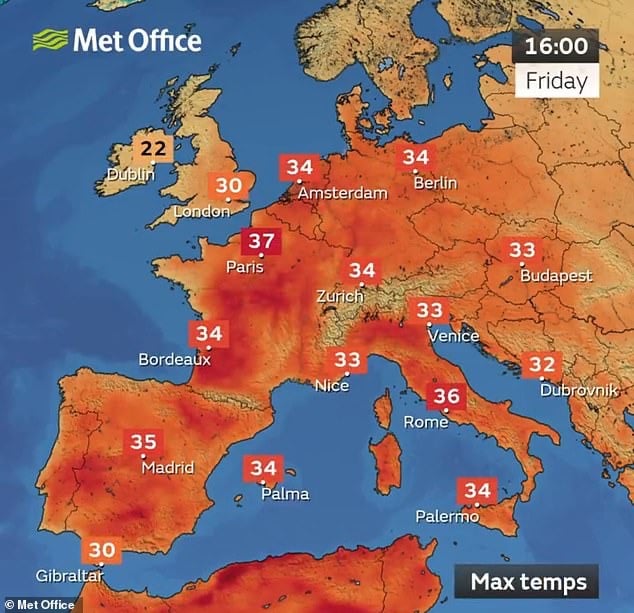
Britain is bracing for yet another heatwave this weekend — just weeks after the last one — but experts say the most significant development is not the temperatures themselves, it is what they reveal about how dramatically the UK’s climate has already shifted.
Professor Andrew Charlton-Perez, head of the School of Mathematical, Computational and Physical Sciences at the University of Reading, said the fact that late June temperatures in the high 20s barely raise an eyebrow any more is itself a warning sign. “It’s perhaps a sign of how much our perception of hot weather has shifted that 27 or 28 degrees for south east England no longer feels particularly warm,” he said. “The likelihood of similar temperatures has approximately doubled since the latter decades of the 20th century.”
This weekend, temperatures are expected to hit the high 20s “quite widely,” with the potential for 32°C in parts of southern and eastern England, according to the Met Office. By Monday, forecasters say there is a possibility of 33°C in some areas — figures that would have been considered exceptional a generation ago.
The Met Office is forecasting a marked north-south split, with settled and increasingly hot conditions in the south and east while more changeable weather pushes through the northwest. Deputy Chief Forecaster Gregory Wolverson said: “As we move towards the weekend, we’ll see conditions become more widely settled and temperatures rise all round. Many parts of southern and eastern England are likely to see temperatures high enough to meet heatwave thresholds. It’s important to note that while temperatures may be high, we might not all see the wall-to-wall sunshine and blue skies we experienced back in May because there is more cloud around. There is also a chance of thunderstorms developing in places, particularly later each day, which could bring heavy showers and localised impacts.”
A Yellow Heat-Health Alert has been issued by the UK Health Security Agency covering the East Midlands, East of England, London and the south east. But experts warn that a yellow classification can be misleading. Dr Akshay Deoras of the University of Reading said: “Prolonged warmth can place strain on the body, and repeated days of humid weather can lead to cumulative fatigue, particularly for older adults, young children and those with underlying health conditions. Tropical nights may also develop in some southern and eastern areas of the UK towards the weekend, offering little relief overnight.” He urged people to recognise early signs of heat-related illness, including headaches, dizziness, nausea, muscle cramps and confusion, and to stay hydrated, keep living spaces cool and check in on vulnerable people.
Hannah Cloke, Regius Professor of Meteorology and Climate Science at the University of Reading, said heatwaves were one of the clearest signals that the UK’s climate was already changing. “Hot weather goes from a risk to a hazard because of our dated infrastructure,” she said. “It is not just the physical infrastructure of buildings, transport networks and water supplies that need updating, but our imagination infrastructure as well. If we cannot imagine how heat might affect our homes, our health or our communities, we are less likely to act until it is too late. Science can show us the futures that are coming, but we need imagination to help us prepare for them and ultimately choose to build something safer.”
