



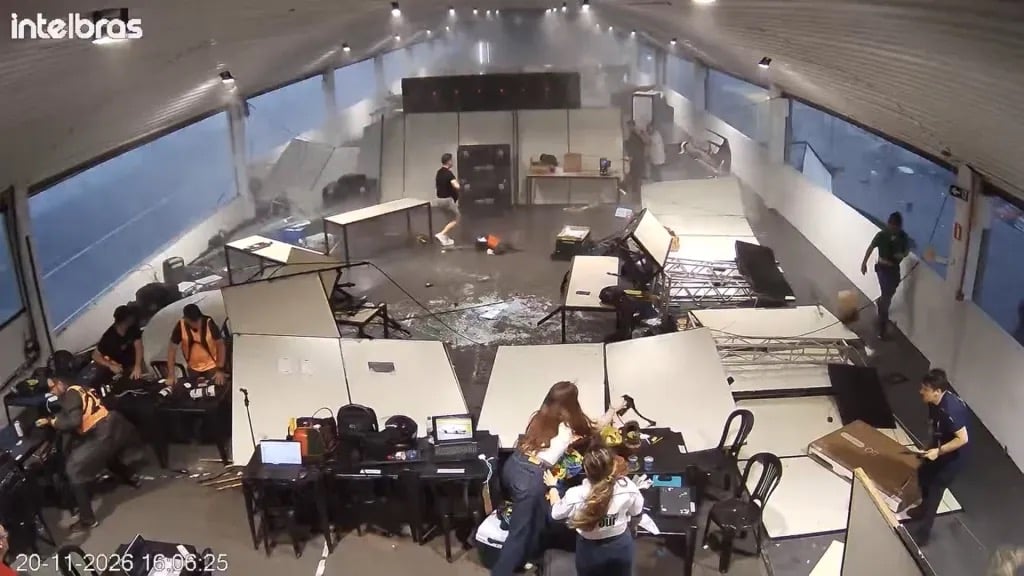
Reports differ on how many people were hurt at the Zilmar Beux circuit in Cascavel. The race went ahead the next day, and Paraná’s government classed the storm as a severe windstorm, not a tornado.
A sudden storm tore through the press area at a racetrack in Cascavel, in southern Brazil, shattering windows and blowing furniture across the room as workers ran for cover. Security-camera footage shows a partition blowing down at the Zilmar Beux International Racetrack at about 4.05pm on Friday 20 November. Reports differ on the number of people injured, with at least one mechanic hurt. Officials suspended all activity during preparations for the 40th Cascavel de Ouro, a traditional Brazilian motor race, but the race went ahead on Saturday.
What happened
The footage shows startled staff scrambling as glass flies across the room, a partition goes down and furniture is swept across the floor. Outside, the storm blew over tents, damaged awnings and affected the circuit’s timing system. Power at the track was deliberately switched off as a precaution while rescue teams helped those affected, according to an event safety worker. Race officials suspended activities while security and emergency teams dealt with the damage. Qualifying planned for Friday was moved to Saturday.
Conflicting reports on injuries
One mechanic was reported injured. Local media quoted a security worker at the event who said two people were hurt when structures collapsed and that both were taken to hospital, with neither injury initially thought serious. Another regional outlet also reported two injuries, but said organisers told a broadcaster that no members of the event were hurt. A television report later said no one was injured inside the press room itself. That could mean the injuries happened elsewhere at the track, but this has not been officially confirmed.
Weather and warnings
Brazil’s National Institute of Meteorology had issued an orange storm warning for Cascavel, in force on 20 November. It forecast heavy rain, winds that could reach 100km/h, hail and power cuts. These are forecasts, not measurements at the circuit. The Paraná meteorological service, Simepar, recorded gusts of 66.2km/h (about 41mph) at 4.15pm, around ten minutes after the windows broke. Simepar said bands of organised storm clouds, known as instability lines, were crossing the state that afternoon.
The state government confirmed tornadoes in Foz do Iguaçu and Manoel Ribas on 20 November but classed the Cascavel event as a severe windstorm. At the storm’s peak, about 353,800 power disconnections were recorded across Paraná. By the morning of 23 November, authorities said electricity had been restored to 98.7% of affected customers, with about 4,600 still waiting. Water services disrupted in parts of the state, including Cascavel, were back to normal by 23 November, the state government said. Cascavel’s fire brigade emergency number, 193, also stopped working for a time during the storm, local reports said.
Separately, days earlier, a violent storm in Tupanciretã, south of Cascavel, reportedly killed five people and injured 265, and officials were investigating whether the winds reached tornado strength.
The race goes ahead
Fifty cars started the three-hour race on Saturday 21 November. Xande Bastos and Eduardo Berlanda won in a Volkswagen Gol numbered 116, completing 115 laps in 3 hours, 2 minutes and 34.269 seconds, according to published results. The car’s engine failed on the final lap, and Mr Berlanda crossed the line with the engine no longer running, winning by 26.470 seconds from Lorenzo Massaro and Wyllian Cezarotto. A team’s post-race account said only 28 of the 50 starters were classified as finishers.
Former Formula One driver Nelsinho Piquet was among the entrants and retired after an early collision. The event’s trophy marked his father Nelson Piquet’s win in the same competition 50 years ago, in 1976.
Next year’s Cascavel de Ouro is scheduled for 14 November 2027, the 60th anniversary of the first race on 14 November 1967. Another night race is planned.
