



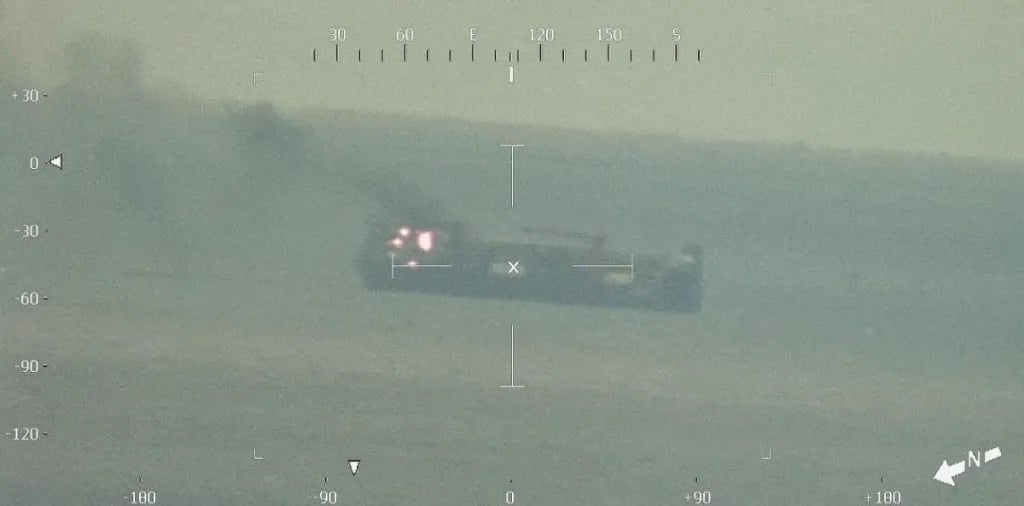
Finnish authorities say the vessel, identified as the sanctioned Sparta II, was burning after entering Finnish waters. Ukraine has not claimed responsibility, and its cargo has not been confirmed.
A Russian cargo ship was set on fire in the Gulf of Finland on Saturday after being attacked by two drones, according to Leningrad governor Alexander Drozdenko, and Finnish authorities said it was burning after entering Finnish territorial waters. Estonian maritime authorities identified the vessel as Sparta II, a sanctioned ship sailing from St Petersburg to Kaliningrad. Its crew were being evacuated, and its cargo has not been confirmed. Ukraine has not claimed responsibility, and no evidence has been presented linking its forces to the strike.
What is known about the ship
Mr Drozdenko said: “In the neutral waters of the Gulf of Finland, three nautical miles from the border of the Russian Federation, an attack occurred on a cargo ship en route to the city of Kaliningrad, using two unmanned aerial vehicles. The crew is currently being evacuated. The consequences are being clarified.”
Estonia’s Police and Border Guard Board received the first emergency report, of a fire and possible explosions aboard, at 9.35am local time, the broadcaster ERR reported. The vessel was then about 11 nautical miles north of Estonia’s Vaindloo island and left Estonia’s exclusive economic zone at about 10am. The independent Russian outlet The Insider said the ship’s tracking signal disappeared at about 9am. The Finnish Defence Forces said the attack happened in international waters west of the Russian-controlled island of Suursaari (Hogland) and that allies had been told. Finland’s Border Guard published a photograph of the damaged ship.
Unconfirmed reports suggest it was carrying military supplies to Kaliningrad. A US Federal Register notice links Sparta II to Oboronlogistika OOO, a Russian defence-logistics company under US sanctions, and lists it as a Russian-flagged roll-on/roll-off vessel of 7,260 gross tonnes. Ukrainian military intelligence has previously said the ship carried S-300 air-defence systems from Syria to Russia in August 2022. It has also said it was photographed carrying military equipment through the Bosporus in April 2022 and was linked to equipment movements from Tartus towards Libya. Ukraine sanctioned it on 23 May 2026. Its previous movements do not establish what it was carrying on Saturday.
Finland and Estonia respond
Finland’s Border Guard said: “The situation poses no danger to other maritime traffic. Preparations for potential rescue operations are being made in cooperation with other authorities in Finland and internationally.” It is also preparing for a possible oil-spill response, though no spill has been confirmed, and Estonian maritime authorities reported no marine pollution at their latest update. Its latest release, at 1.17pm local time, still described the ship as burning. Finnish Prime Minister Petteri Orpo said in a post on X, according to the news agency STT, that the war was spilling into neighbouring areas, and affirmed Ukraine’s right to defend itself.
Finland imposed temporary aviation restrictions at 4.15am and maritime restrictions at 4.20am because drones might cross into its territory. They were lifted at 7.43am and reinstated at 9.33am until at least 2pm, covering waters from Kaunissaari to Hamina Harbour. Estonia issued a drone-threat warning at 4.42am for its north-eastern counties of Lääne-Viru and Ida-Viru, and lifted it at 6.49am. Turkish Air Force fighters on NATO air-policing duty were airborne, and a resident near Väike-Maarja said they heard what sounded like a drone, then a jet. That sighting is not confirmed as one of the drones involved in the ship attack. Estonia’s defence minister said on 12 November that fighters cannot always safely engage low-flying drones because of the risk to civilians from debris.
Mr Drozdenko said Russian air defences shot down 80 drones over the Leningrad region overnight. Ten days earlier, on 11 November, Finland’s military detected a strike on the Russian corvette Naro-Fominsk in the Gulf of Finland, Janes reported. Estonian Colonel Aron Kalmus said the warship was hit several times, had casualties and could not proceed under its own power. Final damage figures have not been published.
Zelensky on Putin
Separately, Ukrainian President Volodymyr Zelensky criticised Mr Putin after US President Donald Trump repeatedly called the Russian leader his “friend” and said they had a “great relationship for many years”. Speaking to CNN, Mr Zelensky said it was up to Mr Trump “how to call Putin”. “For us, he is an enemy… for us, he’s a killer,” he said. “I think mostly for the people in the world, he is a killer because he’s killing – by the way – he’s killing each day and night.” He said that speaking of Mr Putin as a friend meant “he doesn’t feel enough pressure”.
Wider attacks
Ukrainian officials said two people, including a boy, were killed and 52 injured in strikes on Mr Zelensky’s hometown, Kryvyi Rih, with 11 more wounded in the Kharkiv region and one in Rivne. A Russian bombardment on Friday killed at least nine people, with 110 missiles and more than 400 drones fired, in what Mr Zelensky called the “biggest this year”. Poland said Russian missiles breached its airspace, and one cruise missile hit a rural area near Nowy Lipowiec, 31 miles from the Ukrainian border. Warsaw called it a “provocation” and NATO scrambled fighter jets. Polish Foreign Minister Radosław Sikorski said: “This is a war in Europe that affects our security.”
On Friday, Mr Trump said Mr Putin would “love to end the war”. “They [Zelensky and Putin] both want to end it and it’s a very good thing I have a relationship,” he told reporters.
