



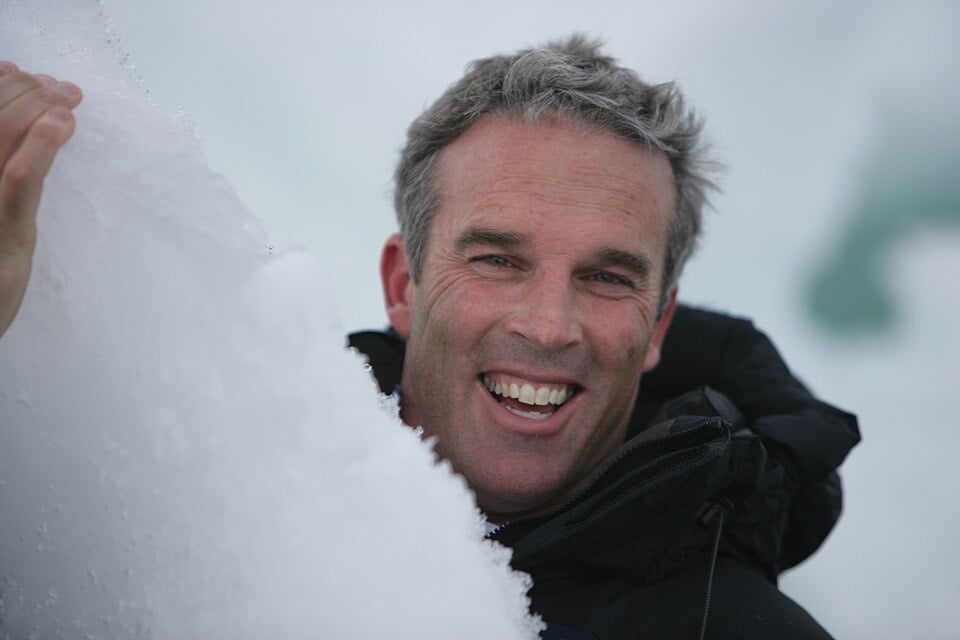
The British endurance swimmer says he saw tankers struck and ships ablaze during three days in the waterway. Greenpeace reports more than 600 possible oil slicks in the region since February.
British endurance swimmer Lewis Pugh has swum about 15km (9.3 miles) through the Strait of Hormuz over three days this week to draw attention to the “devastating environmental cost of war”. Mr Pugh, 56, a UN Patron of the Oceans, set off from the Musandam Peninsula and finished by rounding the Cape of Hormuz. He said a tanker was struck a few kilometres away 30 minutes into his swim.
The swim
The strait is a key route for Middle East oil shipments and has repeatedly been closed because of attacks in the Iran war. Mr Pugh, who was born in Plymouth, is believed to be the first person to attempt a long-distance swim there since the conflict between Iran and the US began. He swam in trunks, goggles and a cap bearing the UN logo. He told the Associated Press (AP) the challenge involved about six and a half hours in the water, covered in separate sections over three days rather than continuously.
In a post on his website, Mr Pugh said: “War causes immense human suffering. Lives are lost, families are torn apart, and homes are destroyed. But there is another casualty that receives far too little attention: nature itself. The Strait of Hormuz is far more than a vital shipping route. It is one of the most beautiful places I have ever visited. There are towering mountains and spectacular fjords, coral reefs and mangrove forests. Dolphins, sea turtles and dugongs live in these waters.”
He added: “Just 30 minutes after I began swimming, an oil tanker was struck a few kilometres away. The explosions rocked the sea around me. During the following days, I witnessed further attacks on commercial shipping and saw vessels engulfed in flames. Oil tankers, gas carriers and other merchant ships are being attacked, day after day. The environmental consequences of this war will last for generations. My message is simple: Stop the fighting. Open the Strait. Clean up the pollution.”
He told AP, after returning to London, that he heard two explosions and saw fighter jets while swimming. A tanker about four kilometres away was struck, he said, and the blasts were strong enough for his team to abandon that section of the swim. On the second day, he said, he came across a burning gas carrier while returning to harbour, saw flames, smelled chemicals and saw fire on the surface of the water. He also reported seeing dolphins, turtles and ospreys. Mr Pugh was the first person to complete a long-distance swim in every ocean and often swims in vulnerable ecosystems to highlight their plight. His foundation says his campaigns have contributed to agreements protecting more than 3.5 million square kilometres of ocean. AP did not independently assess that figure.
Attacks on shipping
The Joint Maritime Information Center (JMIC) recorded several attacks in its 19 November advisory covering 16 to 18 November. The ON PHOENIX suffered an engine-room fire after a projectile strike on 16 November, with no crew casualties reported. The liquefied petroleum gas tanker TARA GAS was struck twice, on 16 and 17 November, leaving one crew member missing and two injured, with the vessel disabled and abandoned. The NAVIG8 MESSI was hit on 17 November about 13 nautical miles north of Khasab, with one crew member missing and 11 injured, and was later towed. On 18 November, another tanker was struck in the engine room about six nautical miles north of Khasab. JMIC recorded four attacks in a 96-hour window and rated the regional threat as severe. The records do not establish which vessels Mr Pugh saw.
On Saturday, UK Maritime Trade Operations reported two more tanker incidents, Reuters said. One vessel was struck on the stern by an unidentified projectile about 11 nautical miles north of Khasab, and another was hit in the engine room about 17 nautical miles east of Khasab. It is unclear whether they were separate vessels. No casualties were reported, and the environmental impact is unknown. Iran’s navy separately said a tanker caught fire after hitting a naval mine, which Reuters could not verify.
Earlier this month, Foreign Secretary Ed Miliband said the “no war, no peace” stalemate was causing “deep economic pain”. He called for an “all-out diplomatic effort” to end the war and properly reopen the strait.
The pollution picture
Greenpeace Middle East and North Africa said on 19 November that its satellite monitoring had identified more than 609 possible oil slicks across the Gulf, the Strait of Hormuz and the Arabian Sea since February, and that 148 vessels had reportedly been attacked. It put the cumulative mapped slick footprints at 21,000 square kilometres. That counts daily satellite detections, so slicks may overlap or be counted on several days, and not every slick has been attributed to military action. Greenpeace executive director Ghiwa Nakat pointed to the cumulative effect on ecosystems and coastal habitats.
United Nations University researchers detected a slick of about 300 square kilometres near Oman’s Hallaniyat Islands on 7 August and another of about 100 square kilometres near Iran’s Qeshm and Hengam islands on 10 August. The Guardian reported on 12 November that the tanker Gem No 2, hit in October, created a slick extending more than 35 kilometres towards Umm Al Quwain in the UAE. Beaches were closed and the UAE monitored desalination plants. Omani crews removed oil from about seven miles of coast near the Hallaniyat Islands. Scientists told the Guardian that oil can remain in sediments and mangrove roots long after the visible slick disappears. They cited studies finding contamination in Saudi coastal sediments from the 1983-85 Nowruz spills, estimated at 80 million gallons, and tar on Qatari beaches linked to the 1991 Gulf War.
Shipping through the strait has fallen sharply. The Financial Times, citing Kpler data, said oil volumes in the second week of November were about half those of the first week. Acting US Navy Secretary Hung Cao said insurance for a tanker transit has risen from about $54,000 a year earlier to $64m. These are his figures, not a verified market average. JMIC said tracking data showed single-digit to low-double-digit transits a day.
