



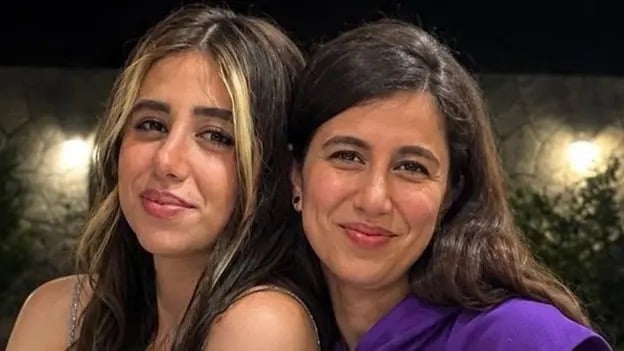
Taraneh Rahimi, 21, is struggling to walk and has balance problems after beatings and an untreated head injury, her cousin says. The European Parliament has demanded her death sentence be overturned, but rights groups report it has been upheld.
Taraneh Rahimi, a 21-year-old on death row in Iran after January’s protests, has been unable to walk properly in recent weeks after her legs were beaten, her cousin says. He also says an ear infection caused by an untreated head injury has affected her balance. Rights groups report that her death sentence has been upheld, and Iran Human Rights says at least 121 people face execution in cases linked to the protests. The European Parliament voted on 8 October to call for her sentence to be overturned.
Taraneh Rahimi’s case
Ms Rahimi is listed by Iran Human Rights, a Norway-based group, as a defendant in the Isfahan Shohada Square case. It says she is held at Dowlatabad Prison and was convicted of moharebeh, meaning enmity against God. Its 16 November case register lists her death sentence as upheld. A source cited by the group alleges that the written verdict in the same mass trial was signed by a judge who had not attended the proceedings. That has not been independently verified against the Iranian court record.
Her family say she and her twin sister, Romina, were tortured and sexually assaulted by an official. On 19 November, their cousin, Masoud Nourmohammadi, told a US news outlet that the same official was later assigned to hear their complaint against the Islamic Revolutionary Guard Corps, and that the sisters recognised him when they entered the hearing. He alleged the complaint was dismissed at once. The outlet said it had not independently verified the allegations or examined court documents. The injuries to her legs and head have not been independently medically assessed.
Before her arrest, Ms Rahimi worked as a horse trainer and competitive equestrian and had won medals, according to a report by IranWire. She had previously had surgery on one leg, which makes the family’s claims about repeated blows to it especially significant.
International pressure
On 8 October the European Parliament adopted a resolution naming Ms Rahimi and another condemned woman, Leila Abolhasani, by 541 votes to 11, with 25 abstentions. MEPs called for their death sentences to be overturned, for political prisoners to be freed and for executions to stop. They demanded immediate medical treatment for Taraneh and Romina Rahimi, wider sanctions on officials implicated in the January crackdown, and stronger international evidence-gathering.
The sisters’ family approached the United Nations in September. British human rights lawyers submitted information on their behalf through the UN special procedures, seeking action over their treatment, sentencing and access to legal representation. The submission does not itself show that the UN has secured any change in their detention. The sisters were also reported to have been shortlisted for the European Parliament’s 2026 Sakharov Prize, according to reports on 21 October.
The wider picture
Iran Human Rights reported on 16 November that at least 121 people face execution in cases linked to the January protests across 15 provinces, and warned the true number may be higher. It said six are women and at least five were minors at the time of their alleged offences. The group has documented 41 protest-related executions since 18 March 2026, 39 of them linked to the January uprising and two to the earlier Woman, Life, Freedom movement. It records executions on espionage charges and of members of banned opposition groups separately.
