



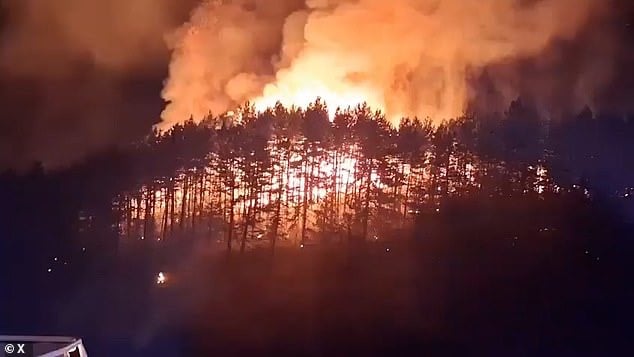
A young volunteer firefighter has died battling a blaze in the French Alps, villas have been evacuated in Spain’s Costa del Sol, and the Foreign Office has warned of a “high risk” to British travellers, as more than 19,000 hectares burn across southern Europe under a fresh heatwave threatening temperatures of up to 43C.
Southern Europe is battling widespread wildfires that have already claimed the life of a firefighter in France and forced evacuations across Spain, as the region faces a renewed heatwave with temperatures set to climb as high as 43C. The Foreign Office has issued a warning to British tourists over the “high risk” posed by wildfires in France, while forecasters expect parts of Europe to see highs of 40C in the coming days. In response, the European Commission has pre-positioned a record 777 firefighters from 14 countries across high-risk areas in Cyprus, Greece, Italy, France, Spain and Portugal, anticipating further outbreaks.
A Young Firefighter’s Death in the Alps
The human cost of the crisis was underlined by the death of a 22-year-old volunteer firefighter in France’s Savoie region, who died after spending part of the night tackling a forest fire in the Alps. French Interior Minister Laurent Nunez confirmed the news on X, writing: “It was with deep sadness that I learnt this morning of the death of a young volunteer firefighter from SDIS 73, aged 22, who died whilst on duty after spending part of the night fighting a forest fire in Savoie.”
Villas Evacuated as Spain’s Fires Spread
In Spain, the wildfires have forced the urgent evacuation of villas along the Costa del Sol, as blazes continue to threaten residential areas across the region. The evacuations come as southern Europe more broadly grapples with fires fuelled by an exceptionally dry spring and early summer, with scorching heatwaves in May and June leaving vast areas of land parched and highly vulnerable to fire this year.
France’s Trevillach Fire Forces Mass Evacuations
The most severe blaze currently burning in France is the Trevillach wildfire in the Pyrénées-Orientales, which has already destroyed 4,900 hectares and forced an estimated 10,000 people from their homes. More than 700 firefighters have been deployed to the scene, backed by water-bombing aircraft and helicopters, though shifting winds have continued to hamper efforts to bring the fire under control.
The blaze has also disrupted one of France’s most high-profile sporting events, with organisers of the Tour de France banning spectators from parts of the route near the fire and scaling back activities around one stage because of the danger it poses.
International Reinforcements Deployed
France has received substantial international support in tackling the crisis, with the European Union activating its civil protection mechanism to deploy four firefighting aircraft and more than 100 firefighters from Cyprus and Sweden to assist French crews. Officials say the scale of this year’s fires already exceeds last year’s: more than twice as much land has burned in France so far this wildfire season compared with the same point in 2025.
Fires Also Raging in Portugal and Greece
The wildfire emergency extends well beyond France and Spain. Portugal is battling major blazes that have already burned around 13,000 hectares, while Greece has recorded almost 100 separate wildfires in the space of two days, triggering further evacuations. Across France, Spain, Portugal and Greece combined, more than 19,000 hectares have now been destroyed as the region faces another intense bout of extreme heat.
A Warming Continent
The scale of this year’s fire season has prompted a fresh warning from the World Meteorological Organization (WMO), which says Europe is warming at more than twice the global average. The organisation has cautioned that this trend is increasing the likelihood of prolonged heatwaves and more severe wildfire seasons across southern Europe in the years ahead.
