



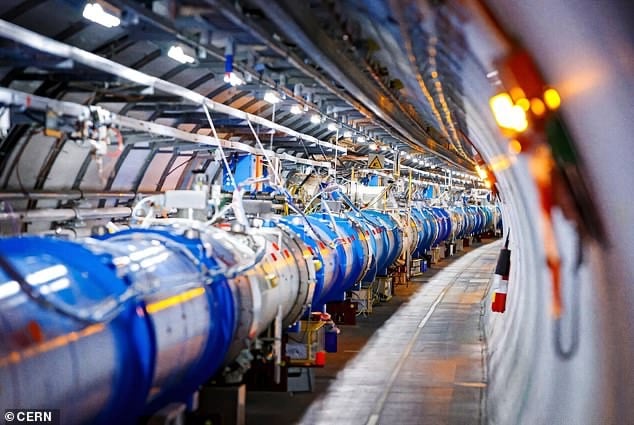
The Large Hadron Collider, the world’s most powerful particle accelerator, has been switched off by CERN after running its final experiment, entering a four-year shutdown period ahead of a £1.29 billion upgrade that scientists say will transform its capabilities and potentially unlock some of the deepest secrets of the universe.
The LHC, which has been operating since 2008, is not being decommissioned. It will return in 2030 as the High-Luminosity LHC, known as HiLumi LHC, having been rebuilt to be ten times more luminous and capable of generating around 100 times more data per run. CERN expects the upgrade to allow researchers to produce more than five billion particle collisions per second, compared to the 60 per crossing currently achieved, with each bunch of particles expected to generate between 140 and 200 collisions when the new machine is operational.
Oliver Brüning, CERN Director for Accelerators and Technology, said: “The LHC has exceeded every expectation. For nearly two decades, it has transformed our understanding of the Universe and inspired generations of scientists, engineers and citizens around the world. Today we say goodbye to the LHC as we have known it, while preparing to welcome its successor: the HiLumi LHC.”
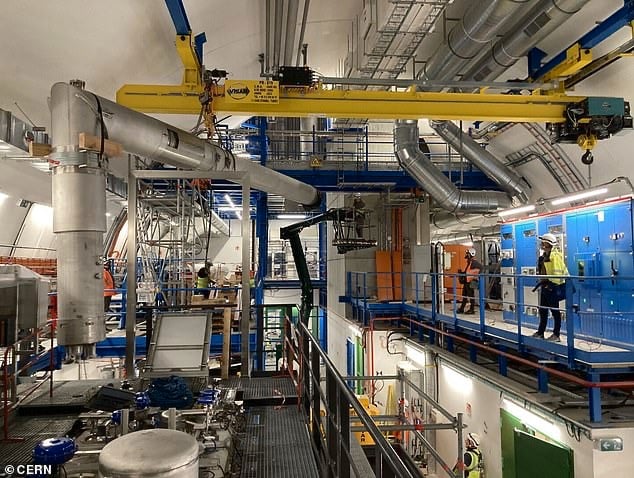
The scale of the upgrade is enormous. More than 0.75 miles of magnets inside the collider tunnels will need to be replaced, and almost the entire surrounding infrastructure requires rebuilding to handle the dramatically increased power. The total cost is estimated at $1.5 billion, funded through CERN membership fees and in-kind contributions from the United States, Japan, Canada and China.
The LHC works by accelerating bunches of protons around a 16.7-mile loop of electromagnets at extraordinary speeds before smashing them together, with highly sensitive detectors analysing the subatomic wreckage that results. The technique has already produced one of the most significant scientific discoveries of the modern era: in 2012, scientists announced the detection of the Higgs boson, the so-called “God Particle” that explains why other particles have mass.
Such volumes of collision data will be generated by the upgraded machine that storing everything will be physically impossible. The new HiLumi LHC will instead rely on AI-equipped detectors that automatically determine which collision events are scientifically significant enough to keep, according to the Daily Mail.
Jean-Philippe Tock, Head of the LS3 Coordination Team, described the logistical challenge ahead. “The LS3 represents a huge and complex logistical and engineering undertaking. Components will be removed and replaced with new equipment, and across the whole complex, dozens of projects are planned, involving thousands of engineers, physicists, technicians and support personnel.”
Scientists hope the upgraded machine will help answer some of the most profound open questions in physics, particularly around dark matter and dark energy. Ordinary matter — stars, planets, dust and everything we can see — is believed to make up only around five per cent of the universe’s total mass. Dark matter accounts for approximately 27 per cent and dark energy the remaining 68 per cent, yet neither has ever been directly detected.
A CERN representative told the Daily Mail: “The HiLumi upgrade will allow researchers to collect vastly larger datasets, measure the Higgs boson in much greater detail, study extremely rare processes and increase the chances of spotting signs of new physics beyond the Standard Model. Over its lifetime it could produce about 380 million Higgs bosons, compared with roughly 55 million Higgs bosons produced since the start of the LHC.”
Among the most ambitious targets is the simultaneous creation of two Higgs bosons and the study of how they interact. Dr Nedaa-Alexandra Asbah, a research physicist at CERN’s ATLAS experiment, said such an achievement may “provide clues about how our universe evolved shortly after the Big Bang.” The HiLumi LHC is expected to begin gradual restart procedures from at least 2028, with first collisions anticipated in 2030.
