



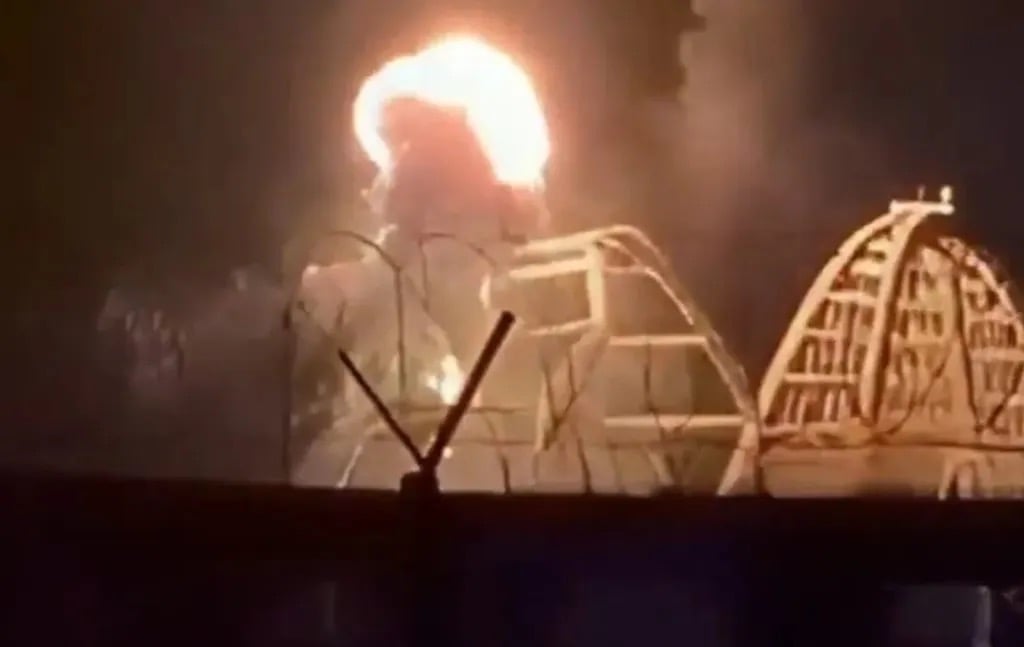
Unnamed military officials say the president wants the structure demolished completely. British intelligence says the road crossing is badly damaged but one railway track is probably still working.
Volodymyr Zelensky wants the rest of the Crimean Bridge destroyed, military officials in Kyiv have told The Telegraph, after Ukrainian strikes this month brought down part of the road crossing between Russia and the annexed peninsula. One official said: “The president wants it demolished completely.” Separately, at least nine people were reported killed in attacks across Ukraine, including seven at an industrial site in Nizhyn, in the northern Chernihiv region. Russia’s Defence Ministry said it had intercepted 1,246 Ukrainian drones overnight.
What Kyiv is reported to want
The officials spoke anonymously, and no public statement from the president is quoted. They described the November strike as part of a wider Ukrainian effort to hit logistical targets inside Russia. Ukraine has tried to destroy the roughly 11-mile bridge several times since the invasion began, according to the report. The latest attempt succeeded where earlier ones did not, and the report said it followed strikes on nearby air defences.
A source familiar with the operation said Ukrainian intelligence spent weeks planning it and used a “considerable” barrage of Neptune anti-ship cruise missiles, fired from undisclosed locations. Servicemen from several Ukrainian units then struck the bridge over the following hours.
The bridge cost an estimated £3bn. Vladimir Putin drove a truck across it at its opening in 2018. Russia has held Crimea since 2014, and the report also said Mr Putin has promised “painful revenge” for the attack.
What British intelligence says happened
The Telegraph’s account puts the destruction of the road section on 18 November. A fuller British assessment gives a different chronology. UK Defence Intelligence identified three separate Ukrainian attacks between 16 and 19 November. It attributed the collapse of the road arch to the second, on 17 November, and said the railway section was hit around midnight on 19 November.
The assessment also said:
- Two Russian Pantsir air-defence systems were about 2.4km from the collapsed section, yet Russian air defences failed to stop the attacks. Their presence does not show whether they were destroyed.
- About 200 metres of roadway suffered further damage, including craters.
- One of the bridge’s railway tracks is probably still operational, although there is damage near the railway arch, to railings, and scorch marks.
Satellite imagery from the commercial operator Vantor, taken at 1.51pm local time on 19 November, showed about 225 metres of the highway bridge collapsed, with sections partly submerged in the Kerch Strait. Analysis of the images by The War Zone found at least two, possibly three, impact points on the railway bridge. The damage appeared to be concentrated on one of the two tracks. No repair work or shipping was visible in that single image, which does not show whether either stayed halted afterwards.
Shipping and supply routes
British intelligence said the Russian port of Azov has stopped operating after attacks on transport infrastructure. It cited the damage to the Crimean Bridge and to a separate bridge at Rostov-on-Don, struck on 10 October. It also linked an obstruction in the waterway to the collapsed road arch, saying ships in the Sea of Azov may be unable to reach the Black Sea directly until it is cleared. The amount of cargo delayed has not been established.
A report in a UK newspaper last week described the route now used by drivers heading to Crimea. It runs about 390 miles (630km) through Russian-occupied southern Ukraine, via Mariupol, Berdiansk and Melitopol. A report on the Russian state broadcaster’s Vesti programme warned that the road crosses three frontline regions and comes under attack. It estimated that up to 20,000 vehicles a day use it. The Armed Conflict Location and Event Data Project (ACLED) recorded an average of two Ukrainian strikes a day along the corridor in the first six months of 2026, about 90% of them involving drones. The same report said Russia’s transport ministry has changed its official illustration of the bridge, and the new image omits the destroyed road arch and shows only the railway.
Repairs
Russian Deputy Prime Minister Marat Khusnullin said on 20 November that engineers had not established when the bridge could be fully repaired. He said designers were still assessing damage to the steel arch and the main beam supporting the roadway. Russian officials suggested some parts might reopen within one or two months, but warned that winter weather could disrupt work. Engineers consulted by The New York Times estimated that replacing the destroyed steel arch, about 750ft long, could take roughly two years in wartime conditions. These are separate scenarios, not confirmed completion dates.
Civilian casualties and overnight attacks
Seven people were killed and seven wounded in a Russian attack on an industrial site in Nizhyn, Ukrainian reports said. The attack took place on Friday 27 November, and the final toll was confirmed after rescue work ended the next morning. Ukraine’s State Emergency Service said rescuers pulled one person out alive, using 55 emergency workers, 14 vehicles and two search dogs.
In Russian-occupied Zaporizhzhia region, two people were reported killed and two wounded when a Ukrainian drone struck a hospital vehicle.
Ukraine’s Air Force said Russia launched 162 drones overnight into 28 November, 74 of them jet-powered. It said 141 were intercepted or suppressed, with strikes recorded at 13 locations and falling debris at seven.
Russia’s Defence Ministry said its air defences intercepted 1,246 Ukrainian drones overnight. It did not say how many reached their targets, and the figure has not been independently verified. Moscow mayor Sergei Sobyanin said more than 400 drones were launched towards the capital and 123 were intercepted near the city. Regional officials said nine people were injured when a drone hit a bus in Klimovo, in Russia’s Bryansk region. They also reported an attempted attack on industrial facilities in Samara, with no injuries.
A suspected drone attack was reported to have caused a major fire at the Novoshakhtinsk oil refinery in Rostov region. The claim circulated on Russian and Ukrainian Telegram channels. The regional governor said more than 50 drones were intercepted but did not specify any damage, so the fire has not been independently confirmed.
