



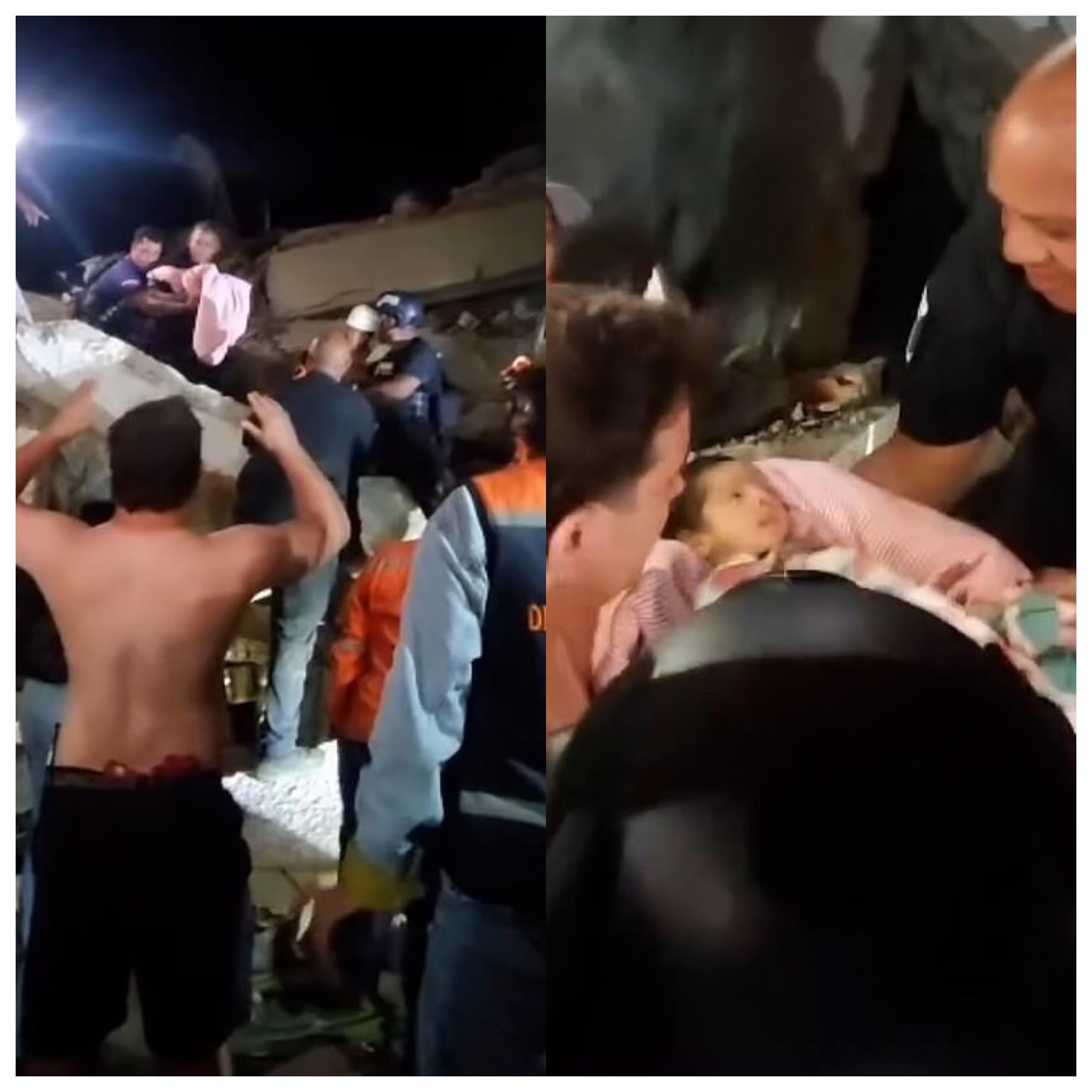
An 11-year-old boy has been pulled alive from the rubble of a collapsed building in Venezuela days after twin earthquakes killed more than 1,400 people, as a British volunteer rescue team with specialist life-detection equipment remains stranded at Madrid airport, desperate to reach survivors before it is too late.
Footage shared by Venezuela’s interim president Delcy Rodríguez showed a large team of emergency workers carrying the boy down from a mountain of debris in Caraballeda, placing him on a stretcher as rescuers attended to him. “A short while ago, an 11-year-old boy was rescued alive in Caraballeda. In these hours, every life is hope for Venezuela,” Rodríguez wrote on social media.
The rescue came as officials confirmed the death toll from the magnitude 7.2 and 7.5 earthquakes that struck on 24 June has risen to 1,430, with 3,238 people injured. Top lawmaker Jorge Rodríguez called it “the most disastrous event” Venezuela has suffered in 123 years. An estimated 3,100 families are now in shelters as whole swathes of towns and cities lie in ruins.
Other moments of hope have emerged from the devastation. A newborn baby was pulled alive from beneath rubble in the coastal city of La Guaira after being trapped for 32 hours, with footage showing rescuers handing the infant to a man believed to be its father. The baby’s mother was also rescued alive, according to AFP.
But the human cost continues to mount in heartbreaking ways. Andrea Bello, wife of Venezuelan second division footballer Hector Bello, was found dead in the rubble of her home in La Guaira — her body positioned over her one-year-old daughter Alana, who survived because of her mother’s efforts to shield her. In raw social media posts, her husband wrote: “You left us alone in the night, mummy. You left me all alone with our daughter. Andrea, how do I explain to your daughter that you lost your life to save hers and I wasn’t there in that moment to do anything? How do I explain? Give me strength now because I can’t take any more.”
The government’s response to the crisis has drawn fierce anger from survivors. During a visit by Rodríguez to a Caracas neighbourhood that had been almost entirely destroyed, residents screamed at her: “The government isn’t doing anything for the people,” with others shouting “Get out! Get out!” Authorities announced on Friday night that access to La Guaira, the worst-hit coastal area near the capital, would be restricted, with anyone seeking entry required to obtain official permits. More than 14,000 military and police personnel are now patrolling the area.
International rescue teams from at least 17 countries have been mobilised to help, with Spanish, Salvadoran, Swiss, Colombian and Mexican teams already on the ground. A British volunteer team from the charity Serve On — 11 people and one dog equipped with seismic and acoustic technology capable of detecting movement from deeply buried survivors — has been trying to reach Venezuela since Friday but remains stranded at Madrid airport after connecting flights from Istanbul were cancelled and onward flights from Madrid also failed to materialise.
Team leader Vernon Young, 57, a veteran of disaster responses in the British Virgin Islands, Turkey and Syria, told the Press Association the situation was becoming critical. “These things are always time critical. We’re a light team and can move quickly. The sooner you get there, the more chance you have of saving lives,” he said. “Every situation is different — in Turkey they were pulling live victims out 14 days after the earthquake. We hope we can get out there and make a difference. We still believe we will make a decent contribution if we get there in the next day or two.”
Simon Bolivar International Airport, the only international gateway to Caracas, was itself damaged in the earthquakes, severely disrupting all flights into the country. Young said the team had been reaching out to military flights and other alternative routes, with a larger British government fire service team of 68 people understood to already be en route. “We’ve been in contact with the Government and we know they’re doing all they can, we have evidence of that,” he said. “It’s the saving lives aspect that motivates me. We’re frustrated and we want to be out there now.”
Volunteer Matt Hasdell, 24, said the team had been working through complex logistics while managing limited funds. “Our priority is to go into the dangerous zone and save as many lives as possible,” he said. “Our team has been working as hard as possible to get us on the ground.”
