


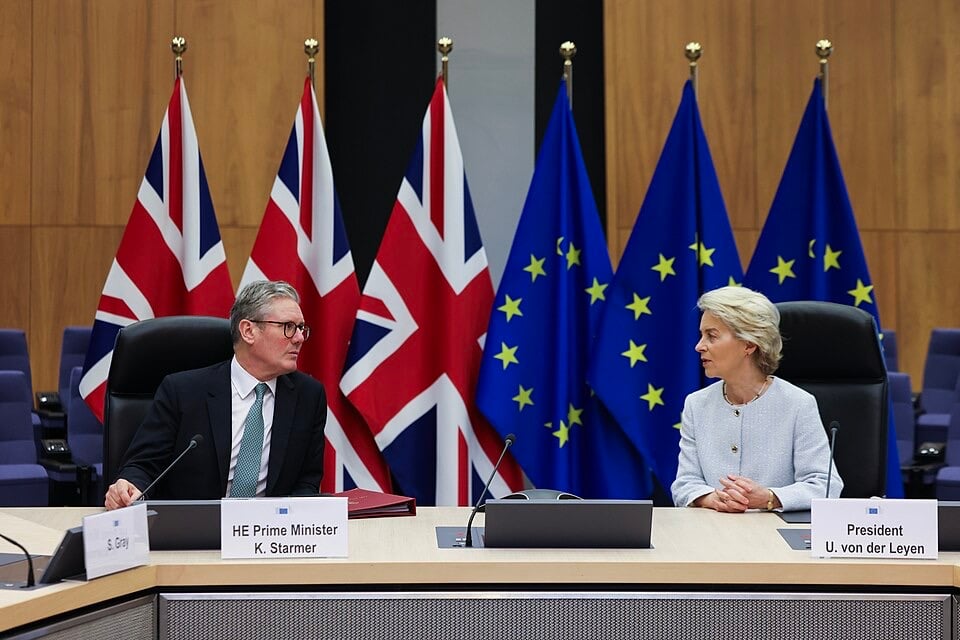
Sir Keir Starmer’s hopes of using Britain’s entry into a €90 billion Ukraine loan scheme as a bargaining chip in post-Brexit reset negotiations have been firmly rebuffed by Brussels, with EU sources making clear that goodwill gestures will not translate into concessions at the negotiating table.
The Prime Minister was speaking at the European Political Community summit in Yerevan, Armenia, on Monday when he suggested that Britain’s involvement in the loan programme was “very good for UK-EU relations, which is very important as we go on to the various discussions we’re going to have today.”
An EU diplomat was blunt in their assessment. “The UK Government should in no way expect this to be their entry ticket into the EU’s single market,” they told The Telegraph. “To think of this as a quid pro quo for EU concessions in the reset talks would be reading the room quite badly.”
Instead of offering concessions, Brussels negotiators said they would push only for what they described as “win-win landing zones.” The EU’s view, according to senior officials, is that Britain’s decision to join the loan scheme was not a diplomatic favour but a geopolitical necessity — driven by mounting pressure from both Donald Trump and Vladimir Putin. “The continent is under pressure,” one senior EU official said. “There’s this feeling that Europe needs to get closer together.”
Despite the diplomatic friction, the Ukraine loan deal does carry tangible benefits for Britain. By agreeing to help cover the interest costs, the Government will unlock access to billions of pounds in potential military contracts for British firms supplying weapons to Ukraine over the coming two years. In a joint statement with European Commission president Ursula von der Leyen following talks in Yerevan, the deal was hailed as a “major step forward” in UK-EU co-operation. Starmer said the benefits of joining “outweigh the cost.”
The episode underscores a tension that analysts have long flagged in the reset process. The reset matters much more to the UK government than it does to the EU, and Starmer’s team have been criticised for moving too quickly to claim “deals” in earlier rounds of talks, potentially weakening their negotiating position.
A major sticking point remains the EU’s demand that its students pay domestic fees at British universities as part of any youth mobility agreement. British negotiators have said they will not yield to that pressure. The EU has also reportedly indicated that progress on UK proposals will require Britain to agree to continued access for EU fishers to UK waters after 2026, when the transitional period set by the Trade and Cooperation Agreement expires.
Beyond the reset talks, Starmer used the Yerevan summit to announce that Britain would begin negotiations to join the European Innovation Council Fund, which supports green technologies and high-risk start-ups across the continent. The move is expected to require Britain to commit several hundred million euros to Brussels. The EU’s Innovation Council carries a budget of around €10.1 billion, designed to back continental start-ups and prevent them from being acquired by foreign — largely American — buyers.
The Prime Minister made no secret of the broader geopolitical anxiety underpinning the summit. “We cannot deny that some of the alliances that we have come to rely on are not in the place we want them to be,” he said during a panel discussion, in what was widely read as a reference to Mr Trump, though he stopped short of naming the US president directly. “There is more tension in the alliances than there should be.”
That tension was sharply visible throughout the gathering. Trump has recently ordered the withdrawal of approximately 5,000 American troops from Germany, and has threatened similar moves elsewhere across the continent in response to European leaders’ refusal to support his confrontation with Iran. Nato secretary-general Mark Rutte, who attended the summit, acknowledged “some disappointment from the US side” but said European leaders had “gotten the message,” adding that more countries were pre-positioning mine-hunting and mine-sweeping vessels in the Gulf ahead of what he called “the next phase.”
Starmer also held talks in Yerevan with Rutte and French president Emmanuel Macron on plans to reopen the Strait of Hormuz following a ceasefire between the US and Iran. A Downing Street spokesman said the leaders “agreed on the need to reopen the Strait of Hormuz to restore freedom of navigation and the free flow of global trade.”
With a UK-EU summit expected later this summer, both sides face pressure to finalise a range of agreements — including on food safety rules and carbon trading — before the two sides meet again. Whether the mood of co-operation on Ukraine will ease the more difficult conversations on trade and migration remains, for now, very much in doubt.
