



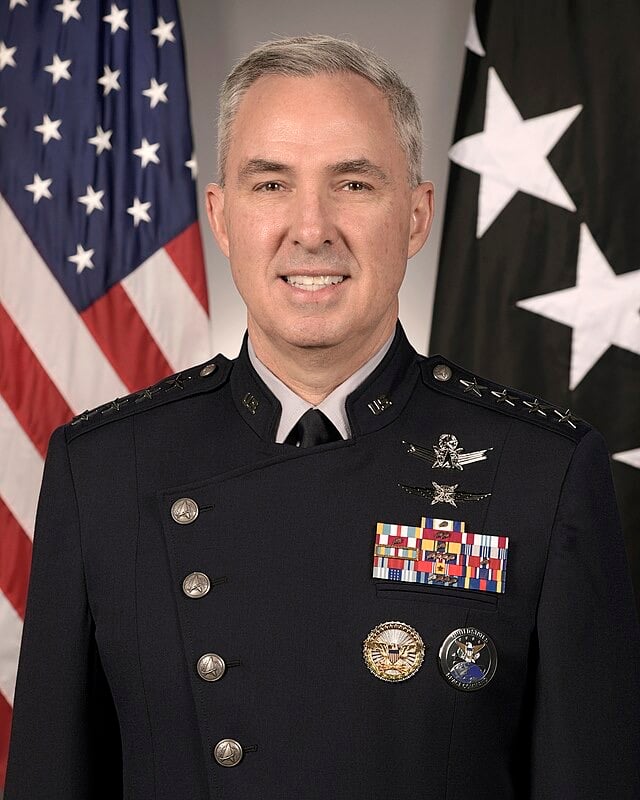
Future military conflicts could be waged beyond Earth’s atmosphere requiring fundamental strategic shifts toward manoeuvre warfare, America’s leading space operations chief has warned following a multinational exercise simulating Russian nuclear weapons deployed against satellites.
General Stephen Whiting told Colorado Springs’ Space Symposium attendees Tuesday that prevailing in extra-terrestrial combat necessitates abandoning current approaches: “We need a different strategy to deter and win a global, protracted conflict against a great power. That strategy is manoeuvre warfare.”
The stark assessment followed last month’s conclusion of the Apollo Insight Commercial Integration exercise—a “worst-case scenario” wargame involving Britain, Australia, Canada, New Zealand alongside US Space Command commercial partners and representatives from 17 American government agencies including NASA, the Department of Energy and the Defense Threat Reduction Agency.
The drill’s central premise focused on Russia’s reported development of orbital weapons of mass destruction—a threat General Whiting characterised as something “we do not want to see come to fruition, but reporting about Russia’s plans to launch such a weapon has forced us to prepare.”
Moscow faces longstanding accusations regarding anti-satellite nuclear weapon development, with the US claiming May 2024 observations showed Russia launching such capabilities—allegations the Kremlin dismissed as fabricated propaganda designed pressuring Congress into approving additional Ukraine aid.
“Russia deployed this new counter-space weapon into the same orbit as a US Government satellite,” a US Space Command spokesman stated at the time, assessing it as “likely a counter-space weapon presumably capable of attacking other satellites in low Earth orbit.”
Russian deputy foreign minister Sergey Ryabkov denied the claims as “fake news from Washington.”
General Whiting declined disclosing wargame results, though Defense One reported such weapons would inflict satellite “devastation,” prompting his emphasis on spacecraft capable of repositioning amid fears American satellites face tracking, targeting or interference during conflicts.
Future satellite designs may incorporate enhanced propulsion enabling orbital changes, introducing real-time atmospheric decision-making ahead of potential hostilities—a shift reflecting manoeuvre warfare principles General Whiting advocates implementing.
Chief Master Sergeant Jacob Simmons underscored civilisation’s satellite dependency: “Space is no longer a supporting supplement…it is a central system woven into the web of our modern life. From markets to medicine, from agriculture to aviation, from navigation to notification, we are all synchronized with space.”
“If and when space is struck down, all of society is struck down,” he warned.
The Space Symposium—describing itself as “the only event with the highest level of senior government officials, military leaders, industry leaders and space experts”—features speakers including NASA administrator Jared Isaacman, presidential science advisor Michael Kratsios, and European Space Agency director general Dr Josef Aschbacher.
The wargame participation underscores Britain’s integration within American-led space defence architectures despite broader transatlantic tensions over Middle Eastern conflicts and trade policy disagreements.
