



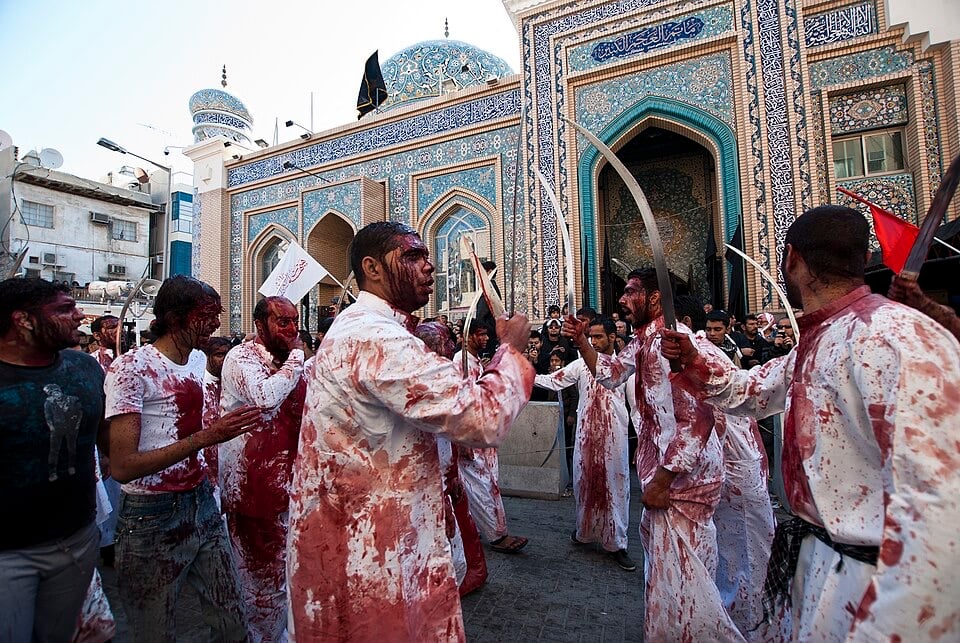
Thousands of Shiite Muslims marked the holy Day of Ashura on Friday with ceremonies of ritual self-flagellation across Iraq, Lebanon, Iran and beyond, as this year’s commemoration carried an additional layer of grief for communities still reeling from the devastation of recent wars.
In Iraq, pilgrims converged on the holy city of Karbala, the site of the seventh-century Battle of Karbala and home to a shrine dedicated to Imam Hussein, dressed in white robes quickly stained red as worshippers cut themselves across the scalp or whipped their bodies with blades attached to chains in acts of mourning. In Baghdad, thousands marched through the streets in similar scenes, with some slashing their heads with razors as part of the annual commemoration of Hussein’s death on the battlefield, which holds profound religious and historical significance for Shiite Muslims worldwide.
Gatherings also took place in Iran and across other parts of the world, but it was in Lebanon where this year’s Ashura took on a particularly charged emotional dimension. Thousands of black-clad mourners gathered in the southern suburbs of Beirut at a shrine to Hezbollah’s former longtime leader Hassan Nasrallah, who was killed in a series of massive Israeli strikes in 2024. Women clutched photographs of sons and brothers lost in the fighting, many of them Hezbollah fighters, while others held images of Nasrallah and Iran’s Supreme Leader Ayatollah Ali Khamenei, who was killed in February in strikes carried out by the United States and Israel. Many in the crowd wept openly.
In the southern Lebanese city of Nabatiyeh, usually one of the most significant centres for Ashura commemorations, crowds gathered near the main square, large parts of which had been destroyed by Israeli airstrikes in recent weeks. Some inflicted head wounds on themselves as an expression of mourning. Earlier on Friday, state media and journalists from the Associated Press on the ground reported two Israeli airstrikes on the nearby village of Nabatiyeh al-Fawqa, with casualties not immediately confirmed.
The practice of self-flagellation during Ashura is widely contested within Shia Islam itself and is opposed by many Shiites, including Hezbollah’s own leadership. Hezbollah’s current leader Naim Kassem addressed followers on Friday, drawing a parallel between the historical suffering of Imam Hussein and what he described as the current “war of elimination” waged against his movement and its supporters by the United States and Israel. He also referenced the memorandum of understanding signed between Washington and Tehran this month, describing it as “a declaration of defeat for America and Israel.”
To Shiites, who form the second-largest branch of Islam after the Sunni majority, the death of Imam Hussein at Karbala in 680AD is the defining event in their religious identity. This year, for many of those gathered across the region, that ancient grief was inseparable from the losses of the present.
