



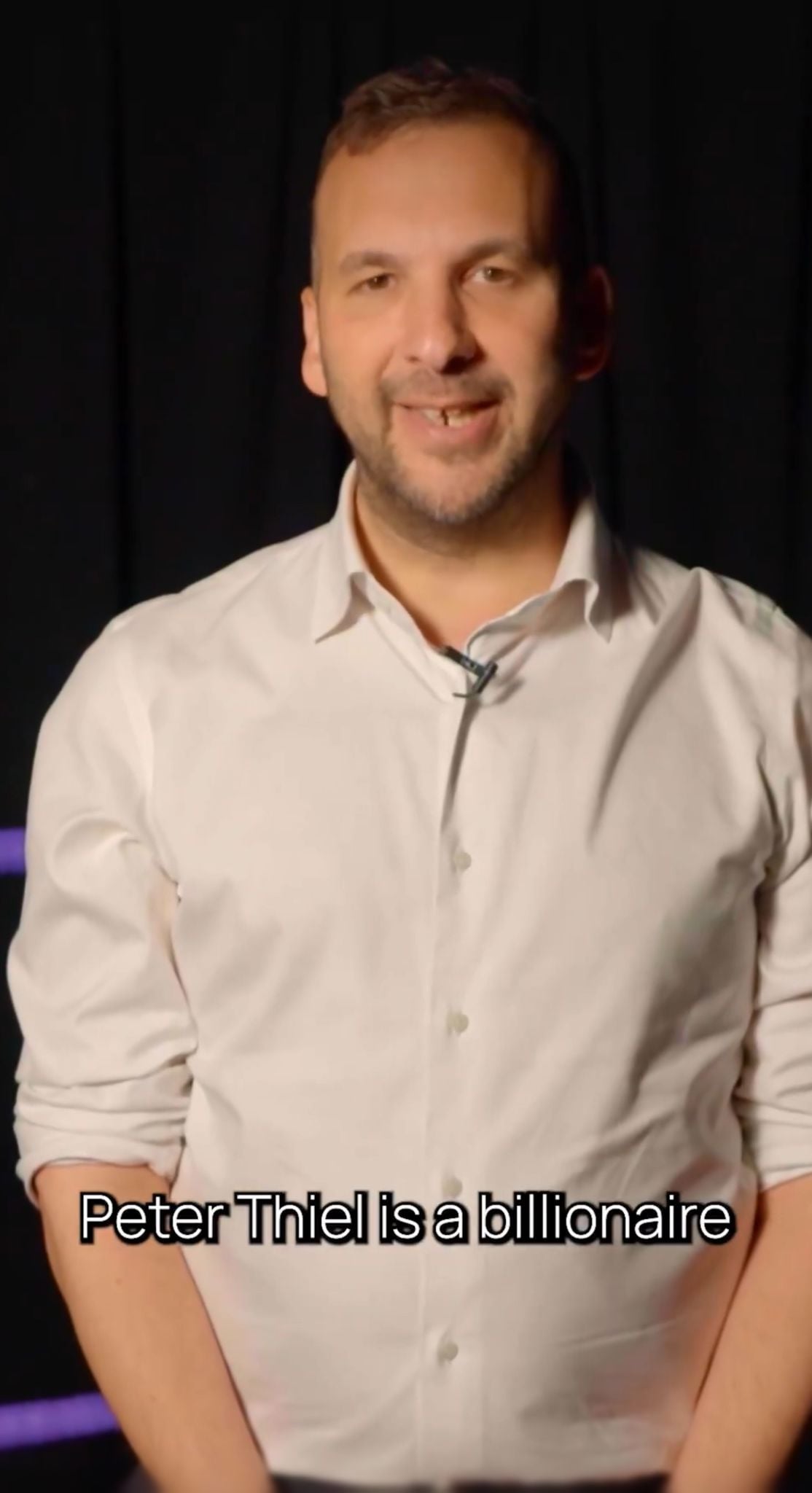
The Green Party leader Zack Polanski has produced what political observers are calling one of the sharpest pieces of opposition video-making of the year — a disciplined three-minute indictment of the American data-analytics firm Palantir, its tangle of connections to the Peter Mandelson scandal, and the role of Sir Keir Starmer’s government in embedding the company ever deeper in British public life. What has surprised Westminster is less the content of the attack than the breadth of the response: commentators well to the right of Polanski have publicly conceded that the case he builds is difficult to dismiss.
What Polanski actually says in the video
The clip, which has spread rapidly across X and other platforms, opens on a note of controlled alarm. “There’s a sickness inside our country,” Polanski tells the camera. “It runs to the very heart of our system, and it’s spreading.” From there he works methodically, rather than rhetorically, through a chain of relationships designed to connect Palantir, Mandelson, and the Prime Minister into a single political story.
He begins with the American billionaire Peter Thiel, a co-founder of Palantir and — though Polanski describes him as chief executive — its long-standing chairman of the board. Thiel, he notes, is on record questioning whether democracy and freedom are compatible and has expressed reservations about the extension of the franchise to women. He moves on to characterise Palantir itself as a surveillance-technology firm whose clients include the Israel Defence Forces and the immigration-enforcement arm of Donald Trump’s administration in the United States.
The bridge between that American picture and British politics, in Polanski’s telling, runs through Mandelson — the former UK ambassador to Washington, who co-founded the strategic advisory firm Global Counsel and whose client list included Palantir. Both men, he notes, have documented associations with the late convicted sex offender Jeffrey Epstein, a point to which he returns only briefly before moving on.

The section of the video that has done most damage politically concerns Starmer directly. Polanski argues that the Prime Minister was aware of these relationships when he appointed Mandelson as ambassador, when the two men toured Palantir’s Washington DC headquarters in February 2025, and when his government signed off on a £240m Ministry of Defence contract that Polanski describes as the largest single defence deal in British history. Switzerland, he notes pointedly, walked away from a military contract with the same company on data-protection grounds; the UK pressed ahead.
From there, he turns to what he presents as the most urgent front. Palantir already holds positions inside the British military, police forces and financial regulators. Its seven-year NHS contract gives it a working role in the analysis of millions of patients’ medical records. A break clause falls due next year, and Polanski’s call to action is specific: use it. He cites NHS clinicians who took part in pilots of Palantir’s software and described it, in his words, as “clunky, demoralising, and a waste of public money”.
“Nothing matters more than our health, our wellbeing, and our safety,” he concludes. “We have to cut Palantir out of our NHS. It’s time to take the fight to Palantir.”
Why the video has travelled beyond Polanski’s usual audience
The reception is the more striking element of the story. Polanski, who took over the Green leadership last year and has presided over a roughly threefold increase in party membership to more than 200,000, is not a figure around whom the political right customarily rallies. Yet the feedback on the clip has cut across the usual tribal lines, with a number of commentators normally hostile to the Greens conceding that the underlying facts are uncomfortable regardless of who is presenting them.
Several reasons suggest themselves. The first is tone: the video is unusually restrained for a political attack piece, closer in texture to a prosecutor’s opening statement than to a campaign broadcast. The second is that many of the specific claims are, on the public record, substantially accurate. The February 2025 visit to Palantir’s Washington headquarters was confirmed by the Cabinet Office, which described it as an “informal” tour involving a meeting with CEO Alex Karp; Downing Street declined a transparency request from the campaign group Foxglove seeking briefings around the visit, saying no formal minutes had been kept. Investigative reporting by openDemocracy has separately documented that at least four former Ministry of Defence officials have moved into senior roles at Palantir, one of them joining nine days after leaving the department in 2025, in the months before it was awarded the £240m MoD contract announced during President Trump’s state visit last September.
The third reason is the growing weight of expert and professional opposition to Palantir’s NHS role. The British Medical Association has publicly opposed the £330m Federated Data Platform contract; several NHS trusts have raised doubts about the platform’s effectiveness; and scrutiny of the procurement has been intensified by refusals from the Department of Health and Social Care and the Foreign Office to release underlying documentation. When a Green Party leader, a centre-left think-tank researcher and a consultant cardiologist arrive at similar conclusions about a single contract, the debate ceases to be easily caricatured as a fringe concern.

The pushback — and what Polanski got wrong
Palantir has responded with unusual sharpness. Louis Mosley, the company’s UK and Europe chief, posted a point-by-point rebuttal on X, conceding only “three things I can’t deny: it is a video… you are wearing a jacket… then you aren’t… then you are again.” He corrected the description of Thiel as chief executive — Karp has held that title for more than two decades — and rejected the characterisation of Palantir as a “spyware” firm, arguing that spyware is, by definition, malicious code. He also disputed Polanski’s framing of the Washington visit as a “private tour”.
Some of those corrections are fair. Thiel is chairman and a substantial shareholder rather than CEO, though he remains the figure most closely identified with the company in public discourse. The “spyware” label is a rhetorical rather than a technical description of Palantir’s products, which are sold as enterprise data-integration and analytics platforms; those platforms are, however, used for surveillance and targeting purposes by several of the firm’s government clients, which is closer to the substance of Polanski’s charge. The MoD deal, at £240m, is among the largest single software contracts the department has signed, though whether it is strictly “the largest defence contract in British history” is a claim that depends on how categories are drawn.
None of these caveats dismantles the wider picture. What Polanski has done, more effectively than any Westminster opposition bench has managed to date, is to stitch an extremely technical procurement argument to a recognisable political narrative about access, influence and trust. That is why the video has travelled. And it is why, with the NHS break clause approaching and the disclosures around Mandelson’s appointment still unfolding, the argument is unlikely to go away quietly.
