



Anne Hathaway’s forthcoming film Mother Mary has generated substantial curiosity less for what it actually depicts than for the religious controversy its marketing suggested would erupt—yet as the April 17 limited release approaches, the expected outrage from Catholic groups and conservative commentators has failed to materialise in any meaningful form, raising questions about whether A24’s provocative promotional strategy miscalculated contemporary religious audiences’ willingness to provide the scandal that prestige cinema increasingly depends upon.
The 112-minute psychological drama directed by David Lowery tells the story of a fictional pop superstar named Mother Mary who reunites with her estranged best friend and former costume designer Sam Anselm, played by Michaela Coel, whilst preparing for a high-stakes comeback performance. The film explores what Lowery characterises as the “psychosexual creative and personal relationship” between the two women as they confront “long-buried wounds” rising to the surface during the intense preparation period.
Crucially, Mother Mary is not a biblical film, religious allegory, or modern retelling of the Virgin Mary’s story. The title refers solely to the pop star’s stage name—a fictional diva whom Lowery and Hathaway have described as channelling elements of Lady Gaga and Taylor Swift whilst existing as entirely original creation. Marketing materials emphasise what the film explicitly is not: “This is not a ghost story. This is not a love story,” taglines that suggest the project resists easy categorisation whilst hinting at elements of psychological thriller, melodrama, and potentially supernatural or ambiguous narrative territory.
Lowery himself has described Mother Mary as “a very weird movie” designed to provoke “strong reactions in every possible direction”—a characterisation that promises either genuinely innovative storytelling or the sort of deliberately obscure pretension that independent cinema sometimes mistakes for artistic vision.
What Actually Happens in the Film and Why Hathaway Took the Role
The plot centres on the reunion between Mother Mary and Sam Anselm on the eve of the pop star’s comeback concert following some unspecified period of estrangement or absence from the music industry. The costume designer’s return to collaborate on the show’s elaborate theatrical wardrobe becomes catalyst for confronting whatever trauma, conflict or unresolved emotional entanglement the pair experienced during their previous partnership.
Lowery has described the production as intensely demanding, comparing one climactic week of filming to the legendary chaos of Apocalypse Now—Francis Ford Coppola’s Vietnam War epic notorious for its difficult shoot. Hathaway underwent extensive vocal and dance training to portray the pop star convincingly, with the actress describing the role as among her most challenging. Reports from the German filming locations where production wrapped in summer 2024 indicate that Hathaway experienced emotional breakdown during one particularly raw scene, telling Coel she would “need to apologize for what was coming out in the performance”—a moment that speaks either to genuine artistic intensity or the method-acting mythology that prestige productions cultivate.
The film incorporates original music composed specifically for Hathaway’s character, with contributions from Charli XCX, Jack Antonoff, and FKA Twigs—the latter also appearing in the cast alongside Hunter Schafer, Kaia Gerber, and Jessica Brown Findlay. Two singles have been released ahead of the film: “Burial,” co-written by Hathaway, Charli XCX, Jack Antonoff and George Daniel, and “My Mouth Is Lonely For You,” written by FKA Twigs. A companion album titled Mother Mary: Greatest Hits will release alongside the film on April 17, containing the full soundtrack of fictional pop hits that Hathaway performs in character.
Reactions to Hathaway’s singing have divided listeners between those dismissing her with “stick to acting” mockery and others praising the tracks as unexpected career highlights—a polarisation typical of celebrity musicians regardless of actual merit. The concert sequences reportedly draw inspiration from Taylor Swift’s Reputation-era stadium tours, suggesting elaborate choreography, dramatic costume changes, and theatrical staging that contemporary pop spectacles have perfected.
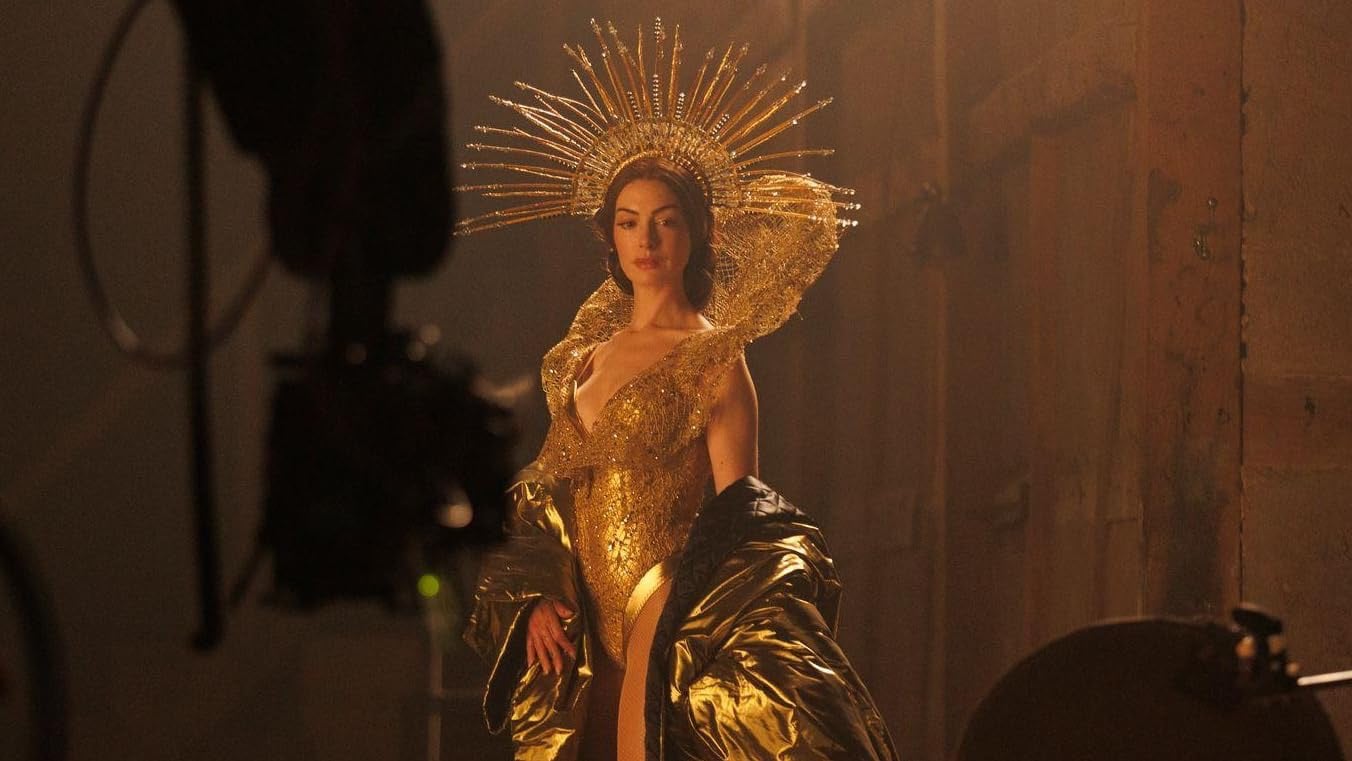
The film’s visual aesthetic emphasises surreal red and gold colour palettes, ornate and provocative costumes including spiked halos and dramatic stage looks that appropriate Catholic religious imagery for pop culture purposes—design choices that form the basis of whatever limited religious controversy the project has generated.
Why Some Religious Viewers Object to the Title and Imagery
The controversy such as it exists stems from the appropriation of the title “Mother Mary”—one of Catholicism’s most sacred designations for the Virgin Mary, mother of Jesus Christ—for a fictional pop star whose persona incorporates sexualised performance, provocative costuming, and dramatic staging that some religious observers view as blasphemous mockery of sacred figures and symbols.
Marketing materials feature Hathaway in elaborate costumes incorporating religious iconography: spiked halos that evoke both punk aesthetics and crown of thorns imagery, dramatic poses suggesting crucifixion or religious ecstasy, and staging that deliberately invokes altar and church visual vocabulary whilst placing these elements within explicitly secular and sexual pop performance contexts. For Catholics who view Mary as embodiment of purity and maternal devotion worthy of veneration, the juxtaposition of her title with pop-star sexuality and theatrical excess constitutes disrespectful appropriation of sacred nomenclature for shock value.
Scattered social media posts from religious users have condemned the film as “sacrilegious,” “demonic,” or “offensive,” with isolated calls for boycotts or bans. Some online observers have noted visual and thematic similarities to the real band MOTHERMARY, which similarly incorporates Catholic imagery within pop and electronic music contexts—suggesting the fictional character may be drawing from existing artistic movements that blend religious symbolism with contemporary performance aesthetics.
Director David Lowery’s background adds another dimension to religious viewers’ concerns: raised Catholic but now identifying as atheist, Lowery represents the pattern of filmmakers whose lost faith apparently entitles them to treat religious imagery as aesthetic resource divorced from the devotional contexts that grant symbols their power for actual believers. Anne Hathaway similarly was raised Roman Catholic but left the church as a teenager, creating dynamic where two lapsed Catholics deploy the iconography of their abandoned faith for artistic purposes that current practitioners view as exploitative or disrespectful.
What the Actual Backlash Looks Like—And Why It Remains Negligible
Despite the marketing emphasis on provocative religious imagery and the film’s potential to generate controversy, the actual backlash as of mid-April 2026 remains extraordinarily limited and confined to fringe social media commentary rather than organised opposition or mainstream media coverage. No Catholic advocacy organisations have launched boycott campaigns, no major religious leaders have issued condemnations, and the scattered individual objections circulating on X and other platforms have failed to coalesce into the cultural flashpoint that A24’s promotional strategy appeared designed to ignite.
This absence of meaningful controversy proves particularly striking given how obviously the film’s title and imagery court religious objection. The spiked halos, the appropriation of Marian nomenclature, the blending of sacred symbolism with pop-star sexuality—all represent precisely the provocations that historically have triggered organised religious backlash when deployed in mainstream entertainment. Yet religious audiences in 2026 appear either to have grown weary of providing free publicity to films courting their condemnation, or to have recognised the provocation as so calculated and superficial that it warrants no serious response.
Several factors likely contribute to the muted reaction. Contemporary Catholic audiences have encountered decades of pop culture appropriating religious imagery—from Madonna’s “Like a Prayer” controversy in 1989 through countless subsequent musical, theatrical and cinematic deployments of Christian symbolism in provocative contexts. The shock value has diminished through repetition, whilst religious communities may have concluded that vocal opposition merely amplifies projects they would prefer to ignore.
Additionally, the film’s explicit positioning as fictional pop-star drama rather than biblical reinterpretation removes the element of direct theological challenge that generates more intense religious opposition. A film reimagining the Virgin Mary as contemporary figure making controversial choices would likely trigger far more substantial backlash than a fictional character who merely shares the title without claiming to represent the actual biblical figure. The clarification that “this is not a biblical story” provides religious audiences with rationale to dismiss the film as irrelevant to their faith rather than direct attack requiring defensive response.
Whether Significant Backlash Will Emerge Upon Release
The limited pre-release controversy suggests that substantial religious backlash upon wide release April 24 remains unlikely unless the film’s actual content proves far more explicitly blasphemous or theologically provocative than marketing materials indicate. If Mother Mary functions primarily as character study exploring creative obsession, female relationships, and celebrity psychology whilst the religious imagery serves merely as aesthetic flourish rather than sustained theological commentary, religious audiences will likely continue their current pattern of indifference.
However, several scenarios could trigger delayed backlash after audiences experience the complete film rather than curated promotional clips. If the narrative explicitly mocks Catholic doctrine, depicts the Mother Mary character as intentionally blaspheming or ridiculing religious believers, or includes scenes that cross from appropriating imagery into directly attacking faith, the currently scattered objections could crystallise into organised opposition. Parents discovering that teenage fans attracted by pop-music elements encounter unexpectedly mature sexual or psychological content might generate different category of controversy focused on age-appropriateness rather than religious offense.
The film’s characterisation as “psychosexual drama” incorporating intense emotional performances and provocative visual aesthetics suggests content that may prove more disturbing or challenging than typical prestige drama, potentially generating backlash from viewers who feel marketing undersold the film’s intensity or explicit nature. Yet such objections would stem from content warnings and audience expectations rather than religious concerns specifically.
Early test screening reactions reportedly included strong positive responses from some audiences, suggesting the film may succeed artistically in ways that transcend the controversy its marketing emphasised. If critics and mainstream audiences embrace Mother Mary as compelling character study or innovative psychological drama, whatever limited religious objections persist will likely remain marginal to broader cultural conversation about the film’s merits or failures as cinema.
Lowery’s promise that the film will be “very weird” and provoke reactions “in every possible direction” leaves open the possibility that the finished work defies easy categorisation in ways that make pre-release controversy predictions meaningless. Whether that weirdness stems from genuine artistic innovation or merely the deliberate obscurity that sometimes passes for profundity in prestige independent cinema will become clear only when audiences can evaluate the complete work rather than the carefully curated marketing materials emphasising its most provocative visual elements.
For now, the most notable aspect of Mother Mary’s pre-release period remains not the controversy it generated but the controversy it conspicuously failed to ignite—suggesting that religious audiences have either evolved beyond providing the outrage that such films appear to expect, or have recognised the provocation as too transparent to warrant serious engagement.
