



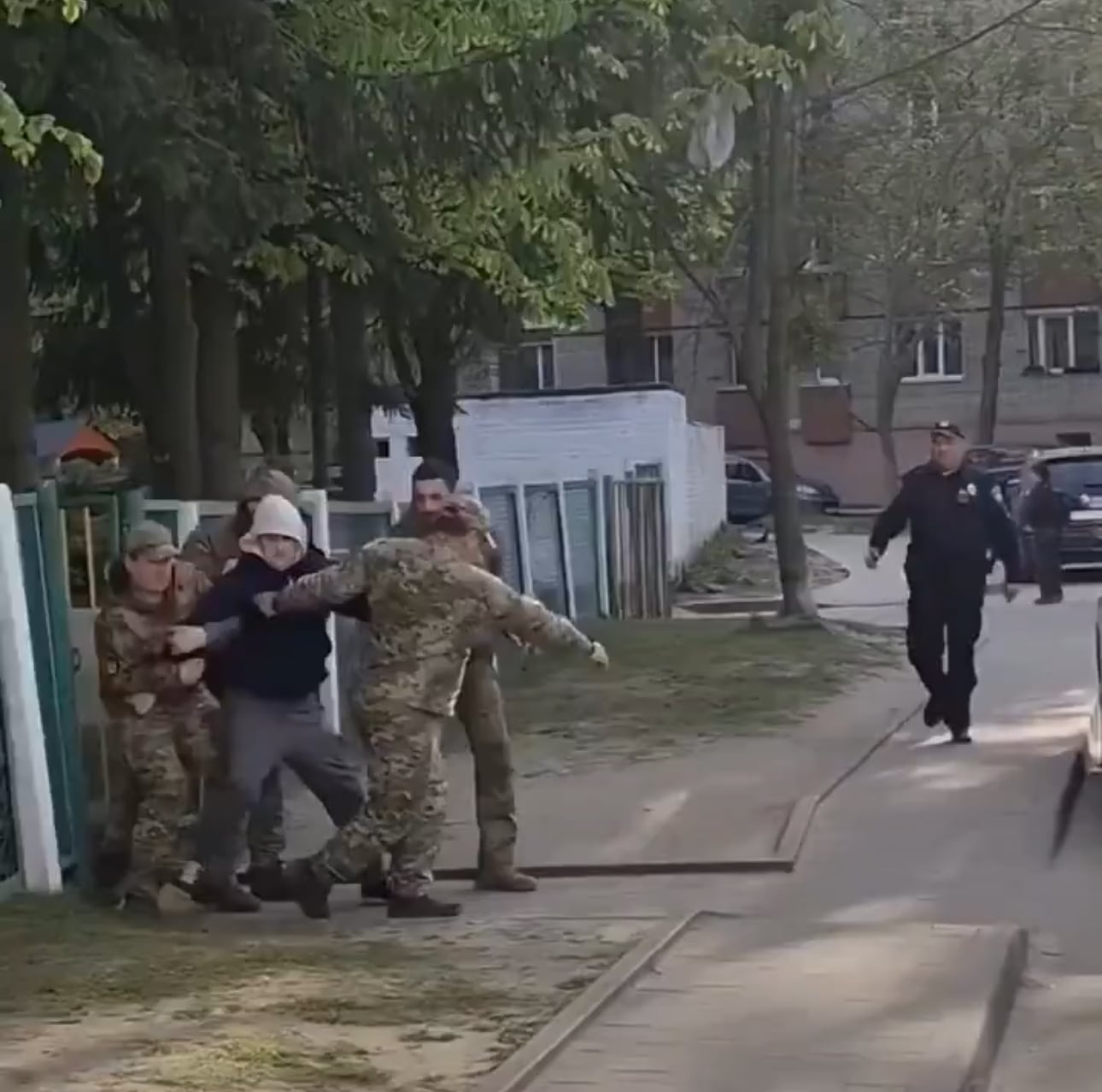
Footage showing Ukrainian military recruitment officers wrestling a man to the ground and dragging him into a vehicle outside what appears to be a kindergarten in Lviv has gone viral, offering a stark and deeply uncomfortable window into the human cost of Ukraine’s intensifying mobilisation drive.
The video, which began circulating rapidly on X and social media platforms on Thursday, shows uniformed officers from Ukraine’s Territorial Recruitment Centres confronting a man near playground fencing in a residential area of the western Ukrainian city. The man resists, a struggle ensues, and he is physically forced into a black SUV which then drives away. Onlookers can be seen watching the scene unfold. Subtitles attached to some versions of the footage carry the words “It’s f*cked up” — a sentiment that appears to reflect the mood of those present.
The clip is not an isolated incident. It is the latest in a growing series of videos from across Ukraine showing forced detentions in public spaces — at apartment building entrances, outside shops, at concerts and in car parks. What has given Thursday’s footage particular impact is its setting: directly adjacent to the kind of everyday civilian space — a children’s playground, a school drop-off point — that most sharply illustrates the collision between ordinary life and the grinding reality of more than three years of full-scale war.
Ukraine is facing a severe manpower shortage on the front line. Under martial law and updated mobilisation rules, all men aged between 25 and 60 are subject to conscription. Ukrainian authorities have stated that more than two million men are currently wanted or facing charges for failing to register, respond to summonses or update their military documents. Territorial Recruitment Centre teams — often staffed in part by wounded veterans — are empowered to conduct street checks, issue draft notices and detain those classified as evaders.
Officials in Kyiv insist the operations target only those with documented evasion records rather than random civilians and point to cases where staff have been dismissed or investigated for misconduct. They argue the measures, however uncomfortable to witness, are a military necessity as voluntary enlistment has dried up and Russian forces continue their offensive along the front.
Critics, including a growing number of Ukrainian voices, have used more direct language — describing the street detentions as “kidnapping” or “manhunts” and raising concerns about reported abuses including beatings during apprehensions. Families of those detained have in some cases physically intervened to resist the process.
The footage from outside the Lviv kindergarten has landed particularly hard because of what it shows about the state of Ukrainian society after three years of enormous losses. The war is no longer something happening only at the front. It is arriving, visibly and forcibly, at the school gate.
