



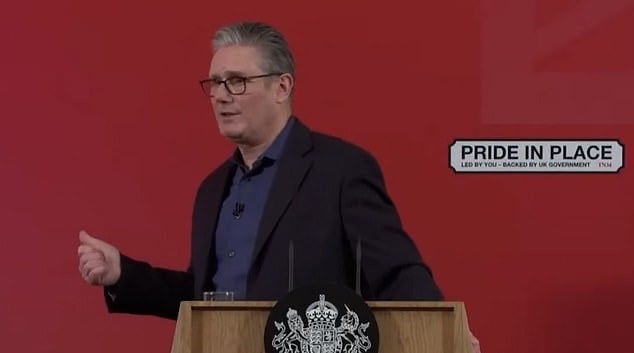
Footage of the Prime Minister wrongly insisting that Lord Mandelson underwent “an intensive security vetting exercise that gave him clearance” for the US ambassador role has resurfaced following Thursday’s extraordinary admission that the disgraced peer was in fact denied developed vetting yet appointed anyway through rarely-deployed Foreign Office authority overriding security officials’ recommendation.
The February 5 clip from an East Sussex press conference captures Sir Keir Starmer attempting to deflect responsibility for the controversial appointment by citing “independent” security vetting processes that he claimed had approved Mandelson for the Washington posting—assertions now revealed as false given that UK Security Vetting agency initially refused clearance before Foreign Office officials intervened to grant it “against the recommendation” that professional security assessors provided.
Downing Street insisted Thursday evening that “neither the PM, nor any Government minister, was aware that Peter Mandelson was granted Developed Vetting against the advice of UK Security Vetting until earlier this week”—a timeline suggesting either catastrophic communication failures within government or deliberate concealment of information from political leadership by civil servants who recognised the political toxicity that vetting failure disclosure would generate.
The revelations—which only emerged when The Guardian published explosive claims Thursday afternoon whilst No10 remained silent for nearly three hours—have triggered demands from Conservative, Reform UK, Liberal Democrat and Green Party leaders that Starmer resign over what they characterise as lies to Parliament about whether “full due process” was followed during Mandelson’s selection for Britain’s most prestigious diplomatic posting.
“Last September, Keir Starmer told Parliament three times that ‘full due process’ was followed over the appointment of Lord Mandelson,” stated Conservative leader Kemi Badenoch. “We now know the Prime Minister misled the House. The Prime Minister must take responsibility.”
What the Video Footage Reveals About Starmer’s Knowledge and Statements
The resurfaced February press conference shows Starmer responding to questions about Mandelson’s security clearance with apparent confidence that standard vetting procedures had been satisfied. “[It was] an intensive exercise that gave him clearance for the role, and you have to go through that before you take up the post,” the Prime Minister stated—an assertion now demonstrably false given that clearance came not through routine approval but via exceptional Foreign Office override of UKSV’s negative recommendation.
Starmer’s additional comments in the clip prove equally problematic given subsequent revelations: “Clearly both the due diligence and security vetting need to be looked at again. I’ve already strengthened the due process and I think we need to look at the security vetting because it now transpires that what was being said was not true. And had I known then what I know now I’d never have appointed him in the first place.”
The formulation positioned security vetting failures as occurring within independent assessment agencies rather than through political decisions to override professional security judgments—a framing that if Starmer genuinely believed it at the time would indicate he had been misinformed by officials about how clearance was obtained, yet which opposition parties interpret as deliberate misdirection designed to obscure that Foreign Office officials had set aside security concerns to proceed with appointment the Prime Minister had already publicly announced.
The timing proves particularly damaging: Starmer named Mandelson as ambassador before vetting concluded, creating pressure on officials to find mechanisms permitting the appointment to proceed despite whatever security concerns assessors identified. Whether that pressure manifested through explicit instructions or merely institutional understanding that reversing publicly-announced appointments would embarrass political leadership remains subject to ongoing investigation that Starmer has ordered following this week’s revelations.
Badenoch’s accusation that “the PM appointed Peter Mandelson before the vetting had been completed, vetting Mandelson failed. Starmer then said full due process was followed. THAT is misleading Parliament” captures the sequence that generates constitutional crisis potential: announcing appointments before completing security checks, discovering that checks produced negative results, overriding those results through exceptional procedures, then assuring Parliament that proper processes were followed without disclosing the override—a chain of decisions and statements that if accurate would constitute the pattern of deception that ministerial resignation conventions are designed to address.
Why Foreign Office Civil Servants Face Scrutiny Over Override Decision
Westminster speculation has focused on Sir Olly Robbins—the architect of Theresa May’s Brexit deal who now serves as the most senior Foreign Office civil servant—as potential “fall guy” for the override decision that permitted Mandelson’s appointment despite UKSV rejection. Whether Robbins personally made the call, delegated it to subordinates, or merely implemented political direction that ministers subsequently disavowed remains central to determining where responsibility ultimately rests.
Deputy Prime Minister David Lammy served as Foreign Secretary during the relevant period, creating questions about whether cabinet-level politicians knew about or approved the vetting override yet have maintained implausible deniability about decisions occurring within departments they controlled. Chancellor Rachel Reeves told reporters in Washington DC Thursday evening: “I didn’t know anything about the vetting process. I’m the Chancellor, I’m not the foreign secretary, and I’m not 10 Downing Street, so I can’t give you any more information on that”—a deflection that whilst technically accurate given her portfolio does nothing to explain how such consequential security decisions proceeded without ministerial involvement or subsequent notification.
Emily Thornberry, the senior Labour MP chairing the House of Commons Foreign Affairs Committee, announced she would summon Robbins to clarify information he provided at previous hearings. “My committee asked several times whether red flags had been raised by Peter Mandelson’s vetting process. It seems there were,” she stated. “Who overrode these concerns? Why were we kept in the dark? People need to stop messing us about and tell us the truth.”
A September 16 letter from Yvette Cooper—by then Foreign Secretary—and Robbins to the Foreign Affairs Select Committee responding to vetting queries stated that “Peter Mandelson’s security vetting was conducted to the usual standard set for developed vetting in line with established Cabinet Office policy,” yet conspicuously omitted mentioning that UKSV had initially refused clearance. The omission suggests either that officials crafted responses designed to technically accurate whilst withholding material information, or that communication breakdowns meant senior figures genuinely remained unaware of the override that their subordinates had implemented.
Government sources indicated that information about Mandelson’s vetting failure only emerged when officials “trawling through piles of documents” discovered it whilst scrambling to comply with MPs’ demand for publication of all files related to his appointment—a narrative suggesting accidental discovery rather than deliberate concealment, yet which opposition parties view sceptically given the documents’ obvious significance for understanding whether proper procedures were followed.
The Parliamentary Privilege Questions That Resignation Demands Invoke
The constitutional principle that ministers who mislead Parliament must resign stems from recognition that democratic accountability depends on MPs receiving truthful information when scrutinising government decisions. If Starmer genuinely believed that standard vetting procedures had approved Mandelson when he assured Parliament that “full due process” was followed, the misleading would constitute error rather than deliberate deception—a distinction that whilst important for assessing personal culpability does not eliminate responsibility for ensuring that statements to the House prove accurate before making them.
Badenoch’s insistence that “I’m only holding him to the same standards to which he’s held previous PMs—that if they mislead parliament, they should resign” invokes Labour’s previous demands that Conservative ministers face consequences for parliamentary misstatements. The precedent Starmer himself established when demanding accountability from predecessors now constrains his ability to argue that inadvertent misleading merits different treatment than deliberate falsehood—a political reality that explains why opposition parties have converged on resignation demands despite their ideological differences on other matters.
Reform UK’s Nigel Farage declared that “now we discover that he has blatantly lied, the Prime Minister should resign,” whilst Liberal Democrat leader Ed Davey stated: “Keir Starmer had already made a catastrophic error of judgement. Now it looks as though he has also misled Parliament and lied to the British public. If that is the case, he must go.”
The cross-party consensus demanding resignation reflects not merely partisan opportunism but genuine constitutional concern that if prime ministers can appoint individuals to sensitive national security positions despite professional vetting rejection, then assure Parliament that proper processes were followed without disclosing the override mechanisms employed, the security clearance system loses credibility whilst parliamentary oversight becomes meaningless theatre rather than substantive accountability mechanism.
One senior Labour source told the Daily Mail that the picture was “far more complicated” than it appeared, adding that when they learned details of what occurred their initial response was “holy f***. This is a huge failure”—an assessment suggesting even government insiders recognise the gravity of procedural breakdowns and communication failures that the scandal has exposed.
The Guardian reported that senior government officials have been considering whether to withhold documents about the vetting refusal from Parliament despite the “humble address” motion requiring full disclosure—a consideration that if accurate would compound the misleading Parliament accusations by suggesting deliberate obstruction of parliamentary investigation into how the appointment proceeded. The Daily Mail understands no document showing initial vetting refusal has been supplied to the Intelligence and Security Committee despite that body’s responsibility for determining what remains too sensitive for publication.
It remains unclear whether UKSV’s rejection stemmed from Mandelson’s extensively documented connections to convicted paedophile Jeffrey Epstein—relationships that internal government documents and email archives demonstrate persisted years after Epstein’s 2008 imprisonment and continued until at least 2016. The peer’s subsequent February 2026 arrest “on suspicion of misconduct in public office” following his September 2025 dismissal as ambassador suggests that whatever security concerns vetting officials identified proved prescient rather than overcautious.
Labour MP Bell Ribeiro-Addy stated: “The Government must come clean about why the Foreign Office overrode security officials’ decision to deny Mandelson clearance. This scandal has been beyond damaging, as has the Government’s handling of it. We need the full facts.”
Whether Starmer can survive the compounding revelations—video footage contradicting his assurances, admission of vetting override, accusations of misleading Parliament, questions about document withholding—depends partly on whether additional evidence emerges about his knowledge and involvement, and partly on whether Labour backbenchers conclude that continued support for leadership so comprehensively compromised threatens their electoral prospects. For a Prime Minister whose February narrowly survived the initial Mandelson appointment controversy, Thursday’s developments risk proving the fatal blow that earlier scandals merely presaged.
