



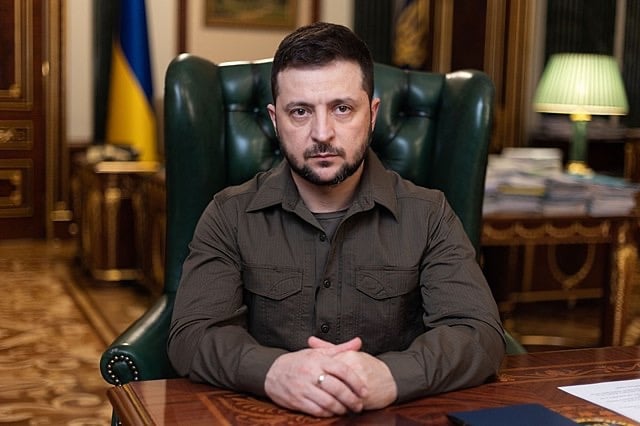
Ukrainian authorities can now prosecute antisemitic offences with criminal sanctions including prison sentences reaching eight years following President Volodymyr Zelensky’s signature Monday on legislation that transforms previously symbolic condemnations into enforceable penalties backed by the country’s justice system.
The measure, designated Law No. 2037-IX, addresses a notable gap in Ukraine’s legal framework where antisemitism had been formally defined and condemned since September 2021 yet lacked corresponding criminal consequences—a legislative peculiarity that permitted authorities to acknowledge such behaviour’s illegality whilst possessing limited tools to punish perpetrators through the courts.
Under the new provisions, incitement to hatred, discrimination, or restriction of rights motivated by antisemitism will carry fines reaching 1,000 hryvnia, restrictions on personal liberty, or imprisonment for up to three years. Penalties escalate sharply when offences involve violence, threats, deception, or abuse of official position—circumstances that can result in five-year sentences. The most severe sanctions, ranging from five to eight years’ imprisonment, apply to cases involving organised groups or where antisemitic acts produce serious consequences, with courts additionally empowered to prohibit convicted individuals from holding specific professional or governmental positions.
The foundational law “On Preventing and Combating Antisemitism in Ukraine” established the legal definition of such offences and declared that perpetrators must face accountability, yet stopped short of specifying what that accountability would entail—an omission that the new criminal code amendments now rectify through explicit sentencing guidelines that prosecutors and judges can apply.
Zelensky, who is himself Jewish, signed the legislation without public ceremony or extended commentary, allowing the legal text to speak for itself in a country whose relationship with antisemitism encompasses both profound historical tragedy and vibrant contemporary Jewish community life.
Why Ukraine’s Jewish Communities Welcomed the Legislative Shift
The United Jewish Community of Ukraine, serving as umbrella organisation representing Jewish populations across the country, issued statement expressing “gratitude to the author of the draft laws, Maksym Buzhansky, for his systematic work on the adoption of the legislative initiatives”—acknowledgment that the measure resulted from sustained advocacy rather than sudden governmental initiative responding to immediate crisis.
Ukraine’s Jewish historical experience includes centuries of cultural contribution alongside episodes of devastating violence, most notably the Babyn Yar massacre where Nazi forces and collaborators murdered tens of thousands of Jews during the Holocaust. The site remains potent symbol of the consequences when antisemitism receives state sanction or societal tolerance rather than legal prohibition backed by meaningful enforcement mechanisms.
Contemporary Ukraine maintains active Jewish community infrastructure and hosts annual Rosh Hashanah pilgrimages to Uman that attract tens of thousands of Chasidic Jews from around the world—religious tourism demonstrating that Jewish life persists and even flourishes despite the historical traumas that the new law implicitly acknowledges through its protective provisions.
The Anti-Defamation League’s 100 Index published in late 2022 showed Ukraine registering fluctuating but not exceptionally elevated antisemitic attitudes compared to Eastern European peers including Poland and Hungary—data suggesting the criminal sanctions address existing challenges whilst not responding to crisis levels of bigotry that would indicate imminent danger requiring emergency intervention.
The timing of the law’s passage, occurring whilst Ukraine confronts existential military threat from Russia’s ongoing invasion, demonstrates governmental capacity to advance domestic human rights protections even as the country’s resources remain heavily concentrated on wartime survival. Whether prosecutors will actively pursue antisemitism cases given competing demands on judicial resources, or whether the law functions primarily as symbolic statement of values that enforcement will vindicate only selectively, remains to be determined through subsequent application in actual criminal proceedings that test the legislation’s practical impact beyond its formal legal status.
