



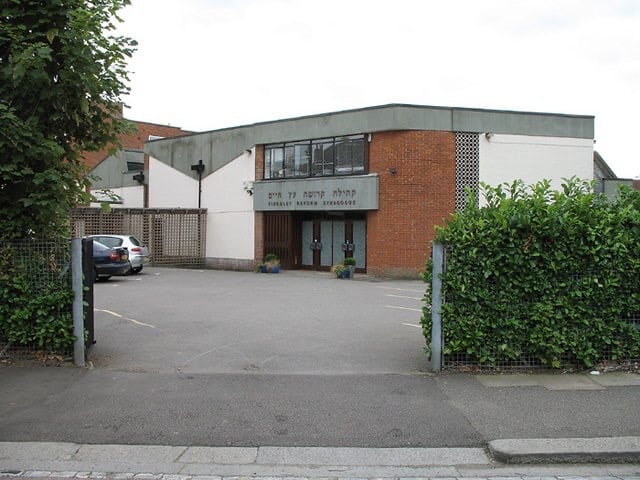
Police have detained a 47-year-old woman and 46-year-old man following an attempted arson at a north London synagogue—the second such attack targeting Jewish communal institutions in the area within three weeks, intensifying concerns about a coordinated campaign of intimidation against Britain’s Jewish population at a moment when antisemitic incidents nationally have surged to record levels.
The arrests in Watford on Tuesday afternoon followed overnight CCTV footage capturing balaclava-clad figures hurling suspected petrol bombs and a brick at Finchley Reform Synagogue in Fallow Court Avenue shortly after midnight. Neither improvised incendiary device ignited, sparing the building from damage and preventing what investigators fear could have resulted in catastrophic loss of life had the attack succeeded.
The woman was detained at 4.47pm and the man at 7.15pm, both on suspicion of arson endangering life, as detectives from the Metropolitan Police’s North West Command Unit worked alongside Counter Terrorism Policing London specialists to identify those responsible for an assault that Sarah Sackman, MP for Finchley and Golders Green, characterised as part of “a series of alarming attacks on the Jewish community” that must not become Britain’s “new normal.”
The attempted firebombing arrived barely three weeks after four Hatzola volunteer ambulances were destroyed in a separate arson attack outside a Golders Green synagogue on 23 March—an incident that saw gas canisters explode and resulted in charges against three men including Hamza Iqbal, 20, Rehan Khan, 19, and a 17-year-old boy for arson with reckless endangerment of life. The proximity of the two attacks, both targeting Jewish communal infrastructure in adjacent neighbourhoods, has generated fears within Britain’s Jewish population that isolated incidents are coalescing into sustained campaign requiring security postures more associated with conflict zones than residential London suburbs.
Why the Pattern of Attacks Signals Deliberate Campaign Rather Than Random Violence
The targeting of synagogues and Jewish communal emergency services within a concentrated geographic area and compressed timeframe suggests coordination or copycat behaviour that security analysts view as qualitatively different from historical patterns of antisemitic vandalism typically involving spray-painted graffiti or isolated acts of abuse. Firebombing attempts employing petrol bombs represent escalation to potentially lethal violence aimed at institutions serving hundreds of families whose regular worship, childcare arrangements, and emergency medical responses now require armed police protection and counter-terrorism investigation.
Detective Chief Superintendent Luke Williams, who leads policing in the area, acknowledged “the significant concern that this incident will cause in the community, particularly in the wake of the arson attack in Golders Green last month,” whilst promising “a heightened police presence in the area over the coming days” supported by additional officers deployed specifically to reassure Jewish residents confronting what many perceive as existential threats to their ability to practice faith openly.
Finchley Reform Synagogue serves functions extending well beyond religious worship—hosting a nursery where young children spend weekdays, providing shelter for homeless individuals, and offering safe gathering space for refugees. Cantor Zöe Jacobs, speaking on behalf of the senior clergy, emphasised that “we not only hold Jewish services and celebrations, but within our community we host a nursery, a homeless shelter, and are a safe place for refugees to gather”—activities that make the building’s targeting particularly chilling given the diverse vulnerable populations whose safety attackers jeopardised.
The attackers’ choice of shortly after midnight for their assault suggests awareness of when the building would likely be unoccupied yet still represents reckless endangerment given that residential properties surround the synagogue and that petrol bomb explosions can spread fire uncontrollably beyond intended targets. The fact that both improvised devices failed to ignite appears attributable to chance or poor construction rather than deliberate restraint, leaving investigators and community members to contemplate the catastrophic consequences that narrowly failed to materialise.
What Tuesday’s Arrests Mean for Ongoing Security Assessments
The relatively rapid identification and detention of suspects—less than 24 hours after the attack—reflects intensive investigation prioritising the case given its potential to further destabilise Jewish communities already operating under sustained psychological pressure from escalating threats. Whether the arrested individuals possessed connections to the previous Golders Green attack or represent separate actors inspired by that incident remains subject to ongoing investigation that police declined to discuss publicly whilst preserving prosecutorial viability.
The involvement of Counter Terrorism Policing London alongside local detectives signals official assessment that the attacks warrant treatment as potential terrorism rather than mere hate crimes—a distinction carrying implications for investigative resources deployed, sentencing guidelines applicable upon conviction, and political messaging about whether Britain tolerates religiously-motivated violence against minority populations. Whilst terrorism charges have not been filed as of Tuesday evening, the investigative architecture supporting the case suggests authorities view the pattern of synagogue attacks through national security rather than purely criminal justice frameworks.
Sackman’s assertion that “British Jews must be free to go about their lives without fear—whether taking their children to nursery or attending synagogue” and her refusal to accept escalating violence as “new normal” reflects political recognition that failure to arrest the attack pattern risks permanently altering how British Jewish communities navigate daily existence. Her reference to not wanting to “live behind ever higher walls” acknowledges the security infrastructure—CCTV systems, reinforced entrances, volunteer patrols—that synagogues and Jewish schools have implemented yet which prove insufficient against determined attackers willing to employ incendiary devices.
The MP’s statement that she would “continue to raise the issues of antisemitism and security at the highest levels in Government to protect our community” suggests ongoing discussions about whether current security grants and police resources adequately address threats that appear to be intensifying rather than diminishing despite official efforts to combat antisemitic violence through criminal prosecution and community liaison.
The Community Defiance That Attackers Failed to Extinguish
Cantor Jacobs’ characterisation of the assault as “clearly an attempt to intimidate the British Jewish community” coupled with her vow that “we will not be deterred by these cowardly acts” captures the defiant posture that religious leaders have adopted whilst simultaneously acknowledging the profound disruption that such attacks inflict regardless of their immediate physical success or failure.
The statement that the synagogue would “continue to prioritise building bridges across the wider Barnet community” reflects strategic calculation that isolation breeds vulnerability whilst interfaith cooperation and civic engagement provide both practical security through neighbourhood vigilance and symbolic resistance to attackers whose apparent objective involves segregating Jewish populations through fear. Whether such bridge-building efforts can proceed whilst synagogues operate under armed guard and parents drop children at nurseries ringed by security personnel remains an open question testing the resilience of British multiculturalism.
The Community Security Trust, which provides protection coordination for British Jewish institutions, has reported record levels of antisemitic incidents nationally—a trend that the synagogue attacks exemplify whilst raising concerns that verbal abuse and online hatred are metastasising into physical violence that no security architecture can entirely prevent. The fundamental vulnerability of religious buildings—designed to welcome congregants rather than repel attackers—creates inherent tension between openness that faith communities value and defensive postures that contemporary threat environments increasingly demand.
Police have urged anyone with CCTV footage, dash cam recordings, or information about the attack to contact them via reference number 1685/15APR or through Crimestoppers, reflecting recognition that successful prosecution depends partly on community cooperation whilst acknowledging that Jewish residents may feel abandoned by broader society’s insufficient response to violence that continues despite official condemnations and promises of protection.
The arrests provide temporary reassurance that investigative efforts proceed seriously yet cannot eliminate the underlying reality that two separate synagogue attacks within three weeks demonstrate either coordinated campaign or inspirational contagion that threatens to establish pattern of violence requiring permanent security measures incompatible with the open, welcoming religious spaces that British Jewish communities have historically maintained. Whether Tuesday’s detentions mark inflection point toward arrest of the broader threat or merely represent response to symptoms of deeper societal antisemitism will emerge through subsequent investigation and the political will that government demonstrates toward addressing root causes rather than merely prosecuting individual perpetrators after attacks occur.
