



Thursday marks the day each year when England pauses — if only briefly, and not everywhere — to acknowledge its patron saint. St George’s Day falls on 23 April, the presumed anniversary of the death of a fourth-century Roman soldier who almost certainly never set foot in the country that now claims him. The date has been observed for more than six centuries, yet its meaning, its status in the national calendar and even the historical reality of the figure at its centre remain matters of lively dispute.
Who St George really was — and why almost nothing about him is certain
The man behind the legend is thought to have been born somewhere between 256 and 285 AD, most likely in the region of what is now Turkey, and to have served as an officer in the army of the Eastern Roman Empire. He is believed to have been executed on 23 April 303 AD, during the persecutions ordered by the Emperor Diocletian, after refusing to renounce his Christian faith. His precise age at death cannot be established because his year of birth has never been reliably fixed.
Pope Gelasius formally canonised him in 494 AD, and during the Middle Ages he was venerated across Europe as one of the Fourteen Holy Helpers — saints invoked for divine protection in times of plague and peril. His reach as a patron extends far beyond England: he is also held in that role by Ethiopia, Portugal and Georgia, and by cities as geographically scattered as Moscow, Beirut and Freiburg.
The historian Ian Mortimer has argued that the apparent oddity of England adopting a saint with no connection to its soil is less strange than it first appears. Medieval kingdoms, he notes, did not require their patrons to be native-born; what mattered was that the saint embodied the virtues the nation wished to project abroad. In the case of a warrior martyr celebrated for courage and unwavering faith, the fit with the martial self-image of the late medieval English state was close enough.
What the legend of the dragon actually says
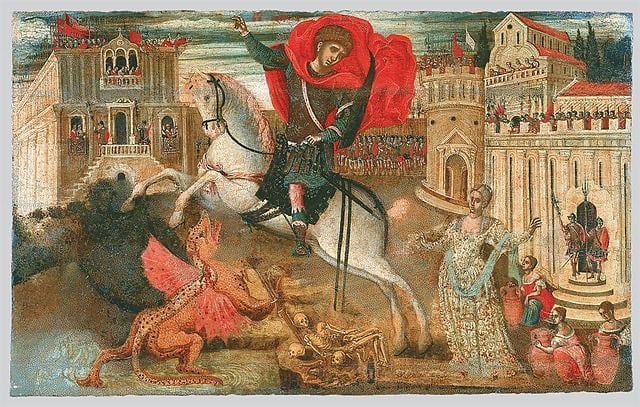
The story that fixes St George in the popular imagination — the knight on a white horse, the maiden, the dragon at the water’s edge — is substantially later than the historical man. Its fullest form is found in the Golden Legend, a thirteenth-century compilation of saints’ lives assembled by the Italian cleric Jacobus de Voragine, which became one of the most widely copied texts of the Middle Ages.
In the best-known telling, a dragon infected with plague has taken up residence in a lake beside a town — variously placed in Libya or in the city of Silene — and is poisoning the surrounding country. To appease the creature, the townspeople feed it two sheep a day. When their flocks run out, a grim lottery is introduced in which local children are offered instead. The king’s own daughter is eventually drawn, and she is being led down to the water when George happens to pass by. He offers to confront the beast on condition that the inhabitants accept Christian baptism; riding his white horse, he wounds the dragon with his lance, subdues it and leads it captive into the town before finally dispatching it.
Scholars generally read the episode as an allegory rather than a chronicle — the triumph of faith and virtue over evil, dressed in the imagery of chivalric romance. It was this story, more than any documentary record of the historical martyr, that carried George into the heart of English national culture.
Why George became England’s saint
The decisive moment in that process came in 1348, when Edward III invoked St George as the spiritual patron of the newly founded Order of the Garter, the senior English order of knighthood. English soldiers had been crying George’s name into battle during the early campaigns of the Hundred Years’ War, and the king credited the saint with intervening at the Battle of Crécy two years earlier. The foundation of the order at Windsor — where St George’s Chapel still stands as the order’s spiritual home — gave the saint a formal place in English royal ceremony that he has never lost. The cult was consolidated under the Tudors, with George’s cross emerging as the dominant military and maritime ensign of the English state.
For a long stretch of English history the day was observed with an enthusiasm comparable to Christmas, complete with feasting, processions and the wearing of a red rose in the lapel. Those observances faded through the eighteenth century, particularly after the 1707 Act of Union with Scotland dissolved the older sense of a distinctly English calendar, and by the Victorian era the feast had contracted to a largely religious occasion. A revival movement, beginning with the founding of the Royal Society of St George in 1894, has been gathering pace ever again since the early 2000s.
A national day, but not quite a public holiday
St George’s Day in 2026 arrives, as it does every year, as a working Thursday. It is England’s national day in all but statutory form — a point of quiet grievance for those who note that Scotland, Wales, Northern Ireland and the Republic of Ireland each mark their patron saints with a day off, while England does not. Campaigners have long argued that the UK offers fewer public holidays than the EU average of eleven per year, and two fresh petitions tabled in the Commons this year have sought once again to elevate 23 April to bank-holiday status. Ministers have indicated that the existing pattern of bank holidays is already well established, and neither of the main parties has made any fresh commitment ahead of this year’s celebrations — despite the Labour Party having promised exactly such a reform in its 2017 and 2019 manifestos under Jeremy Corbyn. Sir Keir Starmer, while in opposition in 2024, told the BBC that the state of the economy ruled the change out for now.
That has not stopped public observance growing. The Mayor of London’s annual festival in Trafalgar Square returned this year with a programme of music, folk dance and cooking demonstrations led by MasterChef winner Harry Maguire, and saw the Pearly Kings and Queens attending in person. The voluntary group St George’s Holiday recorded a 35 per cent increase in registered celebrations across England between 2024 and 2025, and 161 separate listed events have been staged around the country this year. Stratford-upon-Avon, which doubles the date as the traditional birthday and the confirmed death day of William Shakespeare, remains a particular focus.
The day still carries undertones that make it politically delicate. The flag of St George, a red cross on white, has at times in recent years been claimed by far-right movements — a point of awkward symbolism that sits uncomfortably with organisers trying to present the day as an inclusive civic celebration. The folk musician Billy Bragg, whose Story of England 2026 in 50 Objects exhibition is running in east London, has argued that the day should be reclaimed as a straightforward celebration of shared identity and community rather than ceded to any single political current.
Whatever its origins in the sands of late Roman Palestine, and whatever the historical gap between the soldier-martyr and the dragon-slayer of legend, St George has proved remarkably durable as a vessel for English self-understanding. More than seventeen hundred years after his execution, the argument he provokes in England is no longer really about him at all.
