



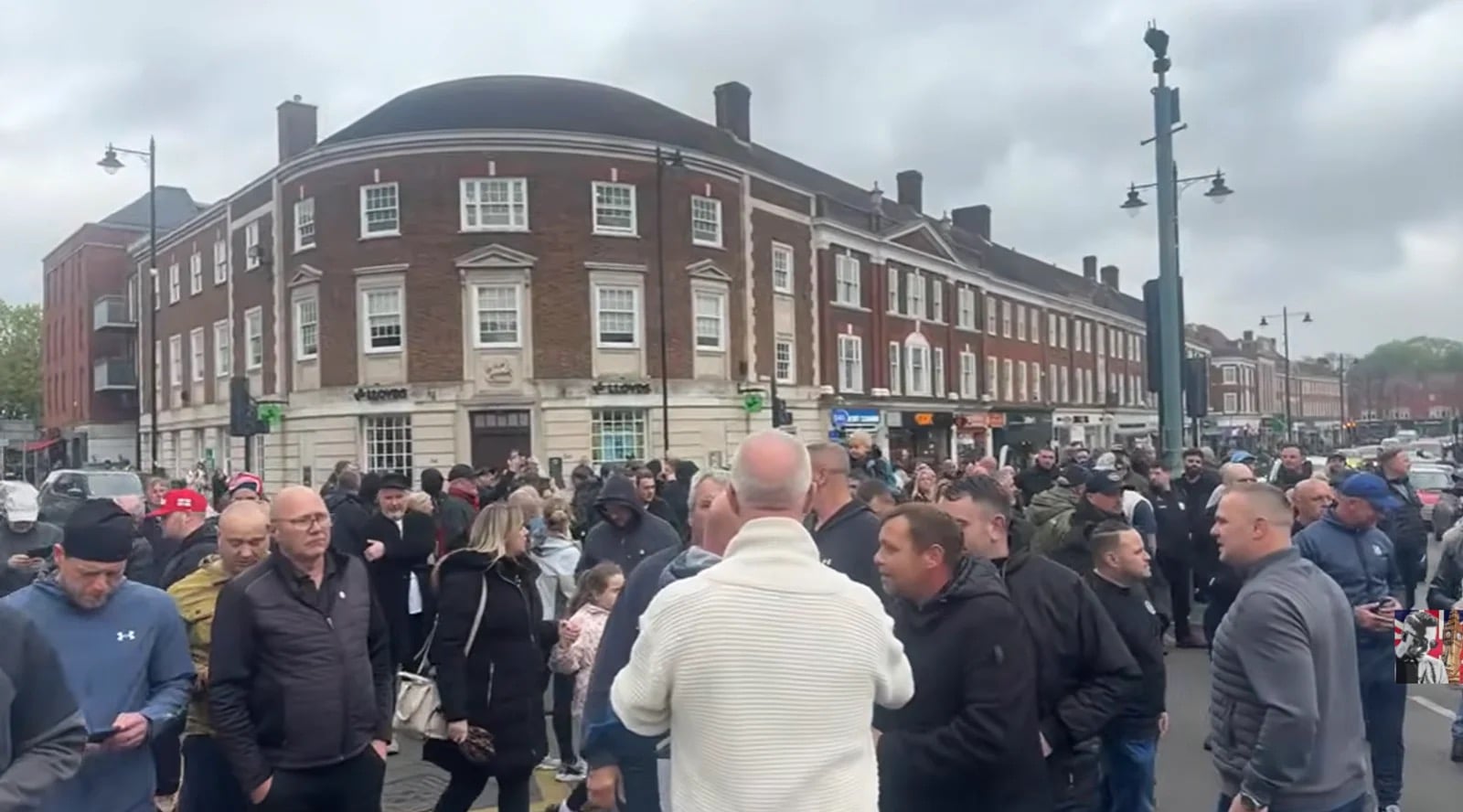
A week-long investigation into reports that a woman in her twenties was raped outside an Epsom church has uncovered no evidence the offence occurred as described, Surrey Police disclosed Thursday, whilst explicitly addressing social media speculation by stating that no evidence suggests asylum seekers or immigrants were involved—a finding that arrives after hundreds of protesters descended on the upmarket town demanding suspect descriptions that police declined to release due to insufficient information about the alleged incident.
Assistant Chief Constable Sarah Grahame acknowledged the “widespread speculation and commentary” following the woman’s report that she was followed and assaulted after leaving Labyrinth Epsom nightclub between 2am and 4am Saturday, emphasising that whilst the investigation remains ongoing, extensive CCTV review, witness interviews, forensic examinations and house-to-house enquiries have thus far failed to corroborate the account as initially reported.
“To date, we have not found any evidence of the offence as reported but the investigation is ongoing,” Grahame stated, before directly confronting the rumours that had fuelled Wednesday evening’s protest: “There has been much speculation about the non-release of a description of any suspects, especially regarding the ethnicity. No descriptions have been released as the information about the incident and potential suspects is so limited. To address the specific commentary, there is no evidence that asylum seekers or immigrants were involved.”
The carefully calibrated statement navigates treacherous terrain where police transparency obligations collide with investigative imperatives and community tensions inflamed by online speculation that filled information vacuum created when officers declined providing suspect details they insisted they lacked. Video footage from Wednesday’s demonstration showed dozens of helmeted officers holding shields whilst cones and other objects were thrown toward them—scenes of public disorder in a Surrey commuter town better known for horse racing than street protests.
Helen Maguire, Liberal Democrat MP for Epsom and Ewell, condemned behaviour including “damaging police vehicles, blocking key roads, and intimidating officers” whilst directing particular criticism toward outsiders: “To those who have come into Epsom from outside our community to spread division and cause disruption: take it elsewhere. It won’t be tolerated here.”
Why Absent Suspect Descriptions Triggered Speculation About Immigration Status
The police decision to withhold suspect descriptions—which Grahame attributed to genuinely limited information rather than deliberate concealment—created conditions where speculation filled the evidentiary void, with social media users constructing narratives about asylum seeker involvement despite no factual basis supporting such claims.
The pattern reflects broader dynamics where immigration-related rumours rapidly gain traction when authorities decline providing information that communities believe they possess but are suppressing for political correctness reasons. Whether such scepticism stems from legitimate concerns about institutional transparency or from prejudicial assumptions that crime involving non-disclosure must involve minority perpetrators varies across individuals yet collectively generates pressure on police to either release information or explicitly deny the specific speculations circulating online.
Grahame’s direct statement that “there is no evidence that asylum seekers or immigrants were involved” represents unusual specificity for police communications typically avoiding engagement with unsubstantiated rumours. The decision to address the speculation explicitly suggests official assessment that silence would be interpreted as confirmation, thereby requiring proactive denial even whilst acknowledging that such denial may prove insufficient convincing those predisposed toward believing establishment cover-up narratives.
The challenge confronting police proves asymmetric: providing evidence disproving negative claims—that asylum seekers were not involved—requires either identifying actual perpetrators whose immigration status can be verified, or demonstrating comprehensively that no credible evidence supports the alleged incident occurring as reported. The former remains impossible when investigations have yet to identify suspects, whilst the latter risks undermining the complainant’s credibility in ways that might deter future sexual assault reporting if victims fear that insufficient corroborating evidence will result in public declarations that offences cannot be confirmed.
What the Investigation Timeline Reveals About Evidential Challenges
The seven-day gap between the reported assault and Thursday’s police statement allowed substantial CCTV review, forensic analysis and witness canvassing yet produced findings sufficiently inconclusive that authorities felt compelled to acknowledge publicly that evidence supporting the complaint as described has not materialised whilst simultaneously emphasising that investigations continue.
Sexual assault cases frequently present evidential difficulties even when offences clearly occurred: victims experiencing trauma may struggle recalling precise timelines and locations, intoxication can impair memory formation, and lack of witnesses or physical evidence does not prove attacks did not happen. Yet the formulation that police have “not found any evidence of the offence as reported” suggests more than merely absence of conclusive proof—it implies active investigation has failed to corroborate key elements of the account through CCTV footage that would be expected to capture individuals in the town centre location between the stated timeframe, through witnesses who might have observed the alleged following and assault, or through forensic evidence that sexual contact occurred.
The ongoing investigation status leaves unresolved whether subsequent enquiries might uncover evidence currently absent, whether the reported incident occurred but with circumstances differing substantially from initial account, or whether the complaint lacks factual foundation. Police cannot declare definitively that no assault occurred without comprehensively eliminating all possibilities—a standard that investigations rarely achieve given the inherent limitations of evidence gathering when events allegedly transpired in circumstances where documentation proves sparse.
The increased police presence promised for the weekend reflects recognition that Thursday’s statement will not satisfy all community members, particularly those who attended Wednesday’s protest convinced that authorities were concealing information about immigrant perpetrators. Whether the explicit denial of asylum seeker involvement reduces tensions or merely hardens convictions amongst those viewing such denials as further evidence of cover-up depends partly on individual predispositions toward trusting official communications and partly on whether subsequent developments either corroborate or contradict the police assessment.
The Church Service That Attempted Community Healing Amid Polarisation
Thursday afternoon’s “Hope for Epsom” service at the Methodist church drew approximately 200 residents alongside community leaders, police officers and clergy seeking to channel outrage about sexual violence into constructive responses rather than the disorder that Wednesday’s protest had generated. Reverend Catherine Hutton framed the gathering as demonstrating “our love for the people of Epsom” whilst providing space to express “our outrage” at the reported rape.
“People of Epsom we are kind. Together we build the future of hopeful Epsom,” Hutton stated, before a specially commissioned song preceded attendees laying stones at the church front in symbolic gesture whose meaning remained somewhat opaque yet apparently resonated with participants seeking ritual acknowledgment of community trauma regardless of whether the precipitating assault occurred as initially reported.
The service exemplifies the pastoral challenge confronting religious and civic leaders when communities demand responses to incidents whose factual status remains contested: validating victims’ experiences and community anger about sexual violence generally whilst avoiding prejudging specific allegations that investigations have yet to resolve creates tension between emotional support imperatives and evidential standards that criminal justice processes require.
Maguire’s call for residents to “let the police do their work” represents standard political positioning urging patience whilst investigations proceed, yet her specific criticism of “those who have come into Epsom from outside our community to spread division and cause disruption” suggests assessment that Wednesday’s protest attracted elements seeking confrontation rather than merely local residents expressing legitimate concerns about public safety and police transparency.
Whether outsider agitators genuinely drove the disorder or whether the MP’s framing attempts to distance Epsom residents from violence that local participants also contributed to remains subject to interpretation that video footage might clarify yet which competing narratives will likely contest regardless of visual evidence. The pattern where protests about immigration-related issues attract both genuine local participants and organised groups seeking to amplify tensions for ideological purposes proves familiar across contemporary Britain, creating situations where legitimate community concerns become entangled with far-right activism in ways that complicate governmental and law enforcement responses.
For the woman who reported the assault, Thursday’s police statement creates additional trauma beyond whatever she experienced Saturday: public declarations that evidence supporting her account cannot be found inevitably invite speculation about whether she fabricated the complaint, misremembered events through intoxication or trauma, or genuinely experienced assault that investigation methods have simply failed to corroborate. The balance between investigative transparency that communities demand and protecting complainants from reputational damage that inconclusive findings generate admits no perfect resolution—police must either maintain silence that fuels speculation or provide updates that may undermine complainants even when intended merely to correct factually-unsupported rumours about perpetrator demographics.
Whether subsequent investigation phases uncover evidence altering current assessments, whether the complaint is eventually withdrawn, or whether the case remains unresolved with neither confirmation nor definitive refutation will determine how this episode enters Epsom’s collective memory and whether it proves isolated incident or harbinger of recurring tensions when sexual assault allegations intersect with immigration politics in ways that transform individual tragedies into flashpoints for broader cultural conflicts that neither police statements nor church services can adequately address.
