



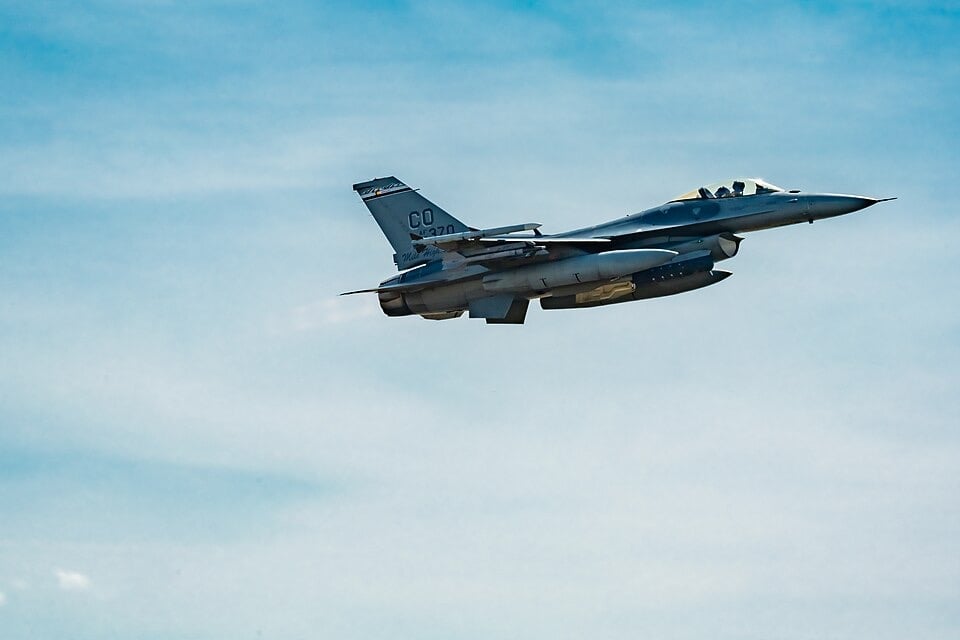
Latvia has ordered residents in its eastern regions to seek shelter indoors and scrambled NATO fighter jets after a drone was spotted in its airspace, in the latest in a series of unmanned aircraft incidents that have put Baltic states on high alert and raised fresh questions about the security of NATO’s eastern flank.
The Latvian Armed Forces confirmed on Thursday that at least one unmanned aircraft had entered Latvian airspace, with a military spokesperson telling broadcaster Latvian Television that one drone had crossed from Belarus, though its precise whereabouts were unknown. Residents in areas bordering Russia and Belarus were instructed to remain inside until further notice.
The alert came just a day after a similar incident in neighbouring Lithuania forced thousands of people to take cover, halted air traffic to the capital and saw the country’s president, prime minister and members of parliament ushered to shelter. It was the first time since Russia’s full-scale invasion of Ukraine in February 2022 that an order to seek shelter had been extended to the general population of an EU and NATO member state.
Tuesday had already marked a significant escalation when a Romanian F-16, stationed in Lithuania as part of NATO’s Baltic Air Policing mission, shot down a suspected Ukrainian drone over Estonia — the first interception of a foreign drone in Baltic airspace by NATO since the war began. Estonia’s Defence Minister Hanno Pevkur confirmed the drone had initially been detected by Latvia before being downed near Poltsamaa in central Estonia. He said he had spoken directly with his Ukrainian counterpart, Mykhailo Fedorov, who apologised for the incident, which occurred as NATO’s Spring Storm 2026 exercises were under way in the country.
“Estonia did not grant any authorisation to use its airspace,” Mr Pevkur told a news conference, adding that “the Ukrainians did not ask for such authorisation.”
Ukraine has significantly stepped up its long-range drone campaign against Russia in recent months, including operations routed via the Baltic Sea. Several Ukrainian military drones have strayed into the airspace of NATO members Finland, Latvia, Lithuania and Estonia as a result.
The Baltic states, all firm supporters of Ukraine, have largely attributed the incursions to Russian interference, claiming Moscow is redirecting Ukrainian drones from their intended targets — though no evidence for that claim has yet been made public. The Kremlin said on Wednesday it was monitoring the situation, while previously accusing the Baltic nations of allowing Ukraine to launch drones from their territory, an allegation that they and NATO have firmly denied.
At a joint press conference with NATO Secretary General Mark Rutte, Swedish Prime Minister Ulf Kristersson acknowledged the complexity of the situation. “They certainly don’t want their drones to end up on friendly territory for obvious reasons,” he said of Ukraine. “Sometimes it’s a matter of jamming. Sometimes it’s a matter of other disturbances.”
Mr Rutte himself sought to keep the focus on Moscow, saying that even where drones attributed to Ukraine landed in Baltic countries, the ultimate responsibility lay elsewhere. “They are there because of the reckless, illegal, full-scale attack of Russia,” he said. European Commission President Ursula von der Leyen similarly stated that Russia and Belarus bore “direct responsibility” for any drone incidents along the bloc’s eastern flank.
Poland’s defence minister added a note of caution on Thursday, urging Ukraine to exercise greater precision in its drone operations to avoid handing Russia opportunities to interfere with their flight paths.
The incidents have come at a particularly sensitive moment for Latvia, whose government resigned last week over its handling of the earlier airspace incursions. Talks on appointing a new cabinet are ongoing.
