



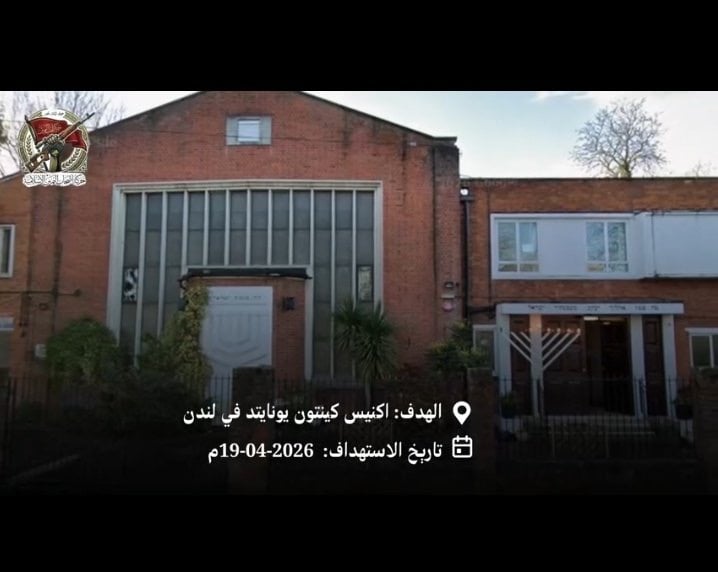
A synagogue in north-west London was targeted with an incendiary device late on Saturday night in what Jewish community leaders are describing as part of an escalating and co-ordinated campaign of arson attacks against Jewish sites across the capital.
Kenton United Synagogue on Shaftesbury Avenue in Harrow was struck at around 10.30pm, with police and fire crews arriving swiftly at the scene. A cordon was established in the early hours of Sunday and forensic teams were subsequently deployed. The attack caused minor smoke damage to an internal room but no significant structural harm to the building, and no injuries were reported. Pro-Iran Telegram channels associated with a group calling itself Ashab Al-Yamin published footage purportedly showing a man approaching the synagogue and hurling what appeared to be a petrol bomb at the building. The group has claimed responsibility for the attack.
The incident is the fourth of its kind in the space of a month. It follows an attempted arson at a Jewish Futures building in Hendon on Friday night, an attack on Finchley Reform Synagogue earlier in the week in which two balaclava-clad suspects threw petrol-filled bottles and a brick at the building, and a firebombing in Golders Green on 23 March in which four Hatzola volunteer ambulances parked outside a synagogue were set alight, causing gas canisters inside the vehicles to explode. Three men — Hamza Iqbal, 20, Rehan Khan, 19, and a 17-year-old — have been charged in connection with the Golders Green attack.
In the Hendon incident on Friday, a man was captured on camera approaching a row of shops carrying a plastic bag containing three fluid-filled bottles. He placed the bag against the building and ignited it, though the bottles failed to fully combust. Counter Terrorism Policing London is leading the investigation into that attack, though the Metropolitan Police said it is not currently being treated as a terrorism incident and that officers are keeping an open mind regarding motive. No arrests have been made.
Following Saturday’s attack on Kenton United Synagogue, the Metropolitan Police confirmed it had significantly increased its presence across north-west London, deploying uniformed and plain-clothed officers alongside armed response vehicles and counter-terrorism resources.
Chief Rabbi Sir Ephraim Mirvis said the pattern of incidents could no longer be viewed in isolation. “A sustained campaign of violence and intimidation against the Jewish community of the UK is gathering momentum,” he said, warning that the attacks represented a direct assault on the ability of Jewish people to worship and live safely in Britain. “Thank God, no lives have been lost, but we cannot, and must not, wait for that to change before we understand just how dangerous this moment is for all of our society.”
The Community Security Trust, which monitors antisemitic incidents and works closely with police, confirmed it was supporting the Kenton synagogue and urged the public to report any suspicious activity to police immediately. “We want to thank the Met Police, London Fire Brigade and our CST team for responding quickly and for all they are doing to protect the Jewish community during this unprecedented period,” a spokesperson said.
The Campaign Against Antisemitism went further, describing the frequency of attacks as a “cataclysmic failure of the state” and accusing politicians, police chiefs and prosecutors of allowing antisemitic extremism to go “largely unchecked for two and a half years.” The group also renewed calls for the Government to proscribe Iran’s Islamic Revolutionary Guard Corps, arguing that the refusal to do so reflected a troubling prioritisation of diplomatic sensitivities over the safety of Jewish communities in Britain. “Britain is fundamentally a different country now,” a spokesperson said.
The Government and the Metropolitan Police have both been approached for comment.
