


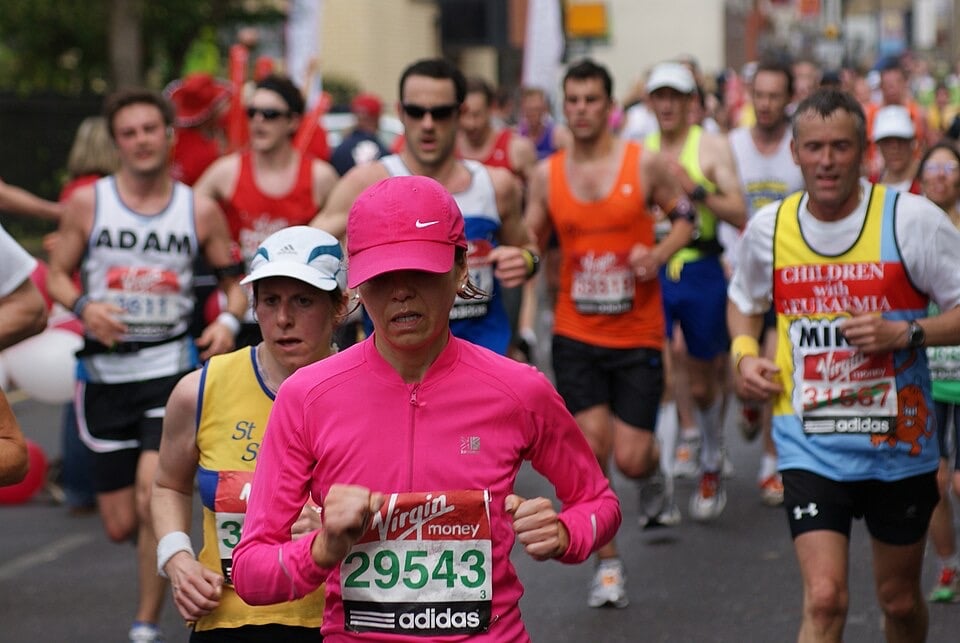
Britain has been making the most of an unseasonably warm spring weekend, with temperatures climbing to 22C across parts of the country and crowds heading to the coast and to the parks — and the timing could scarcely be better for the roughly 59,000 runners due to set off from Blackheath on Sunday morning in the 2026 TCS London Marathon, before rain and possible thunderstorms sweep in on Monday.
A weekend of sunshine before the rain returns
Saturday saw the south coast at its busiest for weeks. Beaches at Bournemouth and Lyme Regis in Dorset filled with sunbathers; Devon’s coastline was similarly packed. In London, Wimbledon Common drew families out into the sunshine, and punts were back on the River Cam in Cambridge. A light easterly breeze kept the air pleasant inland, though parts of the north-east coast and south-east Scotland were noticeably cooler under sea air drifting in from the North Sea.
Met Office deputy chief forecaster Steven Keates summed up the picture mid-week, noting that “high pressure will remain broadly in charge of the UK’s weather for the remainder of this week and into the weekend”, with most areas dry and sunny and temperatures climbing into the low twenties on Friday and through Saturday and Sunday. Onshore breezes, he added, would keep some coastal areas a touch cooler than inland spots.
The break in this benign pattern is now fixed in the forecast for Monday, when heavy rain and a risk of thunderstorms is expected to spread across the Midlands, central southern England and East Anglia — a change all the more abrupt given how dry much of the month has been across these areas. The early days of May are then expected to settle into cloudier but largely dry conditions, with temperatures returning closer to seasonal averages.
What runners can expect on Sunday
For the marathon itself, the Met Office’s Aidan McGivern has summarised the day in characteristically plain terms: “Sunday is largely a dry and bright day.” The official forecast points to a cool start — possibly with patches of overnight frost in rural areas outside the capital and some early-morning fog in eastern England — before the mist lifts and the day brightens. Within London the early-morning chill will be milder, but anyone heading to Blackheath or Greenwich Park for the first wave is being advised to plan for cool conditions on the start line, with an extra layer worth keeping on while waiting.
Forecasters are converging around afternoon highs of 17C to 19C in the capital, with some models edging the figure up to 20C in sheltered spots. That is well short of the 22C felt during last year’s race and a long way off the infamous 28C of 2018, but it is firmly into the range — anything above about 15C — at which most runners begin to feel the heat, particularly on tarmac and over a marathon distance. The Met Office’s official outlook puts it succinctly: light winds and dry weather, a pleasant spring-like day, and “well-suited to one of the capital’s biggest sporting events”. The chance of rain has been put at less than five per cent.
Two complications sit alongside the otherwise favourable conditions. UV levels are forecast to be high across southern England, and the pollen count — driven this weekend by oak rather than the more familiar grass — is expected to be high to very high in London. Runners with pollen allergies have been advised to keep windows shut overnight, take an antihistamine in advance and use a barrier such as Vaseline around the nostrils. Hydration, as ever, will matter; humidity is expected to be low, which should help the body shed heat, but the strong April sunshine on a largely shadeless central-London course can make 19C on a thermometer feel a good deal warmer underfoot.
A capital event under blue skies
The race itself begins on its traditional schedule. The elite wheelchair fields will set off at 8.50am, the elite women at 9.05am, and the elite men and the mass start from 9.35am, with the staggered waves continuing through to around 11.30am. Runners begin from the colour-coded starts in Greenwich Park and Blackheath, merging into a single route by mile three near Charlton before heading through Woolwich, past the Cutty Sark in Greenwich, on through Deptford, Surrey Quays and Rotherhithe, and over Tower Bridge for the long sweep into Canary Wharf and back along the Embankment to the Mall.
Sir Mo Farah, returning to the event for the first time since his retirement from athletics in 2024, will officially start the race alongside the Red Roses’ Ellie Kildunne. The celebrity field is the deepest in years and includes the actor Jack O’Connell, running for Alzheimer’s Research UK, the House of Guinness star James Norton for Breakthrough T1D, and the McFly drummer Harry Judd, a London Marathon veteran. Marcel Hug, already five-time consecutive winner of the men’s wheelchair race, can draw level on Sunday with David Weir as the most successful athlete in the event’s history; Catherine Debrunner returns in the women’s wheelchair race after coming within two seconds of the world record on the London course last year. The men’s course record set by the late Kelvin Kiptum in 2023 — 2:01:25 — and Tigst Assefa’s 2:15:50 women’s record from last year both remain in the conversation, though most observers think the rising afternoon temperatures will work against record attempts in the elite fields.
For the spectators lining the 26.2-mile route, the forecast is close to ideal: dry, bright, with a light easterly breeze and inland warmth that should encourage crowds to linger long after their runners have passed. For runners, it is a forgiving but not effortless day — warmer than would be perfect for a fast time, but a long way from the brutal extremes the race has occasionally produced.
After Sunday, the picture changes sharply. The arrival of heavy rain and possible thunderstorms across central southern England and the Midlands on Monday will close out the weekend’s quiet, high-pressure spell as cleanly as it began. For one Sunday morning, however, the capital should look much as London hopes its marathon will always look: blue skies above the Mall, light winds along the river, and tens of thousands of runners moving through a city basking, briefly, in early summer.
