



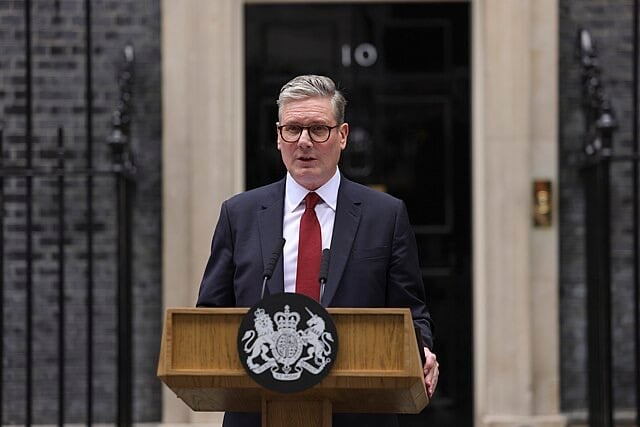
Private warnings from Labour backbenchers that the Prime Minister cannot withstand the political fallout from the Peter Mandelson security clearance affair have intensified pressure on Keir Starmer, who is scheduled to address Parliament on Monday following the dismissal of Britain’s most senior diplomat.
“I fail to see how Starmer survives this,” one Labour MP told the i newspaper, whilst another described the crisis as reaching a “tipping point” where “there can be no more excuses” and “the PM must go.” A third parliamentarian acknowledged to the Daily Mail that the situation was “getting worse” despite reluctance within the party to move against leadership during Middle East hostilities.
The escalating crisis prompted Starmer to deploy close ally Darren Jones on Wednesday morning to condemn Sir Olly Robbins, the Foreign Office permanent secretary effectively sacked Tuesday night after losing the Prime Minister’s confidence.
Jones insisted Starmer remained unaware until this week that security officials had recommended denying Mandelson developed vetting status—a recommendation subsequently overruled by Foreign Office officials despite the appointment’s sensitivity. The minister characterised the situation as “beyond unacceptable” and unprecedented in scale.
Opposition leaders have demanded Starmer’s resignation, with Conservative leader Kemi Badenoch accusing him of having “lied” whilst treating the public “for fools.” Liberal Democrat leader Ed Davey stated accountability “stops” at Downing Street. Reform UK’s Nigel Farage dismissed Robbins as a “sacrificial lamb” deployed to shield the Prime Minister.
The controversy stems from December 2024 when Starmer announced Mandelson’s Washington appointment despite warnings regarding his association with convicted paedophile Jeffrey Epstein and Foreign Office advice against selecting someone twice forced from Cabinet.
Security screening occurred only after the public announcement—an unusual sequence that created bureaucratic complications when UK Security Vetting denied clearance for undisclosed reasons, prompting officials to invoke rarely used override powers.
Following Mandelson’s September resignation over fresh Epstein revelations, the Foreign Office concealed the vetting failure. Correspondence from Cooper and Robbins to Parliament’s foreign affairs committee stated vetting concluded with clearance being granted, omitting mention of the initial denial.
Jones defended Starmer against accusations of misleading Parliament, arguing the Prime Minister accurately stated Mandelson underwent vetting and received Foreign Office clearance—technically correct despite omitting the recommendation override. Jones confirmed even after security officials recommended refusal, Mandelson accessed highly sensitive materials.
The Prime Minister, currently in Paris for Middle East crisis talks, previously told the Commons that “due process” was followed in Mandelson’s appointment—a claim now under intense scrutiny given the concealed security concerns.
