



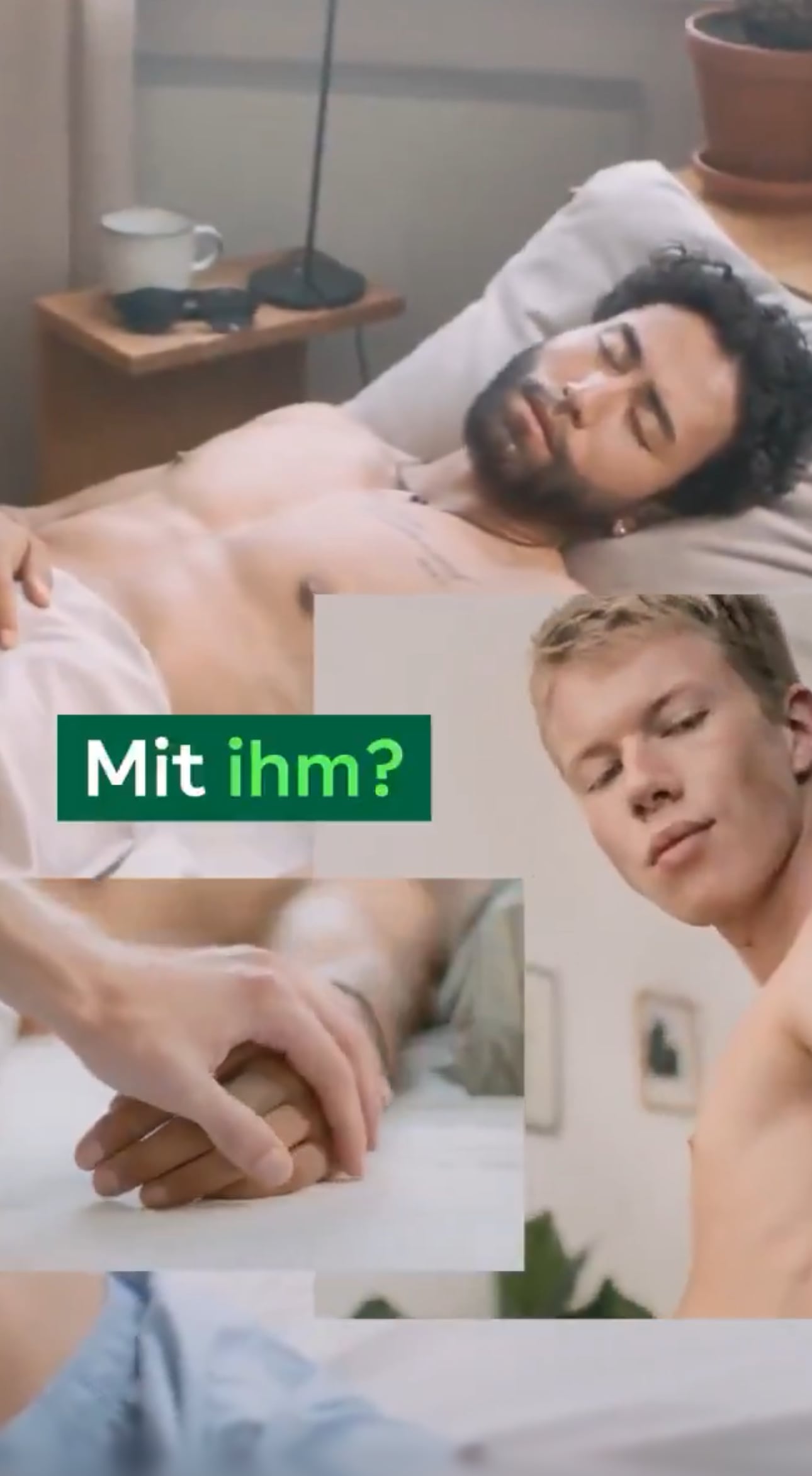
A television advertisement from Germany’s largest public health insurer promoting contraception counselling has gone viral for the second time, reigniting fierce debate about demographic messaging at a moment when the country is grappling with one of Europe’s lowest birth rates and ongoing tensions over migration and national identity.
The advertisement, produced by AOK as part of its 2021 “#AllesOK” campaign, shows a young fair-skinned German couple in bed. While the woman briefly leaves the room, the man wakes to find a dark-haired, bearded man of Mediterranean appearance beside him. On-screen text reads “Mit ihm?” — “With him?” The woman returns, sees both men and smiles, as the text shifts to “Mit beiden?” — “With both?” — before the hashtag “#AllesOK” appears and the three are shown cuddling together. The voiceover states: “With AOK, your love life is safe. We pay for your contraception counselling.”
The ad first aired four years ago and was designed to normalise safe sex across a range of relationship scenarios, including polyamorous and bisexual encounters, as part of a broader campaign targeting young people. AOK has produced similar spots on STI prevention and LGBTQ themes. The intention, supporters say, was straightforwardly progressive sex education — diverse, shame-free and consent-focused.
However, the ad has resurfaced in recent days and exploded across social media, driven almost entirely by outrage rather than approval. Critics on X and other platforms have framed it as taxpayer-funded cultural signalling that depicts a young German couple casually inviting a migrant into a sexual encounter as something aspirational and normal — at precisely the moment Germany is debating demographic collapse, with native fertility rates cited in recent discussions at between 1.23 and 1.3, among the lowest in Europe.
The backlash centres on the perceived disconnect between the ad’s messaging and the lived concerns of ordinary Germans. Critics argue that a public health insurer funded in part through statutory contributions choosing to promote non-procreative group sex with a migrant character — rather than family formation — reflects a wider gulf between elite cultural assumptions and the priorities of much of the population. Many posts sharing the ad have described it as representative of a broader pattern of institutional tone-deafness on issues of identity, immigration and demographic sustainability.
Supporters of the campaign counter that the furore says more about the anxieties of those reacting to it than about the ad itself, and that inclusive sex education serving diverse modern relationships is a legitimate public health goal. The ad has not been withdrawn and AOK has not issued a statement addressing the renewed controversy.
