



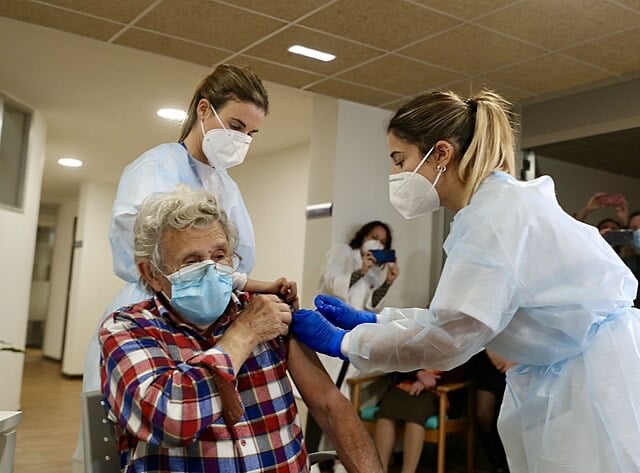
Britain’s Covid inquiry delivered its most positive assessment yet of pandemic response efforts Thursday by characterising the vaccine programme as an “extraordinary feat” that saved countless lives—yet simultaneously condemned as “not sufficiently supportive” a government compensation scheme that has paid out to just one percent of the 20,000 people claiming serious vaccine-related harm.
The £200 million inquiry’s fourth report, spanning more than 280 pages released at midday, strikes markedly different tone from previous instalments that savaged ministerial preparations, decision-making and the “toxic and chaotic” culture at government’s core. Baroness Hallett, the inquiry chair and former judge who previously led the 7 July London bombings inquests, praised the speed at which 132 million jabs were administered during 2021 alone whilst highlighting drug treatment identification as among the pandemic’s “key successes.”
Yet the acknowledgment that vaccine development and deployment proceeded with historic rapidity—transforming laboratory research into mass immunisation campaign within months—coexists uneasily with findings that predictable disparities in uptake amongst poorer communities and ethnic minorities received inadequate mitigation, that misinformation spread unchecked online whilst eroding broader vaccine confidence, and that rare cases of serious injury or death triggered by the jabs confronted compensation bureaucracy that Hallett characterised as requiring “urgent” reform.
The Vaccine Damage Payment Scheme, which caps one-off tax-free awards at £120,000—a level unchanged since 2007 despite inflation having substantially eroded purchasing power—demands applicants demonstrate they suffered disability of at least “60 percent” severity. The inquiry concluded this threshold “does not work effectively for Covid vaccines” whilst the payment ceiling needs raising “at least in line with inflation” alongside introduction of graduated compensation reflecting varying injury severity rather than flat-rate awards regardless of harm extent.
The statistical reality proves stark: more than 20,000 Covid-related claims have been submitted yet fewer than 200 payments have been made—a rejection rate suggesting either that applicants systematically misattribute unrelated health problems to vaccination, or that assessment criteria prove so restrictive that genuine vaccine injuries face denial through bureaucratic obstacles rather than medical evaluation of causation.
Why Vaccine Success and Compensation Failure Coexist in Single Report
The inquiry’s simultaneous celebration of immunisation achievement and condemnation of injury response mechanisms reflects uncomfortable truth about pandemic emergency measures: interventions that prove effective at population scale inevitably generate adverse outcomes for small minorities whose individual suffering the collective benefit calculations inadequately address.
Long-term health problems caused by Covid vaccines occurred rarely, the report acknowledges, yet “there was a small group for whom vaccines did cause serious injury or death”—a formulation that validates concerns vaccine sceptics amplified whilst contextualising risk within broader framework where jab benefits vastly exceeded dangers for overwhelming majority of recipients.
The compensation scheme’s dysfunction compounds the tragedy: individuals who suffered genuine vaccine-related harm—a sacrifice made whilst responding to governmental and medical urgings that vaccination represented civic duty protecting vulnerable populations—confront assessment processes apparently designed to minimise payouts rather than provide meaningful redress for injuries incurred during participation in history’s largest immunisation programme.
The 60 percent disability threshold creates perverse outcomes where applicants suffering substantial harm nonetheless fall short of qualifying criteria, whilst the £120,000 ceiling—frozen for nearly two decades—inadequately compensates life-altering injuries requiring ongoing medical treatment, lost earning capacity, and care support extending across remaining lifespan potentially spanning decades.
Hallett’s call for graduated payments reflecting injury severity acknowledges that flat-rate compensation treats vastly different harm levels identically, whilst inflation-linking recognises that purchasing power erosion since 2007 has rendered the £120,000 figure increasingly inadequate for addressing costs that severe disability imposes. Whether government accepts these recommendations or dismisses them as financially impractical given competing budgetary pressures remains to be seen—public inquiries publish conclusions and recommendations yet lack authority compelling governmental implementation.
What the Inquiry Reveals About Predictable Disparities Government Failed to Prevent
The finding that lower vaccine uptake amongst poorer communities and ethnic minorities proved “predictable and could have been better mitigated” constitutes implicit indictment of officials who apparently recognised these patterns yet deployed insufficient resources addressing them until disparities had already generated substantial mortality differences across demographic groups.
The report praises later pandemic initiatives including pop-up clinics and partnerships with community and religious organisations that successfully reached hesitant populations—acknowledgment that targeted engagement worked when eventually implemented yet arrived too late preventing thousands of preventable deaths amongst groups whose initial exclusion from mainstream vaccination campaigns reflected both structural barriers and trust deficits that generic communications could not overcome.
False information spread online combined with rapid vaccine development timelines and historical mistrust of medical authorities particularly amongst communities subjected to previous experimentation or discrimination created toxic mixture undermining confidence that standard public health messaging proved inadequate to counter. The inquiry’s observation that misinformation “damaged uptake of the Covid jab and has subsequently affected confidence more generally in childhood vaccines that have nothing to do with Covid” identifies cascading consequences extending beyond immediate pandemic response into routine immunisation programmes now confronting heightened scepticism.
The erosion of broader vaccine confidence represents arguably the pandemic response’s most damaging long-term legacy: interventions that saved lives during Covid emergency may ultimately cost lives through reduced childhood vaccination rates protecting against measles, mumps, rubella and other diseases whose control depends on maintaining population immunity thresholds that declining uptake now threatens.
Communication about vaccine benefits and risks requires improvement for future health emergencies, the inquiry concludes, yet provides limited guidance about how to achieve such improvement when social media platforms enabling misinformation spread operate beyond governmental control whilst populations prove increasingly resistant to official messaging they perceive as propaganda rather than evidence-based guidance.
The Vaccine Mandate Controversy and Lessons About Coercive Public Health
The report questions whether government overreached when mandating vaccination for care home workers in June 2021 before extending the requirement to all health and care staff—a policy subsequently scrapped before full implementation once evidence emerged that jabs provided limited protection against infection transmission despite substantial benefits preventing serious illness amongst vaccinated individuals.
“Vaccine mandates are likely to have contributed to alienation and increased hesitancy,” the inquiry warns, suggesting that coercive approaches proved counterproductive by hardening opposition amongst initially undecided populations who resented governmental compulsion whilst questioning why mandates proved necessary if vaccines worked as effectively as officials claimed.
The care home mandate’s abandonment amid mounting evidence about limited transmission prevention reflects how rapidly evolving scientific understanding during pandemic emergencies complicated policymaking that necessarily proceeded based on incomplete data yet generated resistance when subsequent evidence undermined initial justifications. Workers who left employment rather than accept mandatory vaccination, or who complied reluctantly whilst resenting the imposition, represented casualties of policies whose rationale evaporated before implementation completed.
The episode illustrates tension between individual autonomy and collective protection that all pandemic responses navigate: if vaccine mandates for healthcare workers protecting vulnerable patients represented reasonable public health measure when evidence suggested substantial transmission prevention, their continuation once that evidence dissolved constituted unjustifiable coercion. Yet the reversal fed narratives that government had never possessed sound justification, thereby undermining confidence in other measures whose evidence base remained robust.
The inquiry’s fourth report arrives as the investigation enters final stages before concluding in early 2027 after examining remaining pandemic aspects including government procurement and PPE, test-and-trace systems, economic response, and impacts on children and society. Scotland maintains separate inquiry investigating devolved responses whilst coordinating with UK-wide examination to minimise duplication and public confusion.
Whether today’s report—the first offering substantive praise alongside familiar criticism—represents genuine turning point acknowledging pandemic response successes alongside failures, or merely reflects that vaccine development and treatment identification proved easier to execute competently than broader governance challenges that previous reports condemned, will become clearer as remaining instalments address procurement scandals, test-and-trace dysfunction, and societal impacts that preliminary evidence suggests will return inquiry to its characteristic critical mode.
For the small group suffering serious vaccine injury whilst confronting compensation scheme that denies 99 percent of claims, Hallett’s call for urgent reform offers validation yet no guarantee of action. For communities whose predictable hesitancy received belated attention after preventable deaths had already occurred, the acknowledgment arrives as epitaph rather than remedy. And for a nation still processing pandemic trauma whilst confronting eroded vaccine confidence threatening future public health, the report’s mixed messages—celebrating immunisation success whilst condemning response failures—encapsulate the complexity of assessing interventions that saved countless lives yet left substantial casualties whose suffering the triumphalist narratives inadequately acknowledge.
