



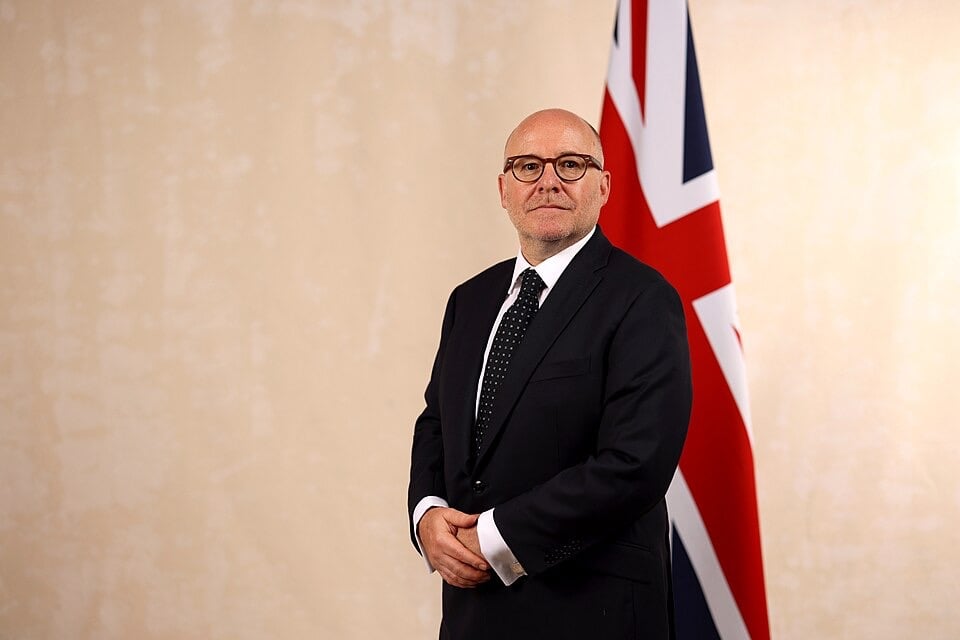
Sir Keir Starmer’s closest Cabinet ally told human rights lawyers they had made a greater contribution to society than the decorated British soldiers they had spent years falsely accusing of murder and torture in Iraq, newly obtained emails reveal — a disclosure that has prompted former senior military figures to demand his immediate resignation.
Emails analysed by The Telegraph show Attorney General Lord Hermer making the extraordinary claim in April 2014, at a moment when key evidence had emerged at a public inquiry that fatally undermined the case his legal team had been pursuing against British troops. Writing to a junior solicitor at the law firm Leigh Day, Lord Hermer said the lawyers were “making an extraordinary contribution to securing redress for torture victims in Iraq” and that their work had “made a real difference to people’s lives — something that Forbes, Neil Garnham or his clients can never say.” Sir Neil Garnham, now a High Court judge, was lead counsel for the British soldiers at the public inquiry. His “clients” were the troops Lord Hermer’s side had falsely branded as killers.
The al-Sweady Inquiry, which cost £31 million, later concluded that the allegations against British soldiers were “deliberate lies” driven by “ingrained hostility” towards the British Army. Lord Hermer’s Iraqi clients had claimed to be innocent farmers caught up in the 2004 Battle of Danny Boy in southern Iraq. In reality, they were members of the Mahdi Army, an Iran-backed militia that had ambushed British troops, sparking a three-hour firefight.
The email Lord Hermer sent was written the day after it emerged that his legal team had failed to recognise the significance of a key Arabic document — a personnel list identifying nine of their clients as members of the Mahdi Army — that had been inadvertently withheld from the inquiry. Rather than confronting the implications of this development, Lord Hermer wrote to reassure the junior solicitor, Anna Crowther, that she should not feel too low about it. A disciplinary tribunal later exonerated Crowther and the firm of deliberate wrongdoing.
Further emails obtained by The Telegraph show Lord Hermer acknowledging privately that it was “inevitable that some of the Iraqi cases were going to collapse” while dismissing anger from military quarters as the “military establishment venting.” In a separate exchange, after Leigh Day founder Martyn Day described the failure to recognise the significance of the document as “a real f— up,” Lord Hermer replied that there could be “no suggestion” the non-disclosure had been improper and turned his attention to the potential impact on more than 200 other Iraqi claims he was advising on, warning that the Ministry of Defence would “fight as hard as they can on the remaining civil claims.”
The disclosures have provoked fury from veterans and senior military figures. General Sir Peter Wall, former head of the Army and commander of British forces in Iraq after the 2003 invasion, said the revelations confirmed “the mismatch between the Attorney General’s role in overseeing the legality of military operations and his apparent disdain for soldiers on the front line.” He said the situation could not be “tenable.”
Lance Corporal Brian Wood, who won a Military Cross at the Battle of Danny Boy before spending years under the cloud of false war crimes allegations, was more blunt. “It is extraordinary that Lord Hermer thinks lawyers, including himself, acting for Iraqi insurgents do more for society than the soldiers his clients falsely accused of war crimes,” he said. “He is clearly not fit to be Attorney General and must resign.”
The Telegraph previously revealed that Lord Hermer had continued pursuing the Danny Boy case as lead counsel on a no-win, no-fee basis despite repeated warnings that his clients’ claims were “implausible” and that some could be “on the make.” He also advised on a 2008 press conference at which British troops were publicly accused of executing Iraqis. Phil Shiner, who acted as solicitor for the Iraqis at the inquiry, was later struck off for dishonesty and convicted of legal aid fraud. In the emails, Lord Hermer referred to Shiner as an “arse.”
Lord Hermer has already been reported to the Bar Standards Board over allegations of professional misconduct. His allies insist there is no contradiction between his past career as a human rights barrister and his current role, pointing to a speech he gave at the University of Manchester in March in which he said his belief in the strength and professionalism of the Armed Forces was a product of, not contrary to, his background as a human rights lawyer.
A spokesman for the Attorney General said the emails showed him offering support to a junior lawyer who had been exonerated and confirming his view of Shiner’s “reprehensible” conduct, adding that the suggestion he had knowingly represented clients making false claims was “categorically untrue.”
