



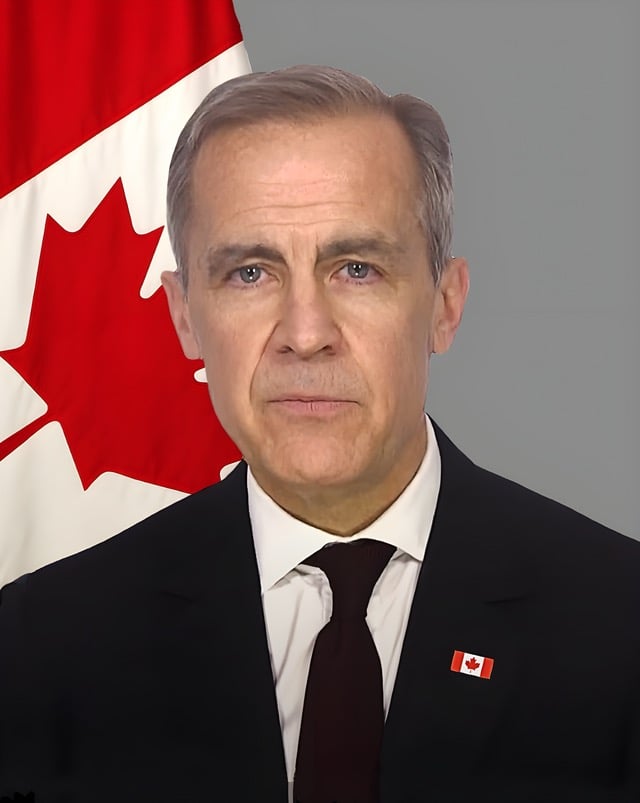
A taxpayer advocacy organisation has delivered scathing condemnation of Canadian Prime Minister Mark Carney’s first-year expenditure on in-flight refreshments, revealing that the former Bank of England governor consumed public funds equivalent to approximately 30 years of grocery bills for typical Canadian families—a comparison that has ignited fury over governmental profligacy amid the cost-of-living pressures ordinary citizens confront.
Franco Terrazzano, director of the Canadian Taxpayers Federation, framed the $524,815 spent on catering across 28 official flights between March 2025 and February 2026 in terms designed to maximise public outrage: “Carney billed more money for airplane food in one year than an average Canadian family will spend on groceries in about 30 years.”
The comparison gains particular potency from Canada’s 2026 Food Price Report indicating that typical families of four spend $17,574 annually on groceries—a figure that situates Carney’s airborne dining expenditure beyond the comprehension of households stretching budgets to afford weekly supermarket trips whilst their prime minister apparently consumed refreshments costing roughly $18,743 per flight on average.
“I guess one way to beat the high cost of groceries in Canada is to take government work trips and bill taxpayers for expensive airplane food,” Terrazzano added, the sardonic observation capturing the disconnect between governmental consumption patterns and the economic realities facing constituents whose taxes funded the catering extravagance.
The data emerged following questions tabled in the Canadian House of Commons, parliamentary scrutiny that has exposed individual journey costs ranging from the eye-watering to the utterly inexplicable when measured against the purposes they supposedly served.
What $159,000 for a Single Trip’s Catering Reveals About Governmental Priorities
The costliest single journey—a combined visit to the United Arab Emirates and G20 summit in Johannesburg carrying catering expenses of $159,034—suggests either extraordinarily lavish provisioning or systemic inefficiencies in governmental procurement processes that permit such expenditure without apparent oversight or cost-benefit assessment.
The Toronto Sun’s reporting identified an October trip where approximately $16,829 was spent on in-flight refreshments for 55 delegates—roughly 11 times the fuel costs for that particular journey. The ratio exposes the perverse economics of governmental travel where catering somehow exceeds by an order of magnitude the expense of propelling the aircraft itself through the air, raising fundamental questions about what precisely delegates were consuming that justified such extraordinary per-person costs.
Carney’s two-hour journey to Washington DC in May—during which he held his first official meeting with President Donald Trump—carried a $21,164 catering bill that translates to approximately $10,582 per hour of flight time. The expenditure seems particularly excessive given the brief duration and the meeting’s significance as initial diplomatic engagement with an American president whose relationship with Carney would subsequently prove fractious and defined by trade tensions.
The prime minister’s visit to Britain, during which he met King Charles and Sir Keir Starmer, generated a $60,283 catering bill, whilst a trip to the Vatican for Pope Leo XIV’s inaugural mass allegedly consumed $93,802 in refreshments—an amount that raises questions about what spiritual or diplomatic objectives justified such material excess during a papal ceremony ostensibly celebrating simplicity and service.
The Department of National Defence’s explanation that catering costs “encompass food, non-alcoholic beverages, handling fees, storage, waste disposal, airport taxes, and security charges” attempts to contextualise the figures by noting that “catering” incorporates expenses beyond actual comestibles. Yet even accounting for these ancillary charges, the per-flight averages exceed what reasonable assessment would consider appropriate for governmental operations supposedly subject to fiscal discipline and public accountability.
Why Catering Excess Compounds Carney’s Political Vulnerabilities
The expenditure revelations arrive amid Carney’s already challenging first year navigating a “fractious relationship” with President Trump that has defined his premiership since succeeding Justin Trudeau last March. The American president “stoked trade war anxieties in February through a Truth Social post asserting that Canada had treated the United States unfairly for decades”—accusations that forced Carney into the humiliating position of publicly apologising for an anti-tariff television advertisement featuring former President Ronald Reagan that had aired in America.
“I did apologise to the president,” Carney acknowledged at an Asia-Pacific summit in South Korea, the admission reflecting how thoroughly Trump had seized diplomatic initiative whilst Carney struggled to maintain Canadian economic interests against threatened tariffs and suspended bilateral trade negotiations.
The catering scandal undermines Carney’s positioning as competent economic manager capable of defending Canadian prosperity against American pressure. A prime minister who cannot control his own in-flight dining expenditure whilst lecturing about fiscal responsibility and economic stewardship invites obvious criticism about priorities and judgment—vulnerabilities that opposition parties and Trump himself could exploit to devastating effect.
Carney’s response strategy of “pivoting towards strengthening relationships with South Africa, China and India” represents attempted diversification away from overwhelming dependence on American trade relationships that Trump has weaponised for leverage. Yet the catering excess associated with these relationship-building trips—particularly the $159,034 UAE-Johannesburg journey—raises questions about whether governmental resources are being deployed effectively or simply consumed in luxury that generates minimal diplomatic return on investment.
The timing proves particularly unfortunate given that Canadian families confront grocery price inflation that Terrazzano’s comparison to 30 years of average spending emphasises with brutal clarity. Citizens stretching household budgets to afford basic provisions whilst watching their prime minister consume equivalent sums on airborne refreshments naturally question both the necessity of such expenditure and the values of leaders apparently insulated from the cost-of-living pressures they claim to understand.
The scandal also exposes tensions between Carney’s previous role as Bank of England governor—a technocratic position where such expenditure might have attracted less scrutiny—and his current accountability as elected leader whose every budgetary decision invites democratic assessment. Central bankers operate within elite financial circles where luxury business travel represents normalised practice; prime ministers supposedly serve constituents whose living standards bear no resemblance to the consumption patterns Carney’s catering bills reveal.
Whether the expenditure represents genuine necessity given security requirements, diplomatic protocol expectations, and the realities of provisioning official delegations, or constitutes indefensible excess enabled by insufficient oversight and accountability, depends partly on details not captured in aggregate figures. Yet the political damage stems less from technical justifications than from the optics of a leader seemingly disconnected from ordinary citizens’ economic realities whilst presiding over a government that demands fiscal sacrifice from programmes serving those same citizens.
Carney’s first year as Canadian prime minister has thus established a pattern where external pressures from Trump’s trade antagonism compound internal vulnerabilities around governmental expenditure and priorities—a combination that leaves him weakened domestically whilst confronting international challenges requiring strength and credibility he has struggled to demonstrate. The catering scandal may prove mere footnote to larger failures, or it may crystallise public frustration into political crisis that further undermines a premiership already marked by apologies, retreats, and consumption patterns that half a million dollars in airborne refreshments cannot disguise as successful leadership.
