



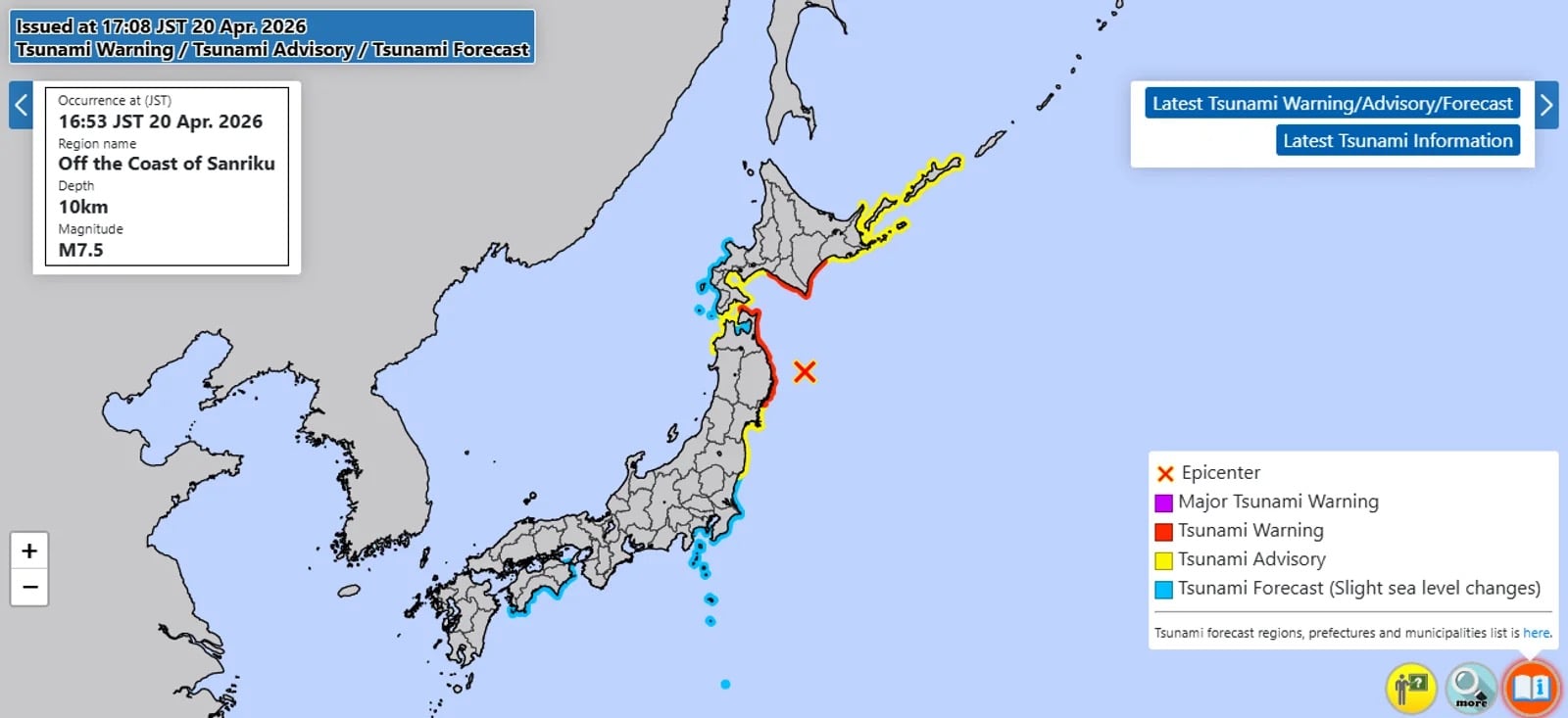
A powerful earthquake measuring 7.5 in magnitude has struck off the northeast coast of Japan, prompting tsunami warnings across multiple coastal prefectures and triggering the evacuation of thousands of residents as emergency services moved swiftly to respond.
The tremor was detected at approximately 4.53pm local time, originating around 100 kilometres off the Sanriku coast at a shallow depth of ten kilometres. The Japan Meteorological Agency initially recorded a preliminary magnitude of 7.9 before revising the figure, and immediately issued warnings of waves of up to three metres expected to strike coastal areas across northern Japan. The shaking was felt as far south as Tokyo.
Three coastal regions have been placed on high alert — the central Pacific Hokkaido coast, the Iwate prefecture coast and the Aomori prefecture coast — with authorities warning residents to evacuate immediately without waiting for further instruction. A tsunami was detected 60 kilometres off the coast of Iwate shortly after the quake struck, and warnings reached the Aomori coastline within 30 minutes of the initial tremor. In Niikappu, Hokkaido, some 3,650 people from more than 2,000 households were formally ordered to leave their homes.
Emergency alerts flashed across television screens with the words “Tsunami! Evacuate!” as national broadcaster NHK reported ships departing Hachinohe port ahead of the approaching waves. Bullet train services connecting Tokyo and Aomori were suspended as a precautionary measure.
Prime Minister Sanae Takaichi confirmed that the Government had established an emergency task force and urged those in affected areas to prioritise their safety. While there are no nuclear power plants currently operating across the Hokkaido and Tohoku regions, both Hokkaido Electric Power Co and Tohoku Electric Power Co have facilities in the area. Tohoku Electric said it was assessing the impact on the Onagawa nuclear plant.
The earthquake is the second significant tremor to strike the same general area in the space of four months, following a magnitude 7.6 earthquake off the northeast coast in December that injured at least 13 people and prompted a warning from the British Foreign Office for UK nationals in Japan.
Japan’s position within the Pacific Ring of Fire — a seismically active zone that accounts for around 90 per cent of the world’s earthquakes — means the country is accustomed to major tremors, recording up to 100,000 seismic events annually. Earthquakes above magnitude seven typically occur roughly once a year. While the three-metre tsunami warning is serious, it remains considerably smaller in scale than the catastrophic 13-metre wave generated by the magnitude-9 Fukushima earthquake of 2011, whose peak reportedly reached 40 metres and caused widespread devastation across the region.
